
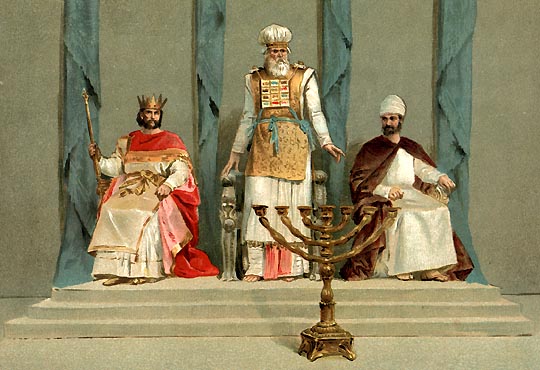
In the Old Testament, a man could be a prophet, a priest or a King, but it was impossible to be all three. Yet Scripture attributes all three of these offices to Christ. To discover what He does for us as He fulfills these three differing roles is a wonderfully enriching biblical study.
As the ultimate revelation of the Prophet, Christ speaks the word of God to us; as Priest, He represents us fully to the Father and brings the supreme atoning sacrifice (of Himself) that placates the Father’s holy and just wrath against us for our sin; and as the conquering and reigning King, He is forever worthy of our worship and adoration. He is King of Kings and Lord of Lords.
Christ’s threefold office of Prophet, Priest, and King is a central teaching in Reformed Theology, but it is a much neglected theme in much of the modern day Church. The Latin theological term for this is Munus Triplex, also known as “the Triple Cure,” referring to these offices of Christ providing the remedy for us in our fallen condition.
As far as we can tell, it was Eusebius in his Ecclesiastical History (1.3.8) who first described the concept of these three fold offices of Christ. He said that Jesus is “the only high priest of all, and the only king of every creature, and the Father’s only supreme prophet of prophets.” Yet as with most things, it was John Calvin who made the concept widely known by his teaching in the Institutes:
“Therefore, in order that faith may find a firm basis for salvation in Christ, and thus rest in him, this principle must be laid down: the office enjoined upon Christ by the Father consists of three parts. For he was given to be prophet, king and priest.” – Institutes II. xv. 1
This concept was then taken up by others in the Reformation, including Herman Bavinck, as seen in this quote:
 “…Christ, both as the Son and as the image of God, for Himself and also as our Mediator and Saviour, had to bear all three offices. He had to be a prophet to know and to disclose the truth of God; a priest, to devote Himself to God and, in our place, to offer Himself up to God; a king, to govern and protect us according to God’s will. To teach, to reconcile, and to lead; to instruct, to acquire and to apply salvation; wisdom, righteousness, and redemption; truth, love, and power – all three are essential to the completeness of our salvation. In Christ’s God-to-humanity relation, He is a prophet; in His humanity-to-God relation He is a priest; in His headship over all humanity He is a king. Rationalism acknowledges only His prophetic office; mysticism only His priestly office; millennialism only His royal office. But Scripture, consistently and simultaneously attributing all three offices to Him, describes Him as our chief prophet, our only [High] priest, and our eternal king. Though a king, He rules not by the sword but by His Word and Spirit. He is a prophet, but His word is power and really happens. He is a priest but lives by dying, conquers by suffering, and is all-powerful by His love. He is always all these things in conjunction, never the one without the other: mighty in speech and action as a king and full of grace and truth in His royal rule.”
The Westminster Shorter Catechism: refers to it in questions 23-26:
Q. 23. What offices doth Christ execute as our Redeemer?
A. Christ, as our Redeemer, executeth the offices of a prophet (Deut 18:18, Heb 1:1-2), of a priest (Heb 4:14-15, Heb 5:5-6),and of a king (Is 9:6-7, Lk 1:32-33, John 18:37, 1 Cor 15:25), both in his estate of humiliation and exaltation.
Q. 24. How doth Christ execute the office of a prophet?
A. Christ executeth the office of a prophet, in revealing to us, by his Word (Heb 2:3) and Spirit (1 Peter 1:11), the will of God for our salvation.
Q. 25. How doth Christ execute the office of a priest?
A. Christ executeth the office of a priest, in his once offering up of himself a sacrifice to satisfy divine justice (Acts 8:32-35), and reconcile us to God (Col 1:21-22), and in making continual intercession for us (Heb 9:24).
Q. 26. How doth Christ execute the office of a king?
A. Christ executeth the office of a king, in subduing us to himself, in ruling and defending us (Col 1:13), and in restraining and conquering all his and our enemies (Col 2:15).
Here is Dr. Kim Riddlebarger teaching on the three fold offices of Christ: Prophet, Priest and King:
 Heresy is not a victimless crime. Theology matters!