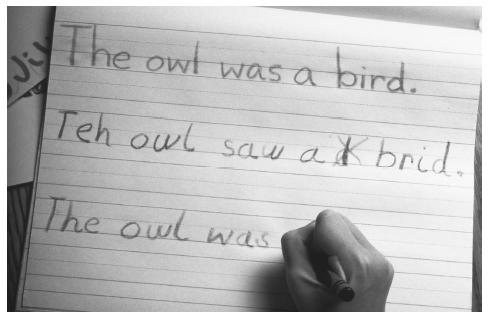
Dyslexia warps reality: the consequences of which can be catastrophic. It is something that causes great hardship to multitudes in our day. People with normal or even above normal intelligence suffer from dyslexia as the brain oftentimes reverses numbers, letters or words. It is a huge learning handicap and in severe cases can greatly limit education and employment opportunities.
For those unfamiliar with the problem,” as the first and last letters of the word are transposed. I am sure you will agree that there is a vast chasm of difference inherent in this misinterpretation. My heart truly goes out to those who go through life having to combat dyslexia.
Moving from the physical to the spiritual realm, I believe multitudes of Christians suffer from what I would call “spiritual dyslexia.” Theologians don’t use that term of course. They would be much more comfortable with a phrase such as “the noetic effects of sin,” which is the simple recognition that since the Fall of Adam, all of mankind’s faculties have been negatively affected, including his mind. In simple terms, we just don’t think as clearly and precisely as we would have done if there had been no Fall.
Theologically, we all have our blind-spots. According to 1 Corinthians 13, this side of glory, we only see through a glass darkly. One day, we will all comprehend things exactly (as much as finite minds can grasp the infinite). Yet right now, we all have our traditions and blind-spots. As my friend Dr. James White says so often, “everyone has traditions and those most blinded by them are those who do not believe they have any.” If we knew exactly where we were wrong, we would change our viewpoint immediately. But the point is that we do not see these things as they really are until God the Holy Spirit enlightens us and overcomes the effects of our depravity.
Someone suffering with spiritual dyslexia then reads certain Bible verses and though the words are clear, the traditions of men jumble up the words or miss out key words entirely in a sentence, or just do not grasp the meaning at all. I speak here from my own experience as I can honestly say that I had read certain verses a certain way (giving them what I believed to be a true interpretation) for many years until suddenly, God the Holy Spirit allowed me to overcome my deeply ingrained spiritual dyslexia to see what the Scripture actually said. This is especially true as I took the theological journey from Arminianism to Reformed theology. I say this (hopefully) not out of spiritual pride, but simply out of sincere grateful thanks to God for opening up my understanding to the true nature of God’s grace. Please allow me to cite just some examples of what I am referring to, with a few quotes from the Gospel of John.
In John 3, Jesus made it clear that unless one is born again he cannot see (or enter) the kingdom of God. (John 3:3,5).
I understood correctly that people enter the kingdom of God by faith but my spiritual dyslexia would not allow me see the clear meaning of the words of Christ here. He said that only born again people can enter – that someone had to be born again before they could enter. My Arminianism said that if I exercised faith I would enter the kingdom and be born again.
Arminianism (or synergism) has non born again people entering the kingdom – something which Jesus said was impossible. Such a concept reverses Jesus words. Unless someone is born again (first) he cannot enter. Therefore, regeneration precedes faith.
This of course is not the only place in Scripture that teaches this. The verb tenses of the original Greek of 1 John 5:1 reveal that the one going on (present continuous action) believing in Christ has already been born of God. The believing is evidence of regeneration, not the other way round. This is of course, in perfect harmony with Jesus clear words in John 3.
Another example is John 6:37. Here Jesus makes the statement that “All that the Father gives me will come to me…”
The context here is that Jesus is addressing a crowd of people who in His words, do not believe in Him (v. 36). He then explains their unbelief starting with the verse in focus now.
For many years, I would see these words but interpret them through the lens of my Arminianism/synergism which said that God, being omniscient and knowing the future ahead of time, foresaw those who would have faith in Christ (and come to Christ) and these were then given as a gift by the Father to the Son. Such was my spiritual dyslexia! I had reversed Jesus clear words.
To see this, lets ask this question – which came first, the people coming, or the Father giving?
The text reveals that it is the Father’s giving that comes first… in explaining the unbelief of the crowd in front of Him Jesus makes it clear that the Father gives a certain group of people to the Son who will then (in time) come to the Son.
My synergism reversed the order of the text, believing it was the people’s coming to the Son that prompted the Father’s giving of that people to the Son. But Jesus taught that everyone who is first given by the Father to the Son will indeed come to the Son.
The final passage I will quote to show how spiritual dyslexia can affect us is John 10:25,26. Once again, Jesus is addressing a crowd of unbelievers and says, “I told you, and you do not believe. The works that I do in my Father’s name bear witness about me, but you do not believe because you are not part of my flock.”
For years, I read this last statement of Christ but interpreted it through the lens of my synergistic tradition which said that people can choose to be part of Christ’s flock. In other words, if someone is not part of Christ’s flock, they can simply choose to be so – their believing will make them one of Christ’s sheep. But this is the exact opposite of what Jesus said. Jesus looks people right in the face and tells them that the reason they did not believe is because they were not part of His flock. Once again, my Arminianism reversed Jesus words completely.
Of course, neither I nor anyone else has a right to reverse Jesus words. As a disciple of Christ, my role is to allow Him to be the Lord over my thinking and to come to His word and allow any tradition I have to be either confirmed by His word, or else refuted by His word. It takes courage sometimes to allow traditions to be exposed to the light of Scripture, but once a tradition is seen to be in opposition to the truth of Scripture, I have no business holding on to my tradition. Let God be true and every man (and tradition) a liar.
I came to embrace reformed theology not because of a love for some theological system but because I love and revere God’s word and find that the Bible teaches the doctrines of grace. I also came to see that my Arminian interpretation of Scripture was nothing less than spiritual dyslexia. I still have my blind-spots of course, but I am so thankful to God for the light He has shown me, that stresses the graciousness of His grace.
May I challenge my Arminian/synergistic friends to look again at the words of Christ. If you, like me, find that you have reversed Jesus’ clear words I ask you to have the courage to renounce your tradition and embrace the doctrine of Christ. My continued prayer for both myself and all who read these words, is that God will lead and guide us into the truth of His Word.

 “The LORD has established his throne in the heavens, and his kingdom rules over all.” – Psalm 103:19
 Well said Dr. Piper! I could not agree more. God has never taken a “risk.”