
Also He spoke this parable to some who trusted in themselves that they were righteous, and despised others: “Two men went up to the temple to pray, one a Pharisee and the other a tax collector. The Pharisee stood and prayed thus with himself, ‘God, I thank You that I am not like other men—extortioners, unjust, adulterers, or even as this tax collector. I fast twice a week; I give tithes of all that I possess.’ And the tax collector, standing afar off, would not so much as raise his eyes to heaven, but beat his breast, saying, ‘God, be merciful to me a sinner!’ I tell you, this man went down to his house justified rather than the other; for everyone who exalts himself will be humbled, and he who humbles himself will be exalted” (Luke 18: 9-14).
 It is an unfair, gross distortion to hold that Rome teaches justification by works, while we Protestants teach justification by faith. The more accurate distinction recognizes on both sides the necessity of the work of Christ. Rome affirms that His righteousness is necessary for our salvation, that without it we are without hope. That righteousness, however, becomes ours through infusion. Protestants affirm also that His righteousness is necessary for salvation, that we have no hope without it. It, however, becomes ours through imputation.
Some here are quick to affirm that our differences now amount to nothing more than a tempest in a teapot. We are arguing over two, thick, theological terms that are not a part of our ordinary language. Surely such a nuance must be insignificant. But it’s not, as Jesus’ parable illustrates. Let’s look at these two men, what they have in common and what separates them.
First, it is an unfair, gross distortion to hold that the Pharisee believes he justifies himself. How quickly we pass over the one good part of his prayer, “Lord, I thank you…” The Pharisee knows from whence came the power to make him righteous. He knows that he needed the grace of God, that God had to work in him, that God is due all the glory for his obedience. The publican likewise looks to God and His grace as His only hope. He knows where to turn, even as the Pharisee knows whom to thank.
The difference, however, is here. The Pharisee believes that God’s grace has made him whole, that he is now, albeit by the grace of God, just in himself. God helped him out. God stood him up. But now he is standing on his own two feet. He gives thanks to God that he is better than other men, that he doesn’t commit this sin and that, that he performs this duty and that. God has poured righteousness into him, and there he stands.
The publican, on the other hand, knows what he still is, a sinner. The mercy he cries out for isn’t that he would be made a saint, but that he would be a forgiven sinner. He cannot cooperate. He cannot stand. He can only, and even this is the grace of God, cry out for the mercy of God, which is found in Christ alone.
The bigger difference than the differing approaches of these two men, however, is what it meant for their eternities. Only one of these two men went home justified. Only one of these men was an adopted son of the living God. Only one of these two men will spend eternity walking with God in paradise. The other will spend eternity weeping and gnashing teeth. Teapot tempests have no such eternal consequences.
– Dr. R. C. Sproul, Jr.
 Back in the year 2004, I attended a seminary class taught by Dr. James White on the Early Church Fathers (also known as Patristics). It was fascinating to read the writings of precious men of God from the first few centuries who hold to the same faith as I do. Yet it has to be said, the Early Church Fathers were indeed a mixed bag.
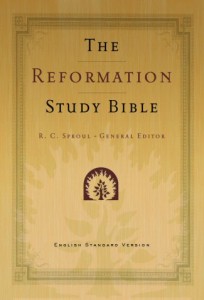 It is a high and holy calling to lead people in the things of God and great care is needed to help guide God’s people in the way of truth. This is certainly the case when it comes to providing study notes in a Bible. Because of this, for many years, I would never recommend a Bible with study notes. It is better to have no notes at all, than to be steered in the wrong direction. However, in recent years, the publishing of two study Bibles have excited me greatly and I would like to see at least one of these in the hands of every English speaking Christian. In terms of the two things that I believe to be most important features of a Study Bible – accurate translation and helpful and reliable (sure guide) study notes – in my opinion, the two which are outstanding are the ESV Study Bible and the Reformation Study Bible (ESV). Both are great resources. However in terms of sheer practicality, the ESV Study Bible is very bulky and a great weight to cart around (my mother said its too heavy to take to church with her, and who am I to argue?). Therefore if I could only recommend one, it would be the Reformation Study Bible in the ESV. Its also the one I use in my preaching. Right now, there is a 40% off sale on this Bible at Ligonier, so if you were interested in obtaining one (either in hardback or several different cover types) now would be a good time to do so.