
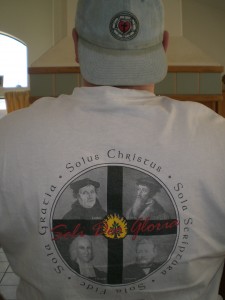
Differences with Rome

Just this week I came across Wes Bredenhof. I particularly enjoyed reading his “Letter to a friend.” Here he outlines the major differences between Protestant and Roman Catholic doctrine both with precision and brevity.

Letter to a Friend By Wes Bredenhof

Some time ago, a friend asked me for some help in figuring out the differences between Roman Catholicism and the biblical faith confessed by Reformed churches. This was my reply:

I think you hit it dead on when you mentioned the “solas” of the Reformation. The “solas” strike at the heart of the differences between Rome and Reformed churches.

Grace Alone

Rome states that salvation is by grace — as your correspondents above have argued. However, it is grace plus man’s effort. The traditional Roman Catholic formulation is, “God will not deny his grace to those who do what is in their power.” In more modern terms, “God helps those who help themselves.” The technical term for this is semi-Pelagianism. Man is not spiritually dead, but only sick and needs a little help from grace.

By contrast, the Reformed churches state that salvation is by grace alone — grace being defined as unmerited or even forfeited divine favour, receiving the opposite of what one deserves. Man is dead in sins and trespasses (Ephesians 2:1), his heart is deceitful above all things (Jeremiah 17:9) and he can do nothing to help himself. This is the traditional Augustinian position — it was emphatically not a Reformation innovation. It is only and entirely by God’s grace that man is saved.

Faith Alone

Rome states that people are justified by faith. However, Rome has explicitly denied that justification is by faith alone and in fact condemns Reformed believers who hold to this position:

If anyone says that the sinner is justified by faith alone, meaning thereby that no other cooperation is required for him to obtain the grace of justification, and that in no sense is it necessary for him to make preparation and be disposed by a movement of his own will: let him be anathema [accursed] (Council of Trent, session 6, canon 9).

Moreover, according to Rome, justification is a life-long process by which we are made righteous, rather than a one-time event where we are declared righteous. We must, they say, increase and preserve our justification. Finally, faith is also redefined by Rome to include good works and these good works become part of the meritorious basis of justification.

By contrast, the Reformed churches state that justification is by faith alone (Romans 3-4). God declares us righteous (a one-time event) not on the basis of our faith, but through the instrument of our faith. We’ll come to the basis in a moment.
Continue reading

Purgatory (2)

Continued from Part 1 or place of purification or temporary punishment in which, according to Roman Catholic belief, the souls of those who die in a state of grace are made ready for heaven. Purgatory (Latin: purgatorium; from purgare, “to purge”)

The claim of the Roman Catholic Church is that the doctrine of purgatory was something all early Christians believed and that it can be substantiated from the Bible, most notably, 1 Corinthians 3:10-15. However, what the text actually says and what Rome claims that it says are two different things.

1 Corinthians 3:10-15 (NASB) – 10 According to the grace of God which was given to me, like a wise master builder I laid a foundation, and another is building on it. But each man must be careful how he builds on it. 11 For no man can lay a foundation other than the one which is laid, which is Jesus Christ. 12 Now if any man builds on the foundation with gold, silver, precious stones, wood, hay, straw, 13 each man’s work will become evident; for the day will show it because it is to be revealed with fire, and the fire itself will test the quality of each man’s work. 14 If any man’s work which he has built on it remains, he will receive a reward. 15 If any man’s work is burned up, he will suffer loss; but he himself will be saved, yet so as through fire.
Continue reading

Purgatory (1)

There is no doubt that Dr. R.C. Sproul is a highly trained theologian. One of the many things I appreciate about him is his ability to simplify issues without distorting them. Very few people are able to accomplish this as well as he does.

If you have ever been to a Ligonier Ministries Conference, you will know that one of the highlights is when Dr. R. C. Sproul (either alone or with an expert panel alongside him) has a Question and Answer session. Usually the questions relate to the theme of the Conference and the answers given are often extremely helpful and insightful.

In a recent CD release called “Ask R.C.” (from Ligonier Ministries), Dr. R. C. Sproul fielded questions and provided answers on a wide range of biblical and theological issues. One of the questions concerned the doctrine of purgatory and I have transcribed the verbal interchange below.

Questioner: Could you explain the Roman Catholic doctrine of purgatory and whether or not it is a truthful doctrine?

R.C. – Thank you for that. I will try to deal with that as briefly as I can and I want to be accurate with it. The doctrine of purgatory is an integral doctrine to the Roman Catholic understanding of redemption. It has been modified just in the last year or so with respect to infants, but purgatory is defined by Rome as a purging place. It is a place where the vast majority of even professing Christians go upon their death.

As recently as the Roman Catholic Catechism, the Church declares that if a person dies with any spot or blemish or stain on their soul – any impurity – instead of going directly to heaven they must first go to this place of purging which is this intermediate state between earth and heaven. And in purgatory, which is not hell, it is not a place of the punitive wrath of God, but it is a place for the corrective wrath of God (as it were), where the sanctifying process is continued through the crucible of fire (as it were).

Now in purgatory, as I said, the vast majority of people experience this time; they may be there for two weeks or they may be there for two hundred million years – in fact at the heart of the controversy in the 16th century Reformation had to do with the sale of indulgences, and on the external situation there, particularly in Germany when Tetzel was selling the indulgences to the peasants, he distorted seriously the Roman doctrine. The Roman Catholic Church has held for many, many centuries that the grace of justification is infused into a person at baptism, and that that grace of justification remains intact until or unless a person commits a mortal sin. That mortal sin is called mortal because it is so serious that it destroys the justifying grace in the soul. And so a person who commits mortal sin, in other words, has to be re-justified, brought anew into a state of grace. In the 16th century, the Council of Trent declared that the sacrament of penance is the second plank of justification for those who have made shipwreck of their souls. Continue reading