
A Filing System

by John Maxwell:

As a communicator, statistics, and stories that I use in my lessons and books. For over thirty years, I’ve always answered the same way: I get everything from my files!

I learned a long time ago that if I was going to have something fresh to share every time I spoke, I needed to read and study what others had to say on a variety of subjects. And I needed a system for capturing what I’d read so I could retrieve it later. It’s easy to read a great article and think, “I could use that sometime!” But finding it later, when you actually need it, requires a system.

Today I’m going to share with you my system for filing and retrieving great material. It may not be the best system for you; in fact, it’s a little primitive in this age of technology. But it’s worked well for me for years, and if you adapt what I do for your own use, you’ll always have great resources at your fingertips – for speaking, writing, or just your own personal growth.

Where I File:
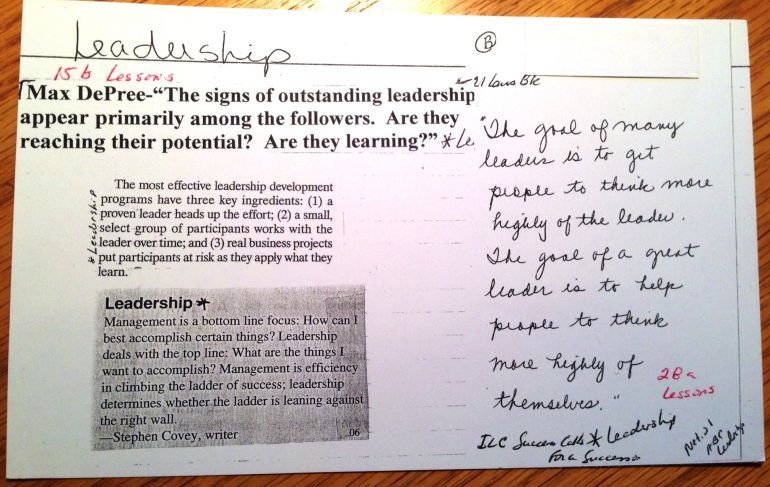
leadership4I have two main systems for filing away the quotes and materials I collect: index cards and lateral files.

Index cards: I use 5×8 cards, which are filed alphabetically in card boxes. They contain quotes and short passages on front and back, written out or taped on with sources included whenever I know them. As soon as a card on a topic fills up, I just start a new card. I have hundreds of quotes for some subjects, and just a few for others. For example, I have quite a few cards for “delegation,” and not quite as many for “management.”

Lateral files: These cabinets are stuffed with manila folders in hanging files, arranged alphabetically by subject. Each subject folder contains larger pieces, like magazine or newspaper articles. If a folder gets too full, I just start another one, which I file behind it.
Trivia Question: How many 5×8 cards (covered front and back) do you think I’ve filed in the course of 30+ years? **look for the answer later in the post

Important note: I get asked all the time for the list of topics that I use. Here’s my answer: My list doesn’t matter. Don’t create a list of topics and try to fill them. Instead, create your topics as you find material that you want to file. You know what you speak or write about, and this will give you a personalized filing system that’s easy for you to search through and use.

How I Read:

Books: I mark them up as I read. I put brackets around sentences and paragraphs that contain ideas, quotes and illustrations that stand out. In the margin next to each I write the subject under which I want it filed. Then for each item, I turn to the inside of the front cover and write down the page number and subject. I do this throughout the book. Really good books will end up with dozens of passages listed inside the front cover.

Articles: I cut or tear the entire article out, writing the subject and source at the top. (I staple multiple pages together.)

How My Staff Files For Me:

(Because you know I delegated this task as soon as I had someone to delegate it to.)

Quotes from books: With a marked-up book, a staff member consults the list at the front of the book to find the passages I want to collect. They make copies of all of those pages. Then they cut each selection out, tape it to a 5×8 index card under the appropriate subject, and write in the source. After so many years of collecting, at least one card probably exists for almost every subject I want to file. If one doesn’t, my staffer just creates one.**I have approximately 4,000 individual cards filed away.

Articles and longer passages from books: Articles are filed in their entirety in manila folders under a subject, with the source noted. Passages from books are copied, then stapled together with the source written in. My office contains hundreds of these files in multiple lateral file cabinets.

How I Use My Files When Writing:

The files I’ve described are what I draw from whenever I write. For whatever I’m writing, my first step is always to pull out all the files and cards on that subject and place them on my desk beside my legal pad, scissors and scotch tape. (I also carry these supplies in my briefcase at all times.)

My one nod to technology in my office is a copy machine. On it I make duplicates of everything I want to use, since I don’t want to cut up my cards. (I still have all of my original cards, going back 30+ years.)

I start writing on my legal pad. Then whenever I want to use a quote or article, I cut out the passage from the photocopy and tape it right into my outline (writing in the source). If it’s from a card, I mark the original card to indicate the lesson or book I’m using it for. That way I can avoid delivering the same illustrations to the same group of people.

Hymn: He will hold me fast

He Will Hold Me Fast

Lyrics vv. 1-2 Ada Habershon (1861-1918), Public Domain;
Alt words vv.1-2, lyrics v.3, and music: Matt Merker, © 2013

When I fear my faith will fail,
Christ will hold me fast;
When the tempter would prevail,
He will hold me fast.
I could never keep my hold
Through life’s fearful path;
For my love is often cold;
He must hold me fast.

He will hold me fast,
He will hold me fast;
For my Saviour loves me so,
He will hold me fast.

Those He saves are His delight,
Christ will hold me fast;
Precious in his holy sight,
He will hold me fast.
He’ll not let my soul be lost;
His promises shall last;
Bought by Him at such a cost,
He will hold me fast.

For my life He bled and died,
Christ will hold me fast;
Justice has been satisfied;
He will hold me fast.
Raised with Him to endless life,
He will hold me fast
‘Till our faith is turned to sight,
When He comes at last!

Go to this page to get free downloads of the music, lyrics and an audio file of the hymn.

HT: TC

Prevenient Grace

As the name suggests, prevenient grace is grace that ‘comes before’ something. It is normally defined as a work that God does for everybody. He gives all people enough grace to respond to Jesus. That is, it is enough grace to make it possible for people to choose Christ. Those who cooperate with and assent to this grace are ‘elect.’ Those who refuse to cooperate with this grace are lost.

The strength of this view is that it recognizes that fallen man’s spiritual condition is severe enough that it requires God’s grace to save him. The weakness of the position may be seen in two ways. If this prevenient grace is merely external to man, then it fails in the same manner that the medicine and the life preserver analogies fail. What good is prevenient grace if offered outwardly to spiritually dead creatures?

On the other hand, if prevenient grace refers to something that God does within the heart of fallen man, then we must ask why it is not always effectual. Why is it that some fallen creatures choose to cooperate with prevenient grace and others choose not to? Doesn’t everyone get the same amount?

Think of it this way, in personal terms. If you are a Christian you are surely aware of other people who are not Christians. Why is it that you have chosen Christ and they have not? Why did you say yes to prevenient grace while they said no? Was it because you were more righteous than they were? If so, then indeed you have something in which to boast. Was that greater righteousness something you achieved on your own or was it the gift of God?

If it was something you achieved, then at the bottom line your salvation depends on your own righteousness. If the righteousness was a gift, then why didn’t God give the same gift to everybody?

Perhaps it wasn’t because you were more righteous. Perhaps it was because you are more intelligent. Why are you more intelligent? Because you study more (which really means you are more righteous)? Or are you more intelligent because God gave you a gift of intelligence he withheld from others?

To be sure, most Christians who hold to the prevenient grace view would shrink from such answers. They see the implied arrogance in them. Rather they are more likely to say, “No, I chose Christ because I recognized my desperate need for him.”

That certainly sounds more humble. But I must press the question. Why did you recognize your desperate need for Christ while your neighbor didn’t? Was it because you were more righteous than your neighbor, or more intelligent?

The $64 question for advocates of prevenient grace is why some people cooperate with it and others’ don’t. How we answer that will reveal how gracious we believe our salvation really is.

The $64,000 question is, “Does the Bible teach such a doctrine of prevenient grace? If so, where?”

We conclude that our salvation is of the Lord. He is the One who regenerates us. Those whom he regenerates come to Christ. Without regeneration no one will ever come to Christ. With regeneration no one will ever reject him. God’s saving grace effects what he intends to effect by it.

………. p. 213 Let me close the book by mentioning that soon after I awoke to the truth of predestination I began to see the beauty of it and taste its sweetness. I have grown to love this doctrine. It is most comforting. It underlines the extent to which God has gone in our behalf. It is a theology that begins and ends with grace. It begins and ends with doxology. We praise a God who lifted us from spiritual deadness and makes us walk in high places. We find a God who may be against us. It makes our souls rejoice to know that all things are working together for our good. We delight in our Savior who truly saves us and preserves us and intercedes for us. We marvel at his craftmanship and in what he has wrought. We skip and kick our heels when we discover his promise to finish in us what he has started in us. We ponder mysteries and bow before them, but not without doxology for the riches of grace he has revealed:

Oh, the depth of the riches both of the wisdom and knowledge of God! … For of Him and through Him and to Him are all things, to whom be glory forever. Amen. (Romans 11:33, 36)

“God Himself supplies the necessary condition to come to Jesus, that’s why it is sola gratia, by grace alone, that we are saved.” – R. C. Sproul