
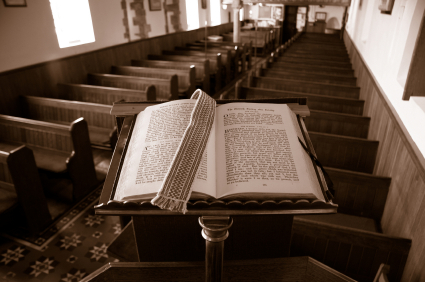
Reading the Bible in Church

pulpit2In an article entitled, we’ve wasted our time reading the Bible aloud if no one has understood what we have said.

Here are three big ideas for people who read the Bible aloud:

your job is to communicate, not just read;
you can’t communicate what you don’t understand;
meaning is not conveyed through words alone.

Your job is to communicate, not just read

It’s possible to read every word from a passage perfectly and clearly, but in such a way that no-one understands what the passage actually means. Worse, it’s also possible to read a passage in a way that gives people a wrong understanding of the Scriptures. Take 1 Corinthians 14:26: “What then shall we say, brothers? When you come together, everyone has a hymn, or a word of instruction, a revelation, a tongue or an interpretation. All of these must be done for the strengthening of the church” (NIV). I once heard this verse read with the emphasis as, “All of these must be done …”. The speaker was trying to convince me that Scripture commanded us to speak in tongues and that, if we didn’t do so, the church would not be strengthened! Thankfully, every other time I’ve heard this verse read, the emphasis has been where it should be—on the words, “for the strengthening of the church”. Reading the same words differently completely changes their meaning. Your job as a Bible reader is not to ‘just read the words’ but to communicate what those words mean. Continue reading

Beauty

God’s Beauty for the Bored, Busy, and Depressed by Tony Reinke

To escape our bondage to sin, we must come alive to the glory of God in Christ. He’s our only hope.

On this theme, theologian Jonathan Edwards was a master. He discovered God’s glory and beauty all over Scripture, and he centered his understanding of the Christian life there.

The classic picture of Edwards as a hellfire preacher, suspending sinners by fishing line over the pit of God’s flaming wrath, simply fails to get a balanced picture of his ministry. He may be most famous for scaring people out of hell with divine wrath, but he spent far more of his time trying to woo people into heaven by proclaiming the beauty of God in the gospel. So writes Dane Ortlund, in a new book destined to be a top book of 2014: Edwards on the Christian Life: Alive to the Beauty of God (Crossway).

This insatiable desire for God’s beauty stokes the fire of the Christian life. We ask for the same thing every day: “to gaze upon the beauty of the L???” (Psalm 27:4). And we testify together: “all the gods of the peoples are worthless idols, but the L??? made the heavens. Splendor and majesty are before him; strength and beauty are in his sanctuary” (Psalm 96:5–6).

We must have God’s beauty.

So what does God’s splendor have to do with my daily life right now — in my busyness, in my temptations, in my boredom, and in my spiritual dryness? I recently sat down to talk with Dane Ortlund, who serves as the Bible publishing director at Crossway.

Beauty and Busyness

First, God’s beauty soothes our busy and anxious hearts.

“The beauty of God’s tender mercy calms me down, lets me breathe again, slows my heart’s frantic scurrying about,” Dane said. “There is so much ambiguity in living as a moral being. In all my anxiety, he is an undeterred and gentle Father who has adopted and justified me. Edwards really felt that. Especially when you read his sermons or letters, there’s an aroma you smell. He really felt safe and loved and calmed because of God and his gentle care for him as a Father.”

“The beauty of God’s tender mercy calms me down, lets me breathe again.” Tweet

Second, God’s beauty fills the affections of our heart, which is essential if we are going to meet our foes of sin and temptation with success. “The world tells me that selfish indulgence in lust is where the fun is,” Dane said. On the contrary, “Edwards writes all over the place about quietly enjoying the beauty of God, and communing with him in his Son, who is the mighty and radiant friend of sinners like me. To use a word Edwards delightfully used, enjoying God happifies us.” Continue reading

The Abomination of Desolation

‘ spoken of through the prophet Daniel—let the reader understand—then let those who are in Judea flee to the mountains.”

The reasons for uncertainty are easy to list. What is an abomination? What abomination does Jesus have in mind? One that belongs to his generation, or one from the last days? What is the connection between the prophecies of Daniel and Jesus? Who is “the reader,” and what should he or she understand? In what sense should readers “flee to the mountains”? Should they obey literally or metaphorically?

As always, the first step is to read the text in literary, cultural, historical, and canonical contexts. Then we analyze the structure of the passage and do the necessary lexical and grammatical work. We begin with the key phrase, “abomination of desolation.”

The term “abomination” (Hebrew toevah and siqqus) appears more than 100 times in the Old Testament and just a few times in the New Testament. An abomination is normally a great sin, commonly worthy of death. Readers immersed in current debates about sexual ethics may first think an abomination is a sexual sin. Indeed, Scripture calls sexual sins like adultery, homosexuality, and bestiality abominations (e.g., Leviticus 18:22, 29-30). But more often throughout the Bible “abomination” refers to major covenant violations, especially idolatry (in Deuteronomy alone, see 7:25, 13:6-16, 17:2-5, 18:9-12, 27:15, 32:16). In the historical books, “abomination” always describes idolatry, often with child sacrifice (1 Kings 11:7, 2 Kings 23:13). Abomination also refers to idolatry in the prophets, including Daniel 9 and 11. (Daniel uses siqqus, a term that always appears in connection with idolatry.)

The interpretation of Daniel 9-11 is difficult and disputed, but it does have some fixed points, and the nature of the abomination that causes desolation is one of them. Daniel 9:26-27 refers to a prince who will destroy the city (Jerusalem) along with its temple and sacrifices, “and on the wings of abominations shall come one who makes desolate.” Two chapters later there is another reference to an “abomination” in connection to the temple: “forces from him shall appear and profane the temple and fortress, and shall take away the regular burnt offering. And they shall set up the abomination that makes desolate” (11:31).

Scholars generally agree that the first reference of these prophecies is the Seleucid king Antiochus Epiphanes IV, who ruled Palestine from 175-64 B.C. Antiochus treated Israel with such violence and contempt that they rebelled against him. When he came to suppress the rebellion, his forces entered the temple, stopped the regular sacrifices, set up an idol of or altar for Zeus, and apparently offered swine there as a sacrifice. This is an abomination because it is idolatry, and it brings desolation because it defiles the holy place at the heart of Israel. This act was the abomination “of” desolation, the abomination “causing” desolation. Continue reading