
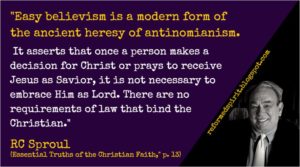
 Article by Phil Johnson (original source here)
Antinomianism is one of those theological terms that is notoriously hard to pin down. It has an admittedly sinister sound, and when many people hear the term, they think it speaks of wantonly advocating sin (“Why not do evil that good may come?”—Romans 3:8). Indeed that kind of extreme antinomianism exists. It was the doctrine of Rasputin, for example.
But in normal theological discourse the term antinomianism usually refers to theoretical antinomianism. Theoretical antinomians don’t necessarily advocate extreme libertinism (or practical antinomianism). In fact, a great many theoretical antinomians are known for their advocacy of holiness. (And conversely, many who adhere to “Holiness doctrine” and various other perfectionist schemes are also theoretical antinomians.)
In totally non-technical terms, antinomianism is simply the view that Christians are not bound by any of the precepts of Moses’ law—moral, civil, ceremonial, or otherwise.
The Reformers saw three proper uses of the moral precepts of Moses’ law. Here’s a summary from Article VI of the Lutheran Formula of Concord (the “Epitome,” or short form):
“The Law has been given to men for three reasons: 1) to maintain external discipline against unruly and disobedient men, 2) to lead men to a knowledge of their sin, 3) after they are reborn, and although the flesh still inheres in them, to give them on that account a definite rule according to which they should pattern and regulate their entire life.”
In other words, the “third use of the law” makes the law’s moral standards the rule by which the faithful must order their conduct. In this sense, the moral strictures of the law remain binding on Christians, even though we are “not under the law” in the Pauline sense—i.e., not dependent on our own obedience for any part of our justification. (By the way, the entire Formula of Concord’s Article VI is a brilliant refutation of antinomianism, and well worth reading.)
Calvin said the third use of the law is “the principle use.” He wrote,
The third use of the Law (being also the principal use, and more closely connected with its proper end) has respect to believers in whose hearts the Spirit of God already flourishes and reigns. For although the Law is written and engraven on their hearts by the finger of God, that is, although they are so influenced and actuated by the Spirit, Meaty stuff that they desire to obey God, there are two ways in which they still profit in the Law. For it is the best instrument for enabling them daily to learn with greater truth and certainty what that will of the Lord is which they aspire to follow, and to confirm them in this knowledge; just as a servant who desires with all his soul to approve himself to his master, must still observe, and be careful to ascertain his master’s dispositions, that he may comport himself in accommodation to them. Let none of us deem ourselves exempt from this necessity, for none have as yet attained to such a degree of wisdom, as that they may not, by the daily instruction of the Law, advance to a purer knowledge of the Divine will. Then, because we need not doctrine merely, but exhortation also, the servant of God will derive this further advantage from the Law: by frequently meditating upon it, he will be excited to obedience, and confirmed in it, and so drawn away from the slippery paths of sin. In this way must the saints press onward . . .
Antinomianism, in essence, is a denial of the third use of the law, claiming that the moral law is not binding on Christians.
There are at least three major strains of theoretical antinomianism:
1. Hyper-Calvinistic antinomianism: Advocates of this view and variations thereof include Tobias Crisp and William Huntington, both 18th-century English preachers. (Some would dispute whether Crisp really fits in this category; I think he does.) They insisted that grace eliminates the moral law as a rule of life. Continue reading
 Article by Matt Smethurst, managing editor of The Gospel Coalition and author of 1–2 Thessalonians: A 12-Week Study (Crossway, 2017). He and his wife, Maghan, have three children and live in Louisville, Kentucky. They belong to Third Avenue Baptist Church, where Matt serves as an elder. (original source