
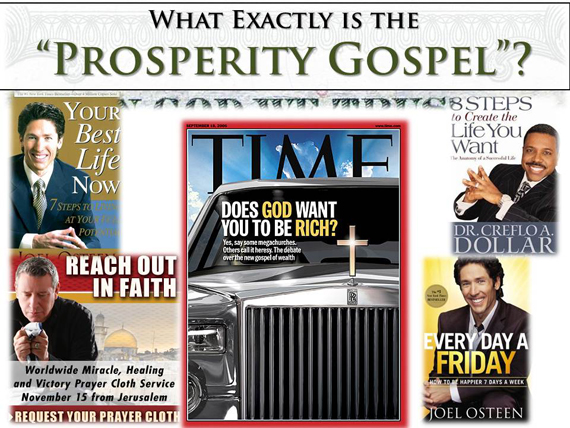
 On Friday, Sept. 8th I am scheduled to team up with Costi Hinn (Benny Hinn’s nephew, now converted and a Reformed Baptist Pastor in California) on Chris Arnzen’s “Iron Sharpens Iron” broadcast. The show’s theme for the two hours will be to bring the light of God’s word in exposing the Word of Faith movement. Please be in prayer that many will be drawn out of deception. Here’s a recent article Pastor Costi wrote:
Article: The Prosperity Gospel: A Global Epidemic by Costi Hinn (original source here)
Prosperity is hot topic in the church. Does God care if a pastor drives a nice car or lives in a nice home? Does God command that all who follow Him take a vow of poverty and starve their families in a protest of earthly comfort? Bible teachers sell millions of books and accumulate mass amounts of wealth, are they in the same league as other wealthy preachers? Some men will have deep convictions about attaining any measure of wealth, while others will be content use their wealth to give back to their church. Some will use their wealth to fund a child’s college tuition, or even scholarship a seminary student. Others will invest their wealth with the goal of giving even more away in the future.
Stewardship comes in all shapes and sizes but one thing doesn’t—God’s ability to weigh a man’s heart and motives. It is a man’s heart that God is most interested in and the gospel a man proclaims that God will judge most. When Heaven’s final bell rings and every man is recompensed according to his deeds, God will have the final say. The issue will not be whether that pastor took home a six-figure salary; the issue will be what that man taught and wrote while representing the gospel of Jesus Christ.
In this article, the prosperity gospel is placed front and center as one of the deadliest teachings in the world today. It has attached itself to the Bible, and to Jesus Christ—though it has no business doing so. Billions chase after it in search of stability and hope. Yet, all those who live and die trusting in the prosperity gospel for salvation will be left wanting in both this life, and the next.
What is Prosperity Gospel Theology?
A very basic definition of the prosperity gospel can be described as this: God’s plan is for you to live your best life now. Health, wealth, and happiness are guaranteed on Earth for all who follow Jesus. Heaven is simply the eternal extension of your temporal blessings. The prosperity gospel’s theological foundation can be traced to at least three twisted versions of biblical truths. Prosperity preacher’s twist these in order to legitimize their version of the gospel.
Christ’s Atonement Means Abundant Life Now
 The Bible clearly teaches that Christ died to atone for our sin (Isaiah 53) and that because of what He accomplished through His death and resurrection, we’ll experience the abundant life that He came to give us (John 10:10). Though we enjoy some benefits of the atonement now—such as the forgiveness of our sins and assurance of salvation—His atonement guarantees eternal promises that won’t be fully be realized until Heaven. We’ll receive a glorified body, there will be no death, no sin, no pain, no suffering, and no disease! Those are just a few of the eternal benefits of the atonement. Best of all, we’ll enjoy perfect fellowship with our God forever more.
Prosperity preachers teach that health and wealth were “paid for” in the atonement—just like sin. Therefore, this twisted interpretation allows them to teach people to expect complete healing, monetary riches, and total victory in every area of their earthly life. Instead of telling people to put faith in Jesus Christ and excitedly await their best life in heaven, they offer an empty gospel that promises people their best life now.
God’s Covenant with Abraham Means Inheritance Now
There’s an old children’s song that goes something like this: “Father Abraham had many sons. Many sons had Father Abraham. I am one of them, and so are you. So let’s just praise the Lord!” It’s used by many faithful Christians as a way to teach children about the great joy associated with God’s covenant with Abraham. Specifically speaking, the Abrahamic covenant (Genesis 12:1-3) has much to do with redemption, and God’s promises to His people. However, prosperity preacher’s use the covenant as a means to promise an inheritance (usually land and money) for their followers now. This has become their most common use for it.
In the prosperity gospel, God’s covenant with Abraham is littered with statements like, “If you’ll sow a seed of faith like Abraham, God will bless you”, or “If you speak it and live it by faith like Abraham, God will prosper you.” These type of statements are a way to present any temporal or eternal inheritance that awaits God’s people as a blanket guarantee.
If these twisted versions of the Abrahamic covenant were true, then the millions who trust in the prosperity gospel would become millionaires and land-owners overnight. Thus far, it is mainly the prosperity preachers who are benefitting from the offerings of those they deceive.
Faith is a Force You Can Use to Control God
The Bible teaches that Christians are justified by faith (Romans 5:1), that Christians overcome the world through faith (1st John 5:5), and that Christians live by faith because of what Christ has done (Galatians 2:20). The list of verses on the blessings of faith is endless! Faith pleases God, is directly related to salvation, and is the evidence of trust in God for the believer.
Prosperity gospel preachers depart from this orthodox teaching on faith when they teach that faith is a force you can use to get what you want from God. In other words, you were able to obtain salvation and justification by faith, so why can’t you obtain a Ferrari the same way? Prosperity theology is centered on the notion that right believing, right thinking, and right speaking are all linked with faith in order to create physical blessings. This is where the word of faith movement also hybrids with the prosperity gospel.
How Did the Prosperity Gospel Get So Popular?
Long before the Catholic Church was selling indulgences, the correlation between ministry, money, and manipulation was crystal clear. The Bible even describes Simon the Sorcerer (Acts 8:9-24) as a magician who thought he could buy the gift of God with money. Specifically speaking, the modern day roots of the prosperity gospel go back approximately seventy years. It was during the 1950’s that this divergent gospel pioneered its way into the mainstream evangelical scene and nobody at the time could have imagined that it would spread across the globe.
Born in 1918, Granville “Oral” Roberts was, in many ways, the lead prosperity pioneer. He went from being a local pastor, to building a multimillion dollar empire based on one major theological premise: God wanted people to be healthy and wealthy.
Oral Roberts didn’t mince words about his version of Jesus or the gospel. He adamantly taught and defended his belief that Jesus’ highest wish is for us to prosper materially and have physical health equal to His peace and power in our soul. He twisted the Bible to make his point and would teach that it was Jesus who said, in 3rd John 1:2, “Beloved, I wish above all things that thou may prosper and be in health, even as thy soul prospereth,” when in fact that was the Apostle John’s loving way of greeting his readers at the time. John’s greeting is comparable to the first line of many of our modern day e-mails that begin with, “Hi! I hope everything is going well for you.” Continue reading
 Article “Christian, Do You Love God’s Law?” by Dr. Sinclair Ferguson Original source