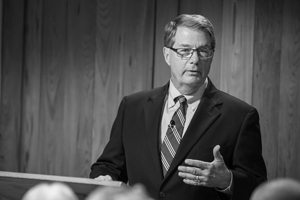
 Article: The Word-less “Church” by Dr. Robert Godfrey (original source here)
Many American churches are in a mess. Theologically they are indifferent, confused, or dangerously wrong. Liturgically they are the captives of superficial fads. Morally they live lives indistinguishable from the world. They often have a lot of people, money, and activities. But are they really churches, or have they degenerated into peculiar clubs?
What has gone wrong? At the heart of the mess is a simple phenomenon: the churches seem to have lost a love for and confidence in the Word of God. They still carry Bibles and declare the authority of the Scriptures. They still have sermons based on Bible verses and still have Bible study classes. But not much of the Bible is actually read in their services. Their sermons and studies usually do not examine the Bible to see what it thinks is important for the people of God. Increasingly they treat the Bible as tidbits of poetic inspiration, of pop psychology, and of self-help advice. Congregations where the Bible is ignored or abused are in the gravest peril. Churches that depart from the Word will soon find that God has departed from them.
What solution does the Bible teach for this sad situation? The short but profound answer is given by Paul in Colossians 3:16: “Let the word of Christ dwell in you richly, teaching and admonishing one another in all wisdom, singing psalms and hymns and spiritual songs, with thankfulness in your hearts to God.” We need the Word to dwell in us richly so that we will know the truths that God thinks are most important and so that we will know His purposes and priorities. We need to be concerned less about “felt-needs” and more about the real needs of lost sinners as taught in the Bible.
Paul not only calls us here to have the Word dwell in us richly, but shows us what that rich experience of the Word looks like. He shows us that in three points. (Paul was a preacher, after all.)
First, he calls us to be educated by the Word, which will lead us on to ever-richer wisdom by “teaching and admonishing one another.” Paul is reminding us that the Word must be taught and applied to us as a part of it dwelling richly in us. The church must encourage and facilitate such teaching whether in preaching, Bible studies, reading, or conversations. We must be growing in the Word.
It is not just information, however, that we are to be gathering from the Word. We must be growing in a knowledge of the will of God for us: “And so, from the day we heard, we have not ceased to pray for you, asking that you may be filled with the knowledge of his will in all spiritual wisdom and understanding” (Col. 1:9). Knowing the will of God will make us wise and in that wisdom we will be renewed in the image of our Creator, an image so damaged by sin: “Put on the new self, which is being renewed in knowledge after the image of its creator” (3:10).
This wisdom will also reorder our priorities and purposes, from that which is worldly to that which is heavenly: “The hope laid up for you in heaven. Of this you have heard before in the word of truth, the gospel” (1:5). When that Word dwells in us richly we can be confident that we know the full will of God: “I became a minister according to the stewardship from God that was given to me for you, to make the word of God fully known” (1:25). From the Bible we know all that we need for salvation and godliness.
Second, Paul calls us to expressing the Word from ever-renewed hearts in our “singing.” Interestingly, Paul connects the Word dwelling in us richly with singing. He reminds us that singing is an invaluable means of placing the truth of God deep in our minds and hearts. I have known of elderly Christians far gone with Alzheimer’s disease who can still sing songs of praise to God. Singing also helps connect truth to our emotions. It helps us experience the encouragement and assurance of our faith: “That their hearts may be encouraged, being knit together in love, to reach all the riches of full assurance of understanding and the knowledge of God’s mystery, which is Christ, in whom are hidden all the treasures of wisdom and knowledge” (2:2–3). Continue reading →

 Doug Bruner is a man who exemplifies the character qualities of an Elder listed in 1 Timothy chapter 3. I am proud to call him a friend and it is a joy to serve with him as my fellow elder at King’s Church in Peoria, AZ. Here is his brief bio found on the King’s Church website: