
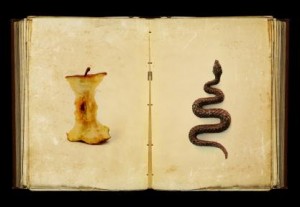
 When speaking of the doctrine of Original Sin, theologians are not so much referring to the first sin of Adam which was carried out in the garden of Eden, but the disastrous effects of that sin in all of his progeny. Since the time of Adam, everyone is born into this world as a sinner. As David writes in Psalm 51, “Surely I was sinful at birth, sinful from the time my mother conceived me.” (v. 5)
In Romans chapter 5, the Apostle Paul makes the following observations:
“Through one man sin entered the world, and death through sin” (v. 12).
“By the one man’s offense many died” (v. 15).
“Through one man’s offense judgment came to all men, resulting in condemnation” (v. 18).
“By one man’s disobedience many were made sinners” (v. 19).
Dr. J.I. Packer in his book Concise Theology writes:
Scripture diagnoses sin as a universal deformity of human nature, found at every point in every person (1 Kings 8:46; Rom. 3:9-23; 7:18; 1 John 1:8-10). Both Testaments have names for it that display its ethical character as rebellion against God’s rule, missing the mark God set us to aim at, transgressing God’s law, disobeying God’s directives, offending God’s purity by defiling oneself, and incurring guilt before God the Judge. This moral deformity is dynamic: sin stands revealed as an energy of irrational, negative, and rebellious reaction to God’s call and command, a spirit of fighting God in order to play God. The root of sin is pride and enmity against God, the spirit seen in Adam’s first transgression; and sinful acts always have behind them thoughts, motives, and desires that one way or another express the willful opposition of the fallen heart to God’s claims on our lives.
Sin may be comprehensively defined as lack of conformity to the law of God in act, habit, attitude, outlook, disposition, motivation, and mode of existence…
Original sin, meaning sin derived from our origin, is not a biblical phrase (Augustine coined it), but it is one that brings into fruitful focus the reality of sin in our spiritual system. The assertion of original sin means not that sin belongs to human nature as God made it (God made mankind upright, Eccles. 7:29), nor that sin is involved in the processes of reproduction and birth (the uncleanness connected with menstruation, semen, and childbirth in Leviticus 12 and 15 was typical and ceremonial only, not moral and real), but that (a) sinfulness marks everyone from birth, and is there in the form of a motivationally twisted heart, prior to any actual sins; (b) this inner sinfulness is the root and source of all actual sins; (c) it derives to us in a real though mysterious way from Adam, our first representative before God. The assertion of original sin makes the point that we are not sinners because we sin, but rather we sin because we are sinners, born with a nature enslaved to sin.
The phrase total depravity is commonly used to make explicit the implications of original sin. It signifies a corruption of our moral and spiritual nature that is total not in degree (for no one is as bad as he or she might be) but in extent. It declares that no part of us is untouched by sin, and therefore no action of ours is as good as it should be, and consequently nothing in us or about us ever appears meritorious in God’s eyes. We cannot earn God’s favor, no matter what we do; unless grace saves us, we are lost…
Dr. R. C. Sproul has commented, “There is no way to avoid the obvious teaching of Scripture that Adam’s sin had dreadful consequences for his descendents. It is precisely because of the abundance of such biblical statements that virtually every Christian body has composed some doctrine of original sin linked to the fall of Adam.”
Concerning this doctrine, a brief post at the Ligonier website reads:
Original sin has to do with the fallenness of human nature. Jonathan Edwards wrote a tremendous treatise on original sin. He not only devoted himself to a lengthy exposition of what the Bible teaches about man’s fallen character and his propensity toward wickedness, but he made a study from a secular, rational perspective that addressed the philosophy that was widespread in his day: Everyone in the world is born innocent, in a state of moral neutrality in which they don’t have any predilection toward either the good or the evil. It’s society that corrupts these innocent natives, so to speak. As we are exposed to sinful behavior around us, our normal, natural innocence is eroded by the influence of society. But that begs the question, How did society get corrupt in the first place? Society is people. Why is it that so many people have sinned? It’s almost axiomatic in our culture that nobody is perfect. And Edwards asked questions like, Why not? If everyone were born in a state of moral neutrality, you would expect statistically that approximately 50 percent of those people would grow up and never sin. But that’s not what we find. Everywhere we find human beings acting against the moral precepts and standards of the New Testament. In fact, whatever the moral standards are of the culture in which they live, nobody keeps them perfectly. Even the honor that’s established among thieves is violated by thieves. No matter how low the level of morality is in a given society, people break it.
So there is something indubitable about the fallenness of our human character. All people sin.
The doctrine of original sin teaches that people sin because we are sinners. It’s not that we are sinners because we sin, but rather, we sin because we are sinners; that is, since the fall of man, we have inherited a corrupted condition of sinfulness. We now have a sin nature. The New Testament says we are under sin; we have a disposition toward wickedness, so that we all do, in fact, commit sins because it is our nature to commit sins. But that’s not the nature that was originally given to us by God. We were originally innocent, but now the race has been plummeted into a state of corruption.
Elsewhere on the same site, we read this question and answer:
Continue reading
 The following is a short article by Dr. John Piper entitled, “Being Mocked: The Essence of Christ’s Work, Not Mohammed’s.”
 “As the salt flavors every drop in the Atlantic, so does sin affect every atom of our nature. It is so sadly there, so abundantly there, that if you cannot detect it, you are deceived.”