
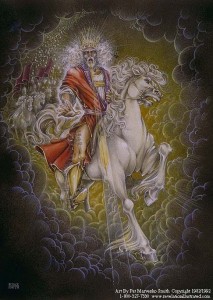
 “Jesus Christ is not a tyrant claiming divine right, He is now head over all things in His church, and He reigns over heaven and earth and hell with the keys of life and death at His belt. Certain princes have been glad to call themselves kings by the popular will, and certainly our Lord Jesus Christ is such in His church. If it could be put to the vote whether He should be King in the church, every believing heart would crown Him. We ought to crown Him more gloriously than we do! We would regard no expense too great if we could glorify Christ. Suffering would be pleasure, and loss would be gain, if through that we could surround His brow with brighter crowns and make Him more glorious in the eyes of men and angels. Yes, He shall reign. Long live the King! All hail to You, King Jesus! You souls who love your Lord. Bow at His feet; cover His path with the lilies of your love and the roses of your gratitude: “Bring forth the royal diadem, and crown Him Lord of all.”
Our Lord Jesus is King in Zion by right of conquest: He has taken the hearts of His people by storm and has defeated their enemies who held them in cruel bondage. In the Red Sea of His own blood, our Redeemer has drowned the Pharaoh of our sins: Shall He not be Lord and King? He has delivered us from sin’s dominion and from the heavy curse of the law: Shall not the Liberator be crowned? We are His portion, whom He has taken out of the hand of the enemy with His sword and with His bow: Who will snatch His conquest from His hand? All hail, King Jesus! We gladly own Your gentle sway! Rule in our hearts forever, You lovely Prince of Peace.”
– C.H. Spurgeon
 God raises up both the true and the false prophet for His purposes. Throughout the centuries, the greatest challenge to the people of God has always been the false prophet within the ranks, rather than the military enemy outside. When Israel was right with Yahweh, no weapon formed against them could ever prosper. The clearest sign of God’s judgment is when He allows a people to have its carnal desires; when He gives them what they want but sends leaness to their souls; when He gives them over to the sin they crave (Romans 1) and allows them to embrace false prophets who lead them astray crying “peace,” “peace,” when there is no peace. As Jeremiah found to his own cost, when God’s hand of judgment comes on a people, the false prophet becomes more popular than the true. Its always been this way. When men refuse to embrace His truth, God sends them strong delusion so that they will believe falsehood.
 After examining a number of passages that attest to Scripture’s inspiration and authority, which fills the whole New Testament; and which includes not only such direct assertions of divinity and infallibility for Scripture as these, but, along with them, an endless variety of expressions of confidence in, and phenomena of use of, Scripture which are irresistible in their teaching when it is once fairly apprehended.
 But avalanches, unfortunately, do not come upon us, stone by stone, one at a time, courteously leaving us opportunity to withdraw from the pathway of each in turn: but all at once, in a roaring mass of destruction.