
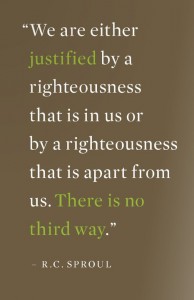
 At the Council of Trent in the 16th century, the Roman Catholic Church placed its eternal and irrevocable curse on the Gospel, announcing it as actually heretical. I am certain that in the hearts and minds of the delegates at the Council, this was never intended – not even for a moment – but that is in fact what happened.
The most relevant Canons are the following:
Canon 9. If anyone says that the sinner is justified by faith alone…, let him be anathema.
Canon 11. If anyone says that men are justified either by the sole imputation of the justice of Christ or by the sole remission of sins,… let him be anathema.
Canon 12. If anyone says that justifying faith is nothing else than confidence in divine mercy (supra, chapter 9), which remits sins for Christ’s sake, or that it is this confidence alone that justifies us, let him be anathema.
Canon 24. If anyone says that the justice received is not preserved and also not increased before God through good works but that those works are merely the fruits and signs of justification obtained, but not the cause of the increase, let him be anathema.
Canon 30. If anyone says that after the reception of the grace of justification the guilt is so remitted and the debt of eternal punishment so blotted out to every repentant sinner, that no debt of temporal punishment remains to be discharged either in this world or in purgatory before the gates of heaven can be opened, let him be anathema.
Canon 32. If anyone says that the good works of the one justified are in such manner the gifts of God that they are not also the good merits of him justified; or that the one justified by the good works that he performs by the grace of God and the merit of Jesus Christ…does not truly merit an increase of grace and eternal life… let him be anathema.
As Dr. Michael Horton rightly noted, “It was, therefore, not the evangelicals who were condemned in 1564, but the evangel itself. The ‘good news,’ which alone is ‘the power of God unto salvation’ was judged by Rome to be so erroneous that anyone who embraced it was to be regarded as condemned.”
But the Council of Trent met a long time ago. Hasn’t Rome since modified its position? In another place Dr. Horton wrote, “Has Rome’s position changed? In fact it has not. The Vatican II documents as well as the new Catechism of the Catholic Church reinvoke the theological position of the Council of Trent, condemning the gospel of justification by an imputed righteousness.” But knowing full well that Rome’s full curse is on me for believing the following, I quote the Scripture and embrace the only true Gospel of my Savior, the Lord Jesus Christ.
“To the one who does not work but trusts him who justifies the ungodly, his faith is counted as righteousness” (Romans 4:5). God justifies the “ungodly.” God does not wait until sinners are righteous in and of themselves before He declares them righteous. If He did, I for one would despair of ever getting there. The word “Gospel” means “good news” and the amazing “good news” of the Gospel is about how Jesus’ life, death and resurrection breaks all the power of despair and saves sinners by supplying to them a perfect unassailable righteousness AS A GIFT.
Question: Whose righteousness is supplied?
Answer: Christ’s own righteousness (1 Cor 1:30).
The connection between the sinner and the Savior is trust, not improvement of behavior. THAT COMES LATER (Eph 2:8-10).
This is our hope – while ungodly in and of ourselves, when we give up all hope of self attained salvation, trust in the Savior allows the Savior to save and He does so with resplendent and majestic power! Paul wrote, “For we hold that one is justified by faith apart from works of the law” (Romans 3:28). The basis of this despair shattering hope (the ungodly justified) is “Christ for righteousness to everyone who believes” (Romans 10:4, literal translation). Through the mechanism of faith alone (which itself is God’s gift) God counts sinners (the ungodly) as righteous because of Christ.
“For our sake [God] made [Christ] to be sin who knew no sin, so that in him we might become the righteousness of God” (2 Corinthians 5:21). Justification by faith alone is really shorthand for justification by the Person and work of Christ alone. Jesus saves – not merely potentially or hypothetically – but He actually saves – all by Himself! All the sins of all the people who would ever believe in Him were transferred to Christ on the cross and He bore the penalty these sins deserved; and what is transferred to these sinners is a righteousness that has never known sin – the very righteousness of Christ. That is the kind of righteousness given to me – a righteousness that always obeyed every command of God fully and perfectly from the heart. The wonder of it all is that now, because of Christ, God not only merely tolerates me, but He has declared me as just, righteous, and fully pleasing to Him. “Therefore having been justified by faith we have peace with God through our Lord Jesus Christ.” (Romans 5:1). This peace is not a mere temporary ceasefire on God’s part. I am forever justified before God through faith in the perfect Savior. To quote Martin Luther’s Latin phrase, I am “simul iustus et peccator” – at the same time just and sinner. Christ’s own perfect righteousness is mine. It is not merely that God because of Christ now sees me as “just as if I’d never sinned”, but more than that.. much more than that… He now sees me as “just as if I’d always obeyed!” This, ladies and gentlemen, is the Gospel of Jesus Christ.
 In case you have not noticed, Christians are not in heaven yet. Though our place there is assured, in the meanwhile, God’s people live under the shadow of less than perfect Government.
 1 Let every person be subject to the governing authorities. For there is no authority except from God, and those that exist have been instituted by God. 2 Therefore whoever resists the authorities resists what God has appointed, and those who resist will incur judgment. 3 For rulers are not a terror to good conduct, but to bad. Would you have no fear of the one who is in authority? Then do what is good, and you will receive his approval, 4 for he is God’s servant for your good. But if you do wrong, be afraid, for he does not bear the sword in vain. For he is the servant of God, an avenger who carries out God’s wrath on the wrongdoer. 5 Therefore one must be in subjection, not only to avoid God’s wrath but also for the sake of conscience. 6 For because of this you also pay taxes, for the authorities are ministers of God, attending to this very thing. 7 Pay to all what is owed to them: taxes to whom taxes are owed, revenue to whom revenue is owed, respect to whom respect is owed, honor to whom honor is owed.
 Tim Challies writes: