
The Divine Intention of the Cross (Part 3)

Scripture is explicit then in saying that Jesus died for His people, His sheep, His friends, His Church, securing eternal life for them in doing so.

However, many object to this understanding of Christ’s work on the cross, not because of the many clear texts that teach it, but because other verses seem, a least at first glance, to strongly deny this. For instance, 1 John 2:2, speaking of Jesus, states, “He is the propitiation for our sins, and not for ours only but also for the sins of the whole world.”

I can certainly see how someone would use this verse to undermine all I have been saying above. Yet scripture, I believe, is not contradictory to itself. There is one Divine Author of Scripture and He does not contradict Himself.

So how are we to understand 1 John 2:2?

I have written elsewhere about the principles of correct interpretation. There is only one correct interpretation of Scripture. Though there may be many applications of a verse, it only means what it was intended to mean when it was written.

In my article entitled “Playing Marbles with Diamonds” I refer to twelve principles of biblical interpretation (hermeneutics), two of which would apply here:

1. Consider the Author – who wrote the book? (what was his background, language, culture, vocation, concerns, education, circumstance, what stage of life?)

2. Consider the Audience (why was the book written? who was the audience? what would these words have meant to its original recipients?)

I quote again Dr. James White, when he wrote, “Remember when you were in school and you had to take a test on a book you were assigned to read? You studied and invested time in learning the background of the author, the context in which he lived and wrote, his purposes in writing, his audience, and the specifics of the text. You did not simply come to class, pop open the book, read a few sentences, and say, “Well, I feel the author here means this.” Yet, for some odd reason, this attitude is prevalent in Christian circles. Whether that feeling results in an interpretation that has anything at all to do with what the original author intended to convey is really not considered an important aspect. Everyone, seemingly, has the right to express their “feelings” about what they “think” the Bible is saying, as if those thoughts actually reflect what God inspired in His Word. While we would never let anyone get away with treating our writings like this, we seem to think God is not bothered, and what is worse, that our conclusions are somehow authoritative in their representation of His Word.”

A third principle I mentioned in the article relates to the concept of considering the author’s context. This refers to looking at all of a person’s writings – John’s writings, Paul’s writings, Luke’s writings, etc..

When we look elsewhere in John’s writings we notice in his Gospel an exact parallel in John’s use of words, which give us a great deal of insight as to what he (John) was referring to.

In John’s Gospel, chapter 11, verses 51-52, John wrote these words, “he prophesied that Jesus would die for the nation, and not for the nation only, but also to gather into one the children of God who are scattered abroad.”

In chart form, the parallel with 1 John 2:2 becomes clear:
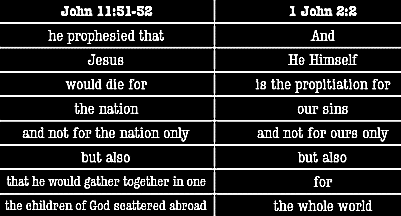
Phil Johnson (who provided this helpful chart) writes, “There is little doubt that this is how John’s initial audience would have understood this expression. “The whole world” means “people of all kinds, including Jews, Gentiles, Greeks, Romans, and whatnot” as opposed to “ours only” i.e., the Jewish nation. What the apostle John is saying in the John 11 passage is particularly significant: Christ died so that he might gather “the children of God” the elect, from the whole world.”

I believe therefore that rather than undermining the case for Christ’s death for His elect sheep, 1 John 2:2 actually affirms it. When we understand the verse in its Johannine context (the writings of the Apostle John) then the correct interpretation becomes very clear.

In Hebrew culture, it is the father who chooses a bride for his son. In the same way, the bride of Christ was chosen by the Father, then given to the Son, and all in this number are without fail raised up to eternal life (John 6:37-39). The Son loses none of those given to Him by the Father.

A second objection to this, that needs to be dealt with are the words of Hebrews 2:9 which say,

“But we see him who for a little while was made lower than the angels, namely Jesus, crowned with glory and honor because of the suffering of death, so that by the grace of God he might taste death for everyone.”

Surely “everyone” means everyone, right?

Well usually, yes, but not always. This in fact has to be determined by the context in which the words are spoken. For example, if a teacher asks his class of students, “Is everyone present?” he is not asking if everyone on the planet is present in the room, but rather all the students enrolled in the class. That’s how the word everyone is used, and so it is the context in which the words are used that determine what is meant by the words. The question in Hebrews 2:9 is whether “everyone” refers to all human beings without distinction, or whether it refers to everyone within a certain group.

To determine the answer to that question, lets now read Hebrews 2: verses 9 -10 together:

9 But we see him who for a little while was made lower than the angels, namely Jesus, crowned with glory and honor because of the suffering of death, so that by the grace of God he might taste death for everyone.
10 For it was fitting that he, for whom and by whom all things exist, in bringing many sons to glory, should make the founder of their salvation perfect through suffering.

Immediately after saying that by the grace of God Christ tasted death for everyone, the writer of Hebrews explains that God’s intention or design in the cross of Christ was to “bring many sons to glory” (verse 10). Christ tasted death for everyone, because it seemed fitting to God that the way to lead His children to glory was through the suffering and death of Christ.

The “everyone” of verse 9 refers to the “everyone” of the sons being led to glory in verse 10.

Verses 11 and 12 confirm this is indeed the context for the use of “everyone” (in verse 9):

11 For he who sanctifies and those who are sanctified all have one origin. That is why he is not ashamed to call them brothers,
12 saying, “I will tell of your name to my brothers; in the midst of the congregation I will sing your praise.”
13 And again, “I will put my trust in him.” And again, “Behold, I and the children God has given me.”

Following the thread of these verses, the sons God is leading to the glory of heaven through the death of Christ are now called the brothers of Christ. It was for everyone of these that Christ tasted death.

Hebrews 9:15 declares, “Therefore He is the mediator of a new covenant, so that those who are called may receive the promised eternal inheritance, since a death has occurred that redeems them from the transgressions committed under the first covenant.”

According to this text who does it redeem?

Answer: The called.

Christ’s work on the cross achieved all of the Divine purposes for it. The intent of the design was not merely to try to save all, but when all was said and done, the plan could fail for many because of that stubborn thing called “free will,” with the Savior sad for all eternity because many He died for received no benefit for all His labor. No, He died a satisfied Savior, giving Himself for His friends, for His sheep, for His people, for His Church, and fully accomplished the work of redemption for all in this number.

All who are particularists (who believe that not everyone will be saved – that some people will in fact spend eternity in hell) believe in some type of limitation to the atonement of Christ. The Arminian limits its power, for it only becomes effectual through man’s cooperation; the Reformed person limits its extent.

As C. H. Spurgeon said, “The doctrine of Holy Scripture is this, that inasmuch as man could not keep God’s law, having fallen in Adam, Christ came and fulfilled the law on the behalf of his people; and that inasmuch as man had already broken the divine law and incurred the penalty of the wrath of God, Christ came and suffered in the room, place, and stead of his elect ones, that so by his enduring the full vials of wrath, they might be emptied out and not a drop might ever fall upon the heads of his blood-bought people.” (Sermon 310 – “Christ our Substitute – New Park Street, Southwark)

Elsewhere he preached, “I had rather believe a limited atonement that is efficacious for all men for whom it was intended, than an universal atonement that is not efficacious for anybody, except the will of man be joined with it.” (Sermon number 173 – Metropolitan Pulpit 4:121)

In another sermon, Spurgeon said, “Once again, if it were Christ’s intention to save all men, how deplorably has He been disappointed, for we have His own evidence that there is a lake that burneth with fire and brimstone, and into that pit must be cast some of the very persons, who according to that theory, were bought with His blood. That seems to me a thousand times more frightful than any of those horrors, which are said to be associated with the Calvinistic and Christian doctrine of particular redemption.” (C. H. Spurgeon – Sermon 204 – New Park Street Pulpit 4:553)

This doctrine of the particular redemption or definite atonement of Christ, speaks of God’s design in the atonement, and who it was God was intending to save when Christ went to the cross. Christ died as a substitute who bore the full weight of God’s wrath on behalf of His people, paying the penalty for their sin. Christ intended to save His sheep and actually secured everything necessary for their salvation. The gift of faith is infallibly applied by the Spirit to all for whom Christ died, thereby guaranteeing their salvation.

Christ did not build a wide bridge that merely went most of the way from heaven to earth, requiring all who were willing to jump the final few yards. It was a narrow cross shaped bridge, that extended all the way from heaven to earth, with Jesus the Savior, walking the bridge, finding His sheep on the other side in spiritual death, raising them to life, and carrying each one safely to heaven in His arms.

Salvation is by grace alone, through faith alone, because of Christ alone, based on the Scripture alone, to the glory of God alone! Christ’s all sufficient work affirms this!

The Fight to Read

Charles Spurgeon, where Paul wrote to Timothy:

“When you come, bring the cloak that I left with Carpus at Troas, also the books, and above all the parchments”

We do not know what the books were about, and we can only form some guess as to what the parchments were. Paul had a few books which were left, perhaps wrapped up in the cloak, and Timothy was to be careful to bring them.

Even an apostle must read.

Some of our very ultra-Calvinistic brethren think that a minister who reads books and studies his sermon must be a very deplorable specimen of a preacher. A man who comes up into the pulpit, professes to take his text on the spot and talks any quantity of nonsense is the idol of many. If he will speak without premeditation, or pretend to do so, and never produce what they call a dish of dead men’s brains—oh, that is the preacher!

How rebuked they are by the apostle!

He is inspired, and yet he wants books!

He has been preaching for at least thirty years, and yet he wants books!

He had seen the Lord, and yet he wants books!

He had had a wider experience than most men, and yet wants books!

He had been caught up into the Third Heaven and had heard things which it was unlawful for a man to utter, yet he wants books!

He had written the major part of the New Testament, and yet he wants books!

The apostle says to Timothy, and so he says to every preacher, “Give attendance to reading” (1 Tim. 4:13).

The man who never reads will never be read.

He who never quotes will never be quoted.

He who will not use the thoughts of other men’s brains proves that he has no brains of his own.

Brethren, what is true of ministers is true of all our people. You need to read. Renounce as much as you will all light literature, but study as much as possible sound theological works, especially the Puritanic writers and expositions of the Bible.

Here’s how John Piper put it in his chapter “Fight for Your Life” in Brothers, We Are Not Professionals (new edition coming from B&H in February 2013):

I agree with Martyn Lloyd-Jones that the fight to find time to read is a fight for one’s life. “Let your wife or anyone else take messages for you, and inform the people telephoning that you are not available. One literally has to fight for one’s life in this sense!”

Most of our people have no idea what two or three new messages a week cost us in terms of intellectual and spiritual drain. Not to mention the depletions of family pain, church decisions, and imponderable theological and moral dilemmas. I, for one, am not a self-replenishing spring. My bucket leaks, even when it is not pouring. My spirit does not revive on the run. Without time of unhurried reading and reflection, beyond the press of sermon preparation, my soul shrinks, and the specter of ministerial death rises. Few things frighten me more than the beginnings of barrenness that come from frenzied activity with little spiritual food and meditation.

The great pressure on us today is to be productive managers. But the need of the church is for prayerful, spiritual poets. I don’t mean (necessarily) pastors who write poems. I mean pastors who feel the weight and glory of eternal reality even in the midst of a business meeting; who carry in their soul such a sense of God that they provide, by their very presence, a constant life-giving reorientation on the infinite God. For your own soul and for the life of your church, fight for time to feed your soul with rich reading.

HT:JT

Sanctification – Piper and Keller

From the desiring god website:

Part 1: Earlier this Spring John Piper and Tim Keller sat down to discuss the biblical vision of sanctification. In this 14-minute video they touch on how justification and sanctification relate, along with the psychological dynamics of faith.

Time-markers:

00:20 — How Keller talks about sanctification.

2:25 — What are we conforming to in sanctification?

3:45 — How does justification relate to sanctification?

6:40 — The psychological dynamics of faith.

9:00 — What does it mean to “owe God everything”?

11:20 — “I’m going to work my tail off for Jesus, and it’s all of grace.”

Part 2: The discussion continues in this 15-minute video, including some practical guidance for in-the-moment motivations for holiness.

Time-markers:

0:01 — When action is enticed by a blessing.

3:00 — Looking for the past and future for sanctification now.

4:44 — How pleasure relates to our motives.

7:10 — The battle against pornography and being a “John Owen guy.”

11:10 — Three levels of motivation for holiness.

11:29 — Strategies and means of grace for holiness.

Tim Challies conducted a short interview with Dr. Piper. He writes:

A few weeks ago I had the opportunity to interview John Piper. I promptly solicited questions from you, the readers of this site, and Pastor John was kind enough to answer them. Because the focus of this year’s Desiring God National Conference is sanctification, I asked him questions related to that subject. In this interview he discusses why sanctification is not an instantaneous act, how we can emphasize personal toil in holiness without diminishing the goodness and sovereignty of God, why we need to continue to confess our sins to God, and how we can know if we are growing in sanctification. If you read only one of the answers, be sure it is the final one!

What is God’s purpose in making sanctification a lifelong pursuit rather than an instantaneous act at the moment of conversion?

First, I agree with the assumption that this is true. God does do this. That is, he intentionally does not conquer all our sins in an instant, though he could. He could perfect us now. We know this because he is going to do it when we die. We will not sin in heaven. We will be among “the spirits of the righteous made perfect” (Heb. 12:23).

And we know that God will finally throw Satan into the lake of fire (Rev. 20:10) and take away his influence in the new world entirely. If he will do it then, he could do it now. But he doesn’t. He gives Satan leash. So why is Satan allowed to rage, and why does God let us go on stumbling toward holiness?

I am not aware of any text in the Bible that answers this question explicitly. So we answer with inferences from God’s broader statements of purpose. The largest answer is that God does all things for the greater display of his glory, and so this too must be for his glory.

One clue to make this more specific comes from Romans 9:22-23. Paul asks rhetorically, “What if God, desiring to show his wrath and to make known his power, has endured with much patience vessels of wrath prepared for destruction, in order to make known the riches of his glory for vessels of mercy?”

Could God’s purpose in “enduring vessels of wrath” be a pointer to his enduring the sins of his people and the raging of his arch-enemy?

In the case of those who will never repent, God’s patience intensifies the display of his power and wrath. And when God forgives his people 70 times 7 times 7 times 7, does he not intensify the display of his mercy?

And does he not provide the most intense experiences of our own humbling and remorse as we see what becomes of us when we fail to trust God’s grace and power? And so God displays both our inadequacy and his all-merciful sufficiency in allowing us to go on stumbling toward holiness.

How do you emphasize personal toil and effort in sanctification without diminishing sanctification as an act of trust in God?

First by seeking to maintain the biblical proportions. The barometer of our balance is the Bible, not the sentiments of our audience. Over the long haul are we speaking in biblical proportions? This requires not just adding up the effort-passages and the rest-passages, but also being so immersed in the spirit of the Bible that we discern the spiritual tone of how to speak of both.

We do not gloss over the words of Jesus, “Strive to enter through the narrow door.” (Luke 13:24)

Or the words of Paul, “Every athlete exercises self-control in all things. They do it to receive a perishable wreath, but we an imperishable. So I do not run aimlessly; I do not box as one beating the air. But I discipline my body and keep it under control, lest after preaching to others I myself should be disqualified.” (1 Cor. 9:25-27)

Or the words of Peter, “Be all the more diligent to confirm your calling and election” (2 Peter 1:10).

But we bring these commands under the blood-bought promise of God’s commitment to complete the work he has begun (Phil. 1:6) and work in us what pleases him (Heb. 13:20-21) and sanctify us wholly (1 Thess. 5:23-24), and “fulfill every resolve for good and every work of faith by his power” (2 Thess. 1:11).

We never forget that there is a “holiness without which no one will see the Lord” (Heb. 12:14). And we never for get that “by a single offering he has perfected for all time those who are being sanctified” (Heb. 10:14). Because he strove with sin and death and Satan, and triumphed, we strive with the assurance we too will prevail.

Why do believers need to continually confess their sins to receive forgiveness for them? If Christ has paid for sins past, present, and future, what actually transacts when I confess my sin to God?

One might think that this problem is created by the contrast between John and Jesus on the one side, and Paul on the other. 1 John 1:9 says, “If we confess our sins, he is faithful and just to forgive us our sins and to cleanse us from all unrighteousness.” Similarly Jesus tells us to pray, “Forgive us our debts,” with the same frequency as “Give us this day our daily bread” (Matt. 6:12).

But Colossians 2:13-14 says, “You, who were dead in your trespasses and the uncircumcision of your flesh, God made alive together with him, having forgiven us all our trespasses, by canceling the record of debt that stood against us with its legal demands. This he set aside, nailing it to the cross.” And Ephesians 4:32 says, “Forgive one another, as God in Christ forgave you.” (See also Col. 3:13.)

So Paul seems to treat forgiveness as past and secure, while John and Jesus seem to treat it as future and contingent—“If we confess . . .”

However the problem is not between John and Paul, or Jesus and Paul, but between John and John. 1 John 2:12 says, “I am writing to you, little children, because your sins are forgiven for his name’s sake.” Here John speaks like Paul. All your sins have been forgiven (perfect tense). So the tension is between 1 John 1:9 and 2:12. This matters because while one might be tempted to pit author against author, it is harder to pit an author against himself.

I think there are two kinds of solution.

1. The solution in 1 John comes from noticing what John says in 1:7-8, “If we walk in the light, as he is in the light, we have fellowship with one another, and the blood of Jesus his Son cleanses us from all sin. If we say we have no sin, we deceive ourselves, and the truth is not in us. If we confess …” Confessing our sins is the opposite of “saying we have no sin.” If we say that, “the truth is not in us.” That is, we are not Christians. We are not born again.

So John sees “confessing our sins” as a habitual way of seeing ourselves “in the light.” Walking in the light (v. 7) includes not saying we are sinless. Walking in the light means seeing sin for what it is and acknowledging it as such. If we walk in the light this way, that is live a life of acknowledged (rather than denied) sin, “the blood of Jesus cleanses us from all sin.”

All sin! In other words, John is not thinking that every sin must be recalled and confessed, else it’s not forgiven. Rather, he is thinking: Are we real Christians? Or are we deceiving ourselves by denying we have sin? If we are real, if we are walking in the light, if we have a continual acknowledgement of our sin, then we are truly born again, truly connected to Christ, truly under the cleansing power of the blood of Jesus.

In short, John 1:9 is saying that, if we confess our sins, the truth is in us, and we are really born of God and united to Christ so that all the forgiveness that Christ purchased is ours.

2. When Jesus teaches us to pray daily, “Forgive us our debts …” he is probably pointing us in the same direction as 1 John (and Paul). We need not take him to mean that every sin must be remembered. He knew the psalmists cry, “Declare me innocent from hidden faults” (19:12). We do not know all our sins. We can’t confess them all by name.

So Jesus probably means: Be aware of your sinfulness. Take note of your sins. Feel their sting. Be grieved by them. Do not hide them. Bring them before God, and ask that the Messiah’s blood cover them all. Jesus knew the plan of Isaiah 53:6, “The LORD has laid on him the iniquity of us all.” And he knew he was the one who would bear the sins of many. “The Son of Man came to give his life as a ransom for many” (Mark 10:45).

So when he told us to ask daily for forgiveness he meant, Ask that God daily apply to us what Christ bought for us. The price of forgiveness was paid once for all. The application to particular sins in our lives is experienced day by day. We add nothing to the purchase. “Father, forgive us,” does not contradict, “The Lord has forgiven you” (Col 3:13). It means: Apply that decisive purchase, that decisive letting go of sin to this days shortcomings.

How can you know if you are making progress in your sanctification and how can you know how much progress you are making? Is sanctification something that can be measured?

Paul believed that sanctification has degrees. You can grow. He prays that “your love may abound more and more” (Phil. 1:9). He says the Thessalonians are pleasing God and tells them to “do so more and more” (1 Thess. 4:1). He tells the Corinthians that God will “increase the harvest of your righteousness” (2 Cor. 9:10). And prays, “May the Lord make you increase and abound in love for one another and for all” (1 Thess. 3:12).

But the New Testament does not quantify these degrees. “More and more” and “increasing” are discernible but not measurable. That is, while length is quantified in inches and feet. Holiness does not have similar measuring units.

So how do you know you are making progress? There is a paradox here. On the one hand, greater holiness is greater victory over sins. But on the other hand, greater holiness is greater sensitivity to and hatred for sin. So it does not follow that becoming more holy will mean becoming more happy with oneself. You may be a better person tomorrow and feel worse about the smaller corruption that remains.

But there are ways to discern growth. One is that those around you will see it and confirm it. Another is that you will see some of it. You will feel the weakening of some temptations as love for Christ pushes the desirability of sin far away. You will feel drawn to holy acts that once were burdens. And you will have holy sorrow when you omit them, not just guilt over a duty neglected. You will see the preferences in your life change. What was once supremely desirable is trumped by a superior desire for Christ and his word and his way. And you will confirm your heart change in action. Action that becomes less burdensome as love grows. “This is the love of God, that we keep his commandments. And his commandments are not burdensome” (1 John 5:3).

We can and should make progress in sanctification. And we can and should be aware that it is happening. This will encourage us that God is at work in our lives. And it will humble us because progress will mean we can see more clearly how far we have to go and how small are our advances. And how much we will always need a great Savior.