 By Dr. James White – Part 1:
Jason Stellman just announced his defection to Romanism in these words:
More specifically, I no longer see the Reformed doctrines of Sola Scriptura and Sola Fide as faithfully reflecting what the Bible teaches, which is why I will, Lord willing, be received into full communion with the Catholic Church sometime in the next several months.
Dr. James White writes: Just a few weeks ago I leaned over and looked Jason in the eye. He was sitting on the couch in my office, a matter of feet from where I am sitting right now. I’m sure he noted with some humor my lava lamps, which would have been directly behind me as I spoke. “If you are going to Rome, go all the way. Mary, Popes, the whole nine yards. Then debate me on it.” He laughed.
As I sadly read the above cited words I could not help but shake my head. Jason knows the Apostles did not teach what Rome teaches on so many things. He knows there wasn’t a single person at Nicea who believes what Rome requires him to believe de fide today, and that he has to buy into a massively complex, easily challenged house of philosophical cards to keep the Roman authority system standing. I do not understand what drives the kind of agnosticism about the authority of God’s Word that has driven him into a system that offers no peace and no finished work of Christ. He refused to defend Romanism when we talked, he only wanted to pose hypotheticals that Rome has no meaningful answer to. But in any case, I can report with honesty that I gave it to him straight: if he went to Rome, he was abandoning the gospel, abandoning his call, abandoning all that is good and right and just and true, for a man-made system of endless penances, alter Christi, non-perfecting sacrifices, satis passio, and enough mythical dogmas about Mary to make the devotees of the Queen of Heaven blush. It will not satisfy, it will leave him empty and forlorn, once that initial “honeymoon” phase is over. When he sees it from the inside, when the glow of the New Convert Syndrome wears off, he will see he has accomplished nothing outside of the destruction of his own ministry and the trust others had placed in him. It is sad to see, but he will have to testify: I warned him clearly, and without compromise. I even asked him, “Has anyone else spoken to you with as much passion?” “No” was his reply.
Immature Christians are often troubled by conversion stories like Jason’s. Look! A minister joined Rome! Look, another joined Islam! Another became a Mormon! Look how many have left the faith and become agnostic or even atheist! There must be something wrong! Such immaturity is borne out of an ignorance of the context of the early Church. The little epistle of First John shows us that even during the days when the Apostles still lived, apostasy was rampant. Opposition was everywhere. False teachers flourished. And the young Christian body could see, out there in the fellowships of the anti-Christs, those who had once stood with them and made a profession of faith. Has Christ failed? Is the Gospel without power? No, the problem here is a false assumption: that it is God’s intention for the church to ever live in ease, without opposition, without false brethren and false teachers to battle, without persecution from the world, and tribulation within. No one who seriously reads the NT literature would come to that conclusion, but sadly, that is the idea many have. John told the young believers,
They went out from us, but they were not really of us; for if they had been of us, they would have remained with us; but they went out, so that it would be shown that they all are not of us. (1 John 2:19)
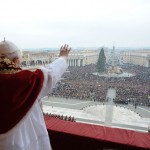
There is a reason for apostasy: “so that it would be shown that they all are not of us.” The gospel drives out the hypocrite, the false professor. In fact, if hypocrites and false professors are comfortable in your church, then you have a good reason to question whether the gospel is being preached with clarity and power. Christ knows His sheep. They hear His voice. They do not listen to a man who claims to be the Vicar of Christ, who arrogantly allows himself to be called “Holy Father.” They are satisfied with His Word, which is why false teachers tirelessly seek to inculcate dissatisfaction and distrust in the Word. That is how they get the false disciples to follow them. And we see it happen every day. We should expect to see it happening every day. It is a fulfillment of God’s Word.
Part 2:
More specifically, I no longer see the Reformed doctrines of Sola Scriptura and Sola Fide as faithfully reflecting what the Bible teaches, which is why I will, Lord willing, be received into full communion with the Catholic Church sometime in the next several months. – Jason Stellman
Dr. James White writes:
Let’s ponder this a moment. Scripture never directs us to a higher authority than God’s own voice, and identifies itself as theopneustos, God-breathed. Scripture tells us we are justified by grace, by faith, and by the blood of Christ, and that works can never justify. But…that is not what the Bible actually teaches.
What does it teach? It teaches about an infallible Magisterium, and the bishop of Rome; it teaches about an oral tradition no one can identify but which existed outside of the Bible (and, in the case of the Marian dogmas, outside of—everything); it teaches about transubstantiation in all its Aristotelian glory, a never-perfecting sacrifice of Christ, propitiatory sacrifices overseen by men called alter Christus (“another Christ”), purgatory, satis passio, (the suffering of atonement in purgatory), indulgences, and the whole range of Marian dogmas and corollaries including de fide definitions of beliefs utterly unknown to the Apostles or the first ten generations of Christians. Yes indeed, that’s what the Bible teaches because, of course, once you lose confidence in the Word, well, the Word becomes the slave of whatever authority you submit yourself to. And Rome has said it, therefore, that’s what you are to believe.
Compare:
For what does the Scripture say? “Abraham believed God, and it was counted to him as righteousness.” Now to the one who works, his wages are not counted as a gift but as his due. And to the one who does not work but believes in him who justifies the ungodly, his faith is counted as righteousness, just as David also speaks of the blessing of the one to whom God counts righteousness apart from works: “Blessed are those whose lawless deeds are forgiven, and whose sins are covered; blessed is the man against whom the Lord will not count his sin.” – Romans 4:3–8 ESV
(employing a great measure of sarcasm, Dr. White continues….)
Now remember, that’s unclear. We can’t really know what it means, or trust what it says. We need an infallible interpreter, which has instead given us these clear, compelling and truly apostolic words:
1. The doctrine and practice of indulgences which have been in force for many centuries in the Catholic Church have a solid foundation in divine revelation which comes from the Apostles and “develops in the Church with the help of the Holy Spirit,” while “as the centuries succeed one another the Church constantly moves forward toward the fullness of divine truth until the words of God reach their complete fulfillment in her.”
For an exact understanding of this doctrine and of its beneficial use it is necessary, however, to remember truths which the entire Church illumined by the Word of God has always believed and which the bishops, the successors of the Apostles, and first and foremost among them the Roman Pontiffs, the successors of Peter, have taught by means of pastoral practice as well as doctrinal documents throughout the course of centuries to this day.
2. It is a divinely revealed truth that sins bring punishments inflicted by God’s sanctity and justice. These must be expiated either on this earth through the sorrows, miseries and calamities of this life and above all through death, or else in the life beyond through fire and torments or “purifying” punishments.
Thus is explained the “treasury of the Church” which should certainly not be imagined as the sum total of material goods accumulated in the course of the centuries, but the infinite and inexhaustible value the expiation and the merits of Christ Our Lord have before God, offered as they were so that all of mankind could be set free from sin and attain communion with the Father. It is Christ the Redeemer Himself in whom the satisfactions and merits of His redemption exist and find their force. This treasury also includes the truly immense, unfathomable and ever pristine value before God of the prayers and good works of the Blessed Virgin Mary and all the saints, who following in the footsteps of Christ the Lord and by His grace have sanctified their lives and fulfilled the mission entrusted to them by the Father. Thus while attaining their own salvation, they have also cooperated in the salvation of their brothers in the unity of the Mystical Body.
That is from Indulgentiarum Doctrina, a post Vatican II document defining, and defending, the doctrine of indulgences. I challenged Jason Stellman to read it. He hadn’t when we met. I’ll be honest, I sorta doubt he took up my challenge. Not that reading this kind of stuff will dissuade someone who has lost their foundation and are grasping for anything, but for most folks, these words are sufficient warning of the emptiness of Rome’s non-gospel. They are so plainly non-apostolic, so plainly contrary to everything the Apostles cherished and proclaimed, that to believe them is to show, clearly, the true direction of one’s heart. But, in any case, when you hear a wide-eyed Tiber Swimmer talking about how the Bible doesn’t teach sola fide, remember that what they are really telling you is that you can’t know what the Bible really does teach, and that what you should believe is what you just read from Indulgentiarum Doctrina. And once you realize that, well, you realize what Romanism really is.

 Question: If Christ actually “saved” the elect on the cross, isn’t it true to say that the elect are born already justified and there is no need to exercise faith?