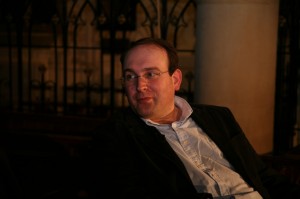
 Michael Reeves is author of Unquenchable Flame: Discovering the Heart of the Reformation (B&H). He is also theological advisor for Universities and Colleges Christian Fellowship (UCCF), a charity supporting evangelism in higher education throughout the United Kingdom. He was previously associate minister at All Souls Church, Langham Place and holds a doctorate in systematic theology from King’s College London. In a recent interview by Matthew Barrett he (Michael Reeves) was asked the following about the Reformation:
What was the church like during the Middle Ages and what did they believe when it came to salvation?
A big question! The church taught that we can be saved by grace. That is, we must be holy and righteous if we are to be saved, and so God in his mercy gives us the grace to make us holy and righteous. ‘Grace’, then, was thought of as being something like a spiritual can of Red Bull: grace would give you the inclination and the energy to be holy. And so, with enough ‘grace’, you could live a holy enough life to merit salvation.
The result was that people were left with no assurance and a strong desire to acquire more ‘grace’ (through attending Masses, going on pilgrimages etc). And even then, it was obvious that very few would manage to live holy enough lives to walk straight into heaven upon death. Thus developed belief in purgatory, a place in which the long process of sanctification-unto-salvation could be completed.
Put simply, the church had drifted a long way from being able to say with Paul ‘for me to live is Christ and die is gain.’
Were there any forerunners to the Reformation and what happened to them when they sought to voice their protest?
Indeed there were. Perhaps the most famous were John Wycliffe in England and Jan Hus in Bohemia (in the modern-day Czech Republic), but there were others. Wycliffe was a fourteenth-century Oxford theologian who taught – shockingly for the time – that the Bible is the supreme source of spiritual authority, and not the pope, as was normally assumed. This led him to reject a number of other then-standard beliefs, such as the idea of transubstantiation. He managed to die before he was officially declared by the church to be a heretic, but he left an important legacy in England: having organized a translation of the Latin Vulgate Bible into English, his followers dedicated themselves to the illegal practice of secret group Bible reading. In many ways that tilled the earth, ready for the seed of the Reformation.
His follower, Jan Hus, fared worse. Defending Wycliffe’s views in Bohemia, he was summoned to a church council and there in 1415 condemned to be burned to death for heresy.
How did Luther come to realize that the Roman Catholic Church was in error and what for Luther was at the heart of his disagreement with Rome?
It was a slow process for Luther, realizing that Rome was going astray in what it taught, and that it had effectively set itself up as an authority over Scripture, thus protecting its own error. At the heart of his disagreement was his understanding of Paul’s phrase ‘the righteousness of God’ (Romans 1:17). In his days as a monk, the phrase had always terrified him: he himself was not righteous, he knew; thus if God was righteous, that could only mean judgment and damnation for him. Then, studying Romans (again) in 1519, he began to see that for Paul, ‘the righteousness of God’ is something God has that he shares with us. God’s righteousness is a gift to sinners, something a sinner can be clothed with and thus stand, perfectly accepted, before the throne of God.
He explained his discovery in a little tract called The Freedom of a Christian (still available to read and still brilliant). At the heart of the tract is a story of a king who marries a prostitute, Luther’s allegory for the marriage of King Jesus and the wicked sinner. When they marry, the prostitute becomes, by status, a queen. It is not that she made her behaviour queenly and so won the right to the king’s hand. She was and is a wicked harlot through and through. However, when the king made his marriage vow, her status changed. Thus she is, simultaneously, a prostitute at heart and a queen by status. In just the same way, Luther saw that the sinner, on accepting Christ’s promise in the gospel, is simultaneously a sinner at heart and righteous by status. What has happened is the ‘joyful exchange’ in which all that she has (her sin) she gives to him, and all that he has (his righteousness, blessedness, life and glory) he gives to her. Thus she can confidently display ‘her sins in the face of death and hell and say, “If I have sinned, yet my Christ, in whom I believe, has not sinned, and all his is mine and all mine is his”.’
When we think of the Reformation it is Luther who gets most of the attention, but Zwingli also played an important role as well. Who was Zwingli and what was his contribution to the Reformation?
Zwingli was a Swiss contemporary of Luther’s who started an independent reformation in Zurich. The reason there could be such an independent movement was because both Luther and Zwingli had read Erasmus’ 1516 edition of the New Testament in its original Greek. Reading the Scriptures in their original language – instead of the sub-standard official Latin translation – was what had ignited reform in both their minds.
The reason Zwingli has been rather forgotten is probably because, quite simply, he was not as good a thinker as Luther. Zwingli’s reformation was all about opening up the Bible, but he was not as clear as Luther on why the Bible should be opened or what message it contains. For example, while Zwingli believed in justification by faith alone, it never had the same prominence in his thinking as it did for Luther and he would not teach it as clearly and persistently as would Luther.
What was so radical about the “Radical Reformers”? What aspects of their theology should we be thankful for and what aspects should we reject?
Well, the Radical Reformers were quite a broad bunch, ranging from mild and peaceful advocates of believer-only baptism (extremely controversial for the time) right through to sword-wielding, hot-headed heretics who denied the Trinity and other Christian essentials. What united them all was their conviction that the Reformation was going too slowly, or not far enough. Those who believed that that ongoing work of reform should be led by Scripture give us an inspiring example: many willingly faced grisly torture and death for their desire to see the church conformed to the word of God. What was unfortunate was their tendency to be theologically lightweight, more interested in holiness than the beliefs that can foster true holiness.
Talk to us about John Calvin, particularly his debate with Cardinal Jacopo Sadoleto. Do you see any resemblance between Sadoleto’s efforts to pull Protestants back home to Rome and the decision of some evangelicals today to return to Rome?
Calvin was a Frenchman, born a generation later than Luther and Zwingli. When, as a young man, he came to embrace the Reformation, he was forced to leave Catholic France for exile in Geneva, where he spent most of his adult life. His debate with Sadoleto in 1539 was one of the great intellectual showdowns of the Reformation. What happened was this: Sadoleto wrote an open letter to the city of Geneva, arguing for why they should abandon the Reformation they had come to embrace, and return to Roman Catholicism. The Reformation was a new-fangled heresy, he suggested, and one that discouraged holiness and so endangered souls. Calvin replied that the Reformers were only seeking to restore the old orthodoxy of the Church, an orthodoxy that had been buried under centuries of human tradition and error. And as for the idea that salvation by grace alone discouraged holiness, that entirely misunderstood salvation, as if it were something other than being freely brought to know, love, and so want to please a beautifully holy God.
As for similarities to today: yes, Sadoleto’s arguments do find echoes in, for example, Francis Beckwith’s Return to Rome, the story of why the President of the Evangelical Theological Society returned to Roman Catholicism. Like Sadoleto, Beckwith played down the fundamental theological differences between Catholicism and Evangelicalism, allowing himself to be lured by the appeal of Rome as the age-old mother of the faithful, the church that has never changed, that has always been one and the same. The moral of the story: evangelicals need to be aware of the theological chasm that separates them from Catholicism if they are to remain sincerely evangelical.
It is probably more accurate to speak of reformations than the reformation. Can you explain what brought about the Reformation in Britain and who were some of the major reformers in this movement?
With Luther, the Reformation was first and foremost a matter of doctrine. He believed that the Bible taught that God saves by his grace alone, and that the Bible was to be trusted on this, even though popes might differ. In Britain, many were won over by his arguments. However, what really shaped things in Britain was the monarch. King Henry VIII wanted a new wife; the pope couldn’t allow it, so Henry wanted to break with Rome. The Reformation thus proved useful to him. However, that the king wanted to break with Rome was also useful to British reformers – men like Thomas Cranmer, the Archbishop of Canterbury. The political cooperation of the crown and the reformers eventually meant that Britain became formally Protestant. That, of course, is something very different to having a nation of heartfelt evangelicals, and that was very much what the Puritans would seek to remedy.
Why was it such a big deal to have the Scriptures translated into the vernacular during the reformation period and who were some of the most important Bible translators?
Imagine that the United States had never had a Bible that people could read for themselves and you’ll sense why it was such a big deal! For something like a thousand years, Europe had been without a Bible people could read. Then Martin Luther translated the Scriptures from their original Hebrew and Greek into German; at the same time, William Tyndale translated them into English, and others translated them into French, Swedish, etc. To be able to read God’s words, and to see in them such good news that God saves sinners, not on the basis of how well they repent, but entirely by his own grace, was truly revolutionary and wildly exciting. When in 1538, for example, Henry VIII decreed that an English Bible be placed in every church, crowds thronged around those who could read them out loud enough. So great was the excitement that priests complained of how, even during the sermon, laypeople were reading the Bible aloud to each other. And it was a big deal because there could be no going back once the word had been unleashed: now butchers and bakers were discussing the Bible, coming to new convictions, and even daring to disagree with clergy over it. The church could no longer pontificate unchallenged. With Bible now in hand, people wanted to know where their priest got his ideas from.
Who were the Puritans and were they in basic continuity or discontinuity with the reformers before them?
Puritanism was a movement that began in England in the 1560s, but the term ‘Puritan’ actually lumps together quite a diverse lot: they held a variety of views on God, salvation and the church. What united them was the belief that the church in England needed to be more reformed by the word of God – and that the very hearts of their countrymen needed to be reformed.
The danger for them was that the desire to have people respond to the gospel could lead to a focus on the response, not the gospel. So, in looking for reformed lives (the sign that a person had responded rightly to the gospel), it was easy to let a concern for growth in personal holiness eclipse the original Reformation focus on justification. In other words, the Puritans could be tempted to concentrate on holy living in response to the gospel at the expense of proclaiming the free, saving grace of God. When that happened, the real spirit of reformation could be lost, and all the doubts and anxieties of medieval Catholicism come streaming back in through the back door of a zealous Christian moralism that had lost sight of the grace of God.
It was here that some of the Puritan ministries that are still most refreshing came in with the cure. Puritans like the heavenly Richard Sibbes proclaimed ‘the gracious nature and office of Christ; the right conceit of which is the spring of all service to Christ, and comfort from him’. That was the aim of all the major Puritans, and when they did that, they were being absolutely loyal to the first reformers.
Is the Reformation over today? Do Catholics and Evangelicals today pretty much agree on the doctrine of justification or are there still significant differences?
Understandably, many have wanted to claim that it is. Professor Mark Noll, for instance, has argued that ‘many Catholics and evangelicals now believe approximately the same thing’ about justification. That is no wild statement: in 1999, the Roman Catholic Church and the Lutheran World Federation signed the Joint Declaration on the Doctrine of Justification, claiming that ‘the subscribing Lutheran churches and the Roman Catholic Church are now able to articulate a common understanding of our justification’.
What exactly was being agreed upon was not clear, though, and the Catechism of the Catholic Church still defines justification as a process which includes our growth in holiness. With that understanding in place, Roman Catholicism still concludes that we can merit for ourselves eternal life – and do so with the aid of purgatory, indulgences and so on. But such doctrines simply cannot be squared with a Reformational understanding of justification, for if, as Luther argued, I am given the righteous status of Christ without that status being in any way dependent upon the state of my heart or life, then there is no place for a purgatory where I am made more worthy of heaven, or indulgences to speed me there.
The Reformation is far from over, then. And if, as the reformers believed, Reformation is essentially about being conformed ever closer to the word of God, it cannot be over. It is, in fact, precisely what we most need today.

 Transcript from a Conference Question and Answer Session with Dr. R. C. Sproul – Pittsburgh, 2000
 “I am writing these things to you so that you may know how one ought to behave in the church of the living God, a pillar and buttress of the truth.” – 1 Timothy 3:14-15