
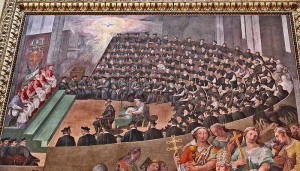
 At the Council of Trent in the 16th century, the Roman Catholic Church placed its eternal and irrevocable curse on the Gospel, announcing it as actually heretical. I am certain that in the hearts and minds of the delegates at the Council, this was never intended – not even for a moment – but that is in fact what happened.
The most relevant Canons are the following:
Canon 9. If anyone says that the sinner is justified by faith alone…, let him be anathema.
Canon 11. If anyone says that men are justified either by the sole imputation of the justice of Christ or by the sole remission of sins,… let him be anathema.
Canon 12. If anyone says that justifying faith is nothing else than confidence in divine mercy (supra, chapter 9), which remits sins for Christ’s sake, or that it is this confidence alone that justifies us, let him be anathema.
Canon 24. If anyone says that the justice received is not preserved and also not increased before God through good works but that those works are merely the fruits and signs of justification obtained, but not the cause of the increase, let him be anathema.
Canon 30. If anyone says that after the reception of the grace of justification the guilt is so remitted and the debt of eternal punishment so blotted out to every repentant sinner, that no debt of temporal punishment remains to be discharged either in this world or in purgatory before the gates of heaven can be opened, let him be anathema.
Canon 32. If anyone says that the good works of the one justified are in such manner the gifts of God that they are not also the good merits of him justified; or that the one justified by the good works that he performs by the grace of God and the merit of Jesus Christ…does not truly merit an increase of grace and eternal life… let him be anathema.
As Dr. Michael Horton rightly noted, “It was, therefore, not the evangelicals who were condemned in 1564, but the evangel itself. The ‘good news,’ which alone is ‘the power of God unto salvation’ was judged by Rome to be so erroneous that anyone who embraced it was to be regarded as condemned.”
The question then is, do the anathemas of Trent still stand? Mike Gendron addresses this question in an article entitled “Does the Vatican Still Condemn Christians?” Continue reading
 Though this debate took place almost 19 years ago now, the fact is that the word of God has not changed in any way at all in that time. On September 28, 1993, at the Bayview Orthodox Presbyterian Church in Chula Vista, California, Dr. James White debated Roman Catholic Patrick Madrid on the subject “Does The Bible Teach Sola Scriptura?” The full transcript of the debate can be found