
Thoughts on a New Pope

D. Scott Meadows is the Pastor of Calvary Baptist Church (Reformed) of Exeter, Pope Benedict XVI) just announced his resignation from the Papacy by the end of this month, February 2013. The process of selecting a successor has begun, with all of this garnering much attention in the news media. As a theologian and pastoral leader, my conscience constrains me to comment.

Years ago I was asked my opinion about the new Cardinal of Boston. I replied, “That’s like asking me about the new captain of a pirate ship. The whole enterprise is illegitimate.” I do not deny that these events may have momentous implications, but I strongly and solemnly protest the show of reverence and awe for such men and for this religious institution even from those who should know better.

A great champion of the biblical faith once wrote a magnificent book entitled, Christianity and Liberalism (1923). In it, J. Gresham Machen detonated an enduring and powerful blast against theological liberalism by asserting that it is not Christianity at all, but an alternative, a competing religion, and deeply anti-Christian.

The same is true of the Roman Catholic Church (RCC). Plainly it is not the Christianity of the New Testament’s apostles and early Christians, as those in agreement with them, and knowledgeable about Roman Catholicism, can discern and attest. At crucial points, the RCC has steadfastly opposed that faith once-for-all delivered to the saints. Historically, she has even slaughtered a great host of Christian believers unjustly branded as heretics. At least since the Council of Trent (1545-1563), the RCC has formally, meticulously, and vociferously repudiated the true, biblical Gospel of Jesus Christ, pronouncing curses upon any who dare to preach it. For example, the Council proclaimed,

CANON XII. If any one saith, that justifying faith is nothing else but confidence in the divine mercy which remits sins for Christ’s sake; or, that this confidence alone is that whereby we are justified: let him be anathema.[1]

That this remains the RCC’s position today is clear from the fact that it still appeals in its modern catechism (c. 2000) to Trent as an authoritative doctrinal statement and teaches in substance along the same very lines.

Justification is not only the remission of sins, but also the sanctification and renewal of the interior man (Council of Trent [1547]).[2]

Though it exceeds the scope of this commentary to vindicate the biblical doctrine of justification by faith alone apart from our works, let the reader remember this Scripture passage: Continue reading
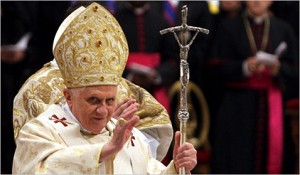
The Pope Resigning This Month

With the breaking news of the Pope resigning this month (the first time a Pope has done so in 598 years) the world is going to be filled with Roman Catholic propaganda over the next 6 weeks or so… its put the issue of the Papacy right back center stage. In the midst of all the media hoopla and rhetoric which is sure to occur, Dr. James White, some years back):
“We all heard the ‘2,000 years of Jesus’ Catholic Church’ mantra last year when John Paul II died, and it was almost never challenged. I would ask our writer to name, please, a single bishop at the Council of Nicea who believed as he believes on each of these topics: Marian dogmas (Perpetual Virginity, Immaculate Conception, Bodily Assumption), Papal Authority (infallibility), Purgatory, transubstantiation. Any semi-serious reader of history knows he would not be able to find such a person, so the claim of ‘2,000 years’ may sound impressive, but it has the truth value any advertising slogan carries: none. It may sound great to those ignorant of history, and to those who wear the glasses Rome provides that filters out all the extraneous problems and issues, but for anyone with an even semi-decent grasp of the past, it is a hollow, shallow claim.”See More

The ‘Gospel’ According to Rome

by Paul says of salvation, “But if it is by grace, it is no longer on the basis of works, otherwise grace is no longer grace.”

By contrast, Roman Catholicism finds itself in the impossible position of advocating a gospel in which salvation is offered both by grace and also on the basis of works. The Catholic church promotes a synergistic sacramental soteriology in which human good works, along with God’s grace, contribute to the sinner’s justification.

This is in distinct contrast to the evangelical understanding of the gospel, in which salvation is received by grace through faith alone.

Despite the eccumenical efforts of some, the difference between Roman Catholicism and Protestant Evangelicalism is one of substance not merely semantics.

Today’s post is intended as a summary of Roman Catholic teaching with regard to the essence of the gospel (in order to demonstrate how it strays from the biblical message of salvation). Catholic sources are included under each of the following points.

* * *

I. According to Rome, salvation is not by grace through faith alone; it does not come through the sole imputation of Christ’s righteousness to the sinner.

Council of Trent, Canons on Justification, Canon 9: “If anyone says, that by faith alone the impious is justified . . . let him be anathema.”

Council of Trent, Canon 11: “If anyone says that men are justified either by the sole imputation of the justice of Christ or by the sole remission of sins, excluding grace and charity which is poured into their hearts by the Holy Spirit and inheres in them, or also that the grace which justifies us is only the favor of God, let him be anathema.”

* * *

II. According to Rome, good works are necessary for salvation. They are not merely the fruits of justification (as evangelicals assert), they are actually the root of it. They are meritorious and will be rewarded with eternal life.

Council of Trent, Canon 24: “If anyone says that the justice [or justification] received is not preserved and also not increased before God through good works but that those works are merely the fruits and signs of justification obtained, but not the cause of the increase, let him be anathema.”

The Catholic Encyclopedia, in an article entitled Sanctifying Grace, states that the sinner “is formally justified and made holy by his own personal justice and holiness” such that “over and above faith other acts are necessary for justification” including acts of charity, penance with contrition, and almsgiving.

Catholic Answers: ”Even though only God’s grace enables us to love others, these acts of love please him, and he promises to reward them with eternal life (Rom. 2:6–7, Gal. 6:6–10). Thus good works are meritorious. When we first come to God in faith, we have nothing in our hands to offer him. Then he gives us grace to obey his commandments in love, and he rewards us with salvation when we offer these acts of love back to him (Rom. 2:6–11, Gal. 6:6–10, Matt. 25:34–40). . . . We do not ‘earn’ our salvation through good works (Eph. 2:8–9, Rom. 9:16), but our faith in Christ puts us in a special grace-filled relationship with God so that our obedience and love, combined with our faith, will be rewarded with eternal life (Rom. 2:7, Gal. 6:8–9).”

Notice the confusion Catholic theology portrays in trying to maintain a gospel of both grace and works. On the one hand, Catholics assert that believers do not earn their salvation through good works. On the other hand, they contend that God rewards good works with eternal life. Those two concepts are contradictory. Is eternal life a free gift (received by grace) or is it a reward (received on the basis of good works)? Continue reading