Dr. Steve Lawson here provides good, sound advice for preachers concerning how to preach the doctrine of predestination.
Preaching Predestination Part 1:
Preaching Predestination Part 2:
Preaching Predestination Part 3:

 Transcript of The Dividing Line. March 6, 2018 at the 9:00 minute mark, Dr. James White.
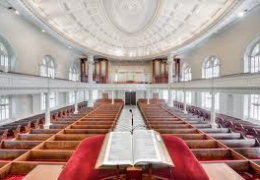
“I believe very, very strongly that the central act of worship of the Church is the full and careful and balanced ministry of the word of God to the people of God, gathered together to hear what God has to say. So meaningful, sound, solid exegesis – everything we do before and after – if there is anything after – is simply meant to heighten and to prepare us, to put us in the proper frame of mind to be obedient and to have hearing ears. Anything that we put into that worship service that closes our ears, distracts us, in any way shuts down our ability to hear the word is wrong – it is going the wrong direction. And the most important thing that a shepherd of the sheep can do is to faithfully communicate not just the part of the message you think is all fire important but if you really believe that all scripture (not just some) but all scripture is theopneustos (God breathed) then you need to deliver all of it… all of it. And that means covering some stuff that ain’t going to make people see gold-dust coming out of the ceiling. I mean there is some tough stuff to handle – there is some difficult stuff in there. And that means there are going to be services that are highly instructional, there are going to be services that are incredibly uplifting, there are going to be services that do bring you into the very presence of God in heaven and there are others that absolutely smack you down into the dirt, when you realize how much of God’s grace you take for granted, and how few of the duties are ours we actually pursue with the proper zeal of redeemed people. In other words, it is going to be balanced. And the balance is determined not by us but by what is found in the Scriptures given to us by the inspiration of the Holy Spirit – that canon of Scripture God has given to us – that… that is where our balance is to be found.”
Something of a surprise at this week’s Shepherds’ Conference was the announcement that John MacArthur (and an assembled team of people) have been working for quite some time behind the scenes to produce The Preacher’s Bible, which, as the name suggests, is a Bible designed especially for preachers and preaching. What was even more of a surprise was that every attendee at the Conference was given one of these new Bibles. Think of that – around 4,000 pastors/ministers received one of these Bibles.
Dr. MacArthur was asked, “If you could design the perfect Bible for preachers, what would it include?” The result is The Preacher’s Bible. Here is where Dr. MacArthur explains the rationale behind the project.
I can say this: After spending a number of hours analyzing ‘The Preacher’s Bible’, I am beyond thrilled with it. More than that, I am happy to announce that this new high quality Bible is now my personal preaching Bible. It is indeed perfect for preaching. It is very heavy though – close to 6lbs in weight. No one would want one of these “puppies” to fall on them from a great height – that is for sure.
What this all means is that I am switching from the ESV (English Standard Version) to the NASB (New American Standard Bible) as my translation of choice for preaching. Doug is also excited by this and as elders at King’s Church we can also announce that the NASB will now be the version used for the reading and preaching of God’s word in our services.
What does this mean for you (at King’s Church)?
Well, what it does NOT mean is that anyone HAS to switch to the NASB as the Bible they bring to Church. Not in any way at all. There are great translations out there and I for one am glad about that. The ESV (which was the version we used) is still an excellent translation and I have nothing negative to say about it. In fact, because both translations are highly accurate, many times the words in the verses of the ESV and the NASB are almost identical to each other. However, to avoid unnecessary confusion in having a number of different translations read in a service (which would be confusing, especially to someone new to the faith), it will be the NASB that will be the one used for reading and preaching.
The NASB has always been known for its high degree of accuracy in translating the Hebrew of the Old Testament and the koine Greek of the New. Praise the Lord for that!
I also especially like two features of the New American Standard Bible:
1) The NASB addresses God with a capital “H”. I like this because by doing this, it becomes absolutely clear as to WHO is being addressed in a verse, leaving nothing to mental guesswork. That is often not the case in other translations.
2) I really like how, when reading the New Testament, the NASB alerts us to the fact that a verse from the Old Testament is being quoted by making it stand out in the text. It does so by making the Old Testament quotation capitalized.
If you go to this link you can check a passage such as Hebrews chapter 1 in both the ESV and the NASB (go to the top right of the page and click on each one) and see the difference between the translations. I very much appreciate the clarity of the NASB in showing exactly what the wording of the Old Testament quotation is. Making the quotation capitalized makes it stand out in the text.
If you want to know more about the Preacher’s Bible, you can do so at this link. Bear in mind that this is not a study Bible, as such. It is designed especially for preaching.
The NASB will also receive an update in the year 2020 (the last one being in 1995) and by all accounts, will become even more accurate and readable at that time.