Does an Unbelieving Child Disqualify an Elder?

JustinTaylor02Does the New Testament teach that an unbelieving child disqualifies an elder?

Justin Taylor, father of three, elder at New Covenant Bible Church in St. Charles, Illinois, and vice president of book publishing at Crossway writes:

There can be few things in life more painful than an unbelieving child. And when the child is the son or daughter of an elder, the questions take on a public dimension in the life of the church. Doesn’t the apostle Paul say something about elders needing to have children who are believers? The verses under consideration are 1 Timothy 3:4-5 and Titus 1:6. We’ll look at them in more detail below, but at this point it’s helpful to look at the two different conclusions that faithful interpreters have reached. Douglas Wilson holds to the first option: “If a man’s children fall away from the faith (either doctrinally or morally), he is at that point disqualified from formal ministry in the church” (Douglas Wilson, “The Pastor’s Kid” in Credenda/Agenda, vol. 2, no. 3). Alexander Strauch holds to the second view: “The contrast is made not between believing and unbelieving children, but between obedient, respectful children and lawless, uncontrolled children.” In other words, Paul is talking about “the children’s behavior, not their eternal state” (Alexander Strauch, Biblical Eldership: An Urgent Call to Restore Biblical Church Leadership, 229). Which one is right? To answer that, we have to take a careful look at the key texts.

Faithful Leadership in the Church and Home

In 1 Timothy 3:4, Paul says that an elder “must manage his own household well, with all dignity keeping his children submissive.” In the next verse he explains why: “for if someone does not know how to manage his own household, how will he care for God’s church?” The obvious answer to the rhetorical question is that he can’t. In other words, if you can’t manage your household at home, you won’t be able to care for the household of God. If you regular lose control of your kids, why should you be trusted to lead and protect a flock? John Stott gets the biblical logic right: “The married pastor is called to leadership in two families, his and God’s, and the former is to be the training ground of the latter” (John Stott, Guard the Truth: The Message of 1 Timothy and Titus, 98). None of this is particularly controversial. It’s when we get to Titus 1:6 that the harder question arises.

Must an Elder’s Children Be Believers?

Paul says that an elder’s “children [must be] believers and not open to the charge of debauchery or insubordination.” On first glance, the answer looks obvious. Paul says that an elder’s kids must be believers. But note the footnote in the ESV: believers can also be translated faithful. (It’s important to pay attention to footnotes in the translations of biblical texts, as they alert us when there are other equally valid translation options.) The Greek word here is pistas, which can mean either “believing” or “faithful” in the pastoral epistles. (For example, see “believing masters” in 1 Timothy 6:2 and “faithful men” in 2 Timothy 2:2). Word studies alone can’t solve this—it depends on the context.

But let’s be clear on the two big options: Paul either meant that (1) an elder’s children have to be believers, or (2) an elder’s children must at least be faithful, submissive, and obedient.

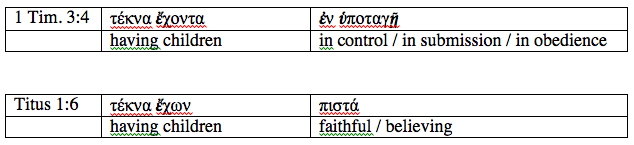
How do we decide? The Reformers rightly insisted that we allow Scripture to interpret Scripture. Here we have one author (Paul) writing separately to two young church planters (Timothy and Titus) talking about the same subject (elder qualifications). How do the two passages about family life compare? When we look at the Greek, we see how similar the language is between 1 Timothy 3:4 and Titus 1:6. You can see the similarities even if you don’t know Greek:
Greek1-JT-Timothy-Titus

The most natural assumption is that Paul is saying the same thing in slightly different ways. (As Andreas Köstenberger points out, it would be unusual if Paul gave Timothy a more lenient standard about elder’s children and Titus a more stringent one.) If they mean the same thing, then to have children who are pista means to have children who are hypotag?. And what does it mean to have children who are hypotag?? Paul explains it in the next clause: “not open to the charge of debauchery or insubordination” (see note below*).

Four More Reasons

With that in mind, here are four further reasons that incline me to believe that Paul is referring to the submission and obedience of an elder’s children, and not to their salvation. Continue reading

1 Timothy 2:12

DanielWallace1 Timothy 2:12 But I suffer not a woman to teach, nor to usurp authority over the man, but to be in silence. 13 For Adam was first formed, then Eve. (KJV)

Transcript (excerpt) of a lecture by Dr. Dan Wallace, “From the KJV to the RV”:

“In 1 Timothy 2:12, Paul gives his instructions to Timothy, and in the King James he says essentially, ‘I do not permit a woman to usurp authority over a man.’ Now usurp means to take that authority on for oneself illegitimately or to steal it if you will.

Every once in a while we have some women preachers who come to the Seminary – its a rare opportunity, but when they come in they get behind a pulpit and they say, ‘I am not usurping anyone’s authority here today to speak to you. This authority has been granted to me by the Chaplain.’

Well, when they say that, their view is based on the wording of the King James Version of 1 Timothy 2:12, but its not based on the meaning of the Greek text.

Now the King James translators got that from Erasmus’ Latin text because the Greek word that is used there is used very rarely in all of Greek literature. And so, they did not know exactly what it meant. So they consulted Erasmus’ Latin text. You recall all of Erasmus’ Greek editions had Latin on one side and Greek on the other, and he had changed Jerome’s Latin Vulgate here incorrectly. The Latin word he used was ‘usurpare’ and consequently, the King James translators, put in ‘usurp.’

Almost all modern translations render it correctly as “exercise authority.'”

**1 Timothy 2:12 I do not permit a woman to teach or to exercise authority over a man; rather, she is to remain quiet. 13 For Adam was formed first, then Eve… (ESV)

**1 Timothy 2:12 But I do not allow a woman to teach or exercise authority over a man, but to remain quiet. 13 For it was Adam who was first created, and then Eve… (NASB)

Plurality of Elders v. Single Bishop

Were Early Churches Ruled by Elders or a Single Bishop? Michael J. Kruger Christians have disagreed about what leadership structure the church ought to use. From the bishop-led Anglicans to the informal Brethren churches, there is great diversity.

And one of the fundamental flash points in this debate is the practice of the early church. What form of government did the earliest Christians have? Of course, early Christian polity is a vast and complex subject with many different issues in play. But, I want to focus in upon a narrow one: Were the earliest churches ruled by a plurality of elders or a single bishop?

Now it needs to be noted from the outset that by the end of the second century, most churches were ruled by a single bishop. For whatever set of reasons, monepiscopacy had won the day. Many scholars attribute this development to Ignatius (pictured above).

But, what about earlier? Was there a single-bishop structure in the first and early second century?

The New Testament evidence itself seems to favor a plurality of elders as the standard model. The book of Acts tells us that as the apostles planted churches, they appointed “elders” (from the Greek term ???????????) to oversee them (Acts 11:30; 14:23; 15:2; 20:17). Likewise, Titus is told to “appoint elders in every town” (Titus 1:5).

A very similar word, ???,??o??? (“bishop” or “overseer”), is used in other contexts to describe what appears to be the same ruling office (Phil 1:1; 1 Tim 3:1-7). The overlap between these two terms is evident in Acts 20:28 when Paul, while addressing the Ephesian “elders” (????????????), declares that “The Holy Spirit has made you overseers (??????????).” Thus, the New Testament writings indicate that the office of elder/bishop is functionally one and the same.

But, what about the church after the New Testament? Did they maintain the model of multiple elders? Three quick examples suggest they maintained this structure at least for a little while:

1. At one point, the Didache addresses the issue of church government directly, “And so, elect for yourselves bishops (??????????) and deacons who are worthy of the Lord, gentle men who are not fond of money, who are true and approved” (15.1). It is noteworthy that the author mentions plural bishops—not a single ruling bishop—and that he places these bishops alongside the office of deacon, as Paul himself does (e.g., Phil 1:1; 1 Tim 3:1-13). Thus, as noted above, it appears that the bishops described here are essentially equivalent to the office of “elder.”

2. A letter known as 1 Clement (c.96) also has much to say about early church governance. This letter is attributed to a “Clement”—whose identity remains uncertain—who represents the church in Rome and writes to the church at Corinth to deal with the fallout of a recent turnover in leadership. The author is writing to convince (not command) the Corinthians to reinstate its bishops (elders) who were wrongly deposed. The letter affirms the testimony of the book of Acts when it tells us that the apostles initially appointed “bishops (??????????) and deacons” in the various churches they visited (42.4). After the time of the apostles, bishops were appointed “by other reputable men with the entire church giving its approval” (44.3). This is an echo of the Didache which indicated that bishops were elected by the church.

3. The Shepherd of Hermas (c.150) provides another confirmation of this governance structure in the second century. After Hermas writes down the angelic vision in a book, he is told, “you will read yours in this city, with the presbyters who lead the church” (Vis. 8.3).Here we are told that the church leadership structure is a plurality of “presbyters” (???????????) or elders. The author also uses the term “bishop,” but always in the plural and often alongside the office of deacon (Vis. 13.1; Sim. 104.2).

In sum, the NT texts and texts from the early second century indicate that a plurality of elders was the standard structure in the earliest stages. But, as noted above, the idea of a singular bishop began to dominate by the end of the second century.

What led to this transition? Most scholars argue that it was the heretical battles fought by the church in the second century that led them to turn to key leaders to defend and represent the church.

This transition is described remarkably well by Jerome himself:

The presbyter is the same as the bishop, and before parties had been raised up in religion by the provocations of Satan, the churches were governed by the Senate of the presbyters. But as each one sought to appropriate to himself those whom he had baptized, instead of leading them to Christ, it was appointed that one of the presbyters, elected by his colleagues, should be set over all the others, and have chief supervision over the general well-being of the community. . . Without doubt it is the duty of the presbyters to bear in mind that by the discipline of the Church they are subordinated to him who has been given them as their head, but it is fitting that the bishops, on their side, do not forget that if they are set over the presbyters, it is the result of tradition, and not by the fact of a particular institution by the Lord (Comm. Tit. 1.7).

Jerome’s comments provide a great summary of this debate. While the single-bishop model might have developed for practical reasons, the plurality of elders model seems to go back to the very beginning.