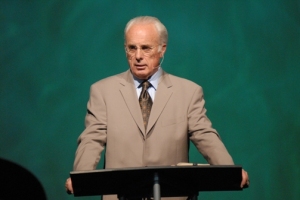
The Results Depend on God

john-macarthurTranscript excerpt from spoken at the Truth Matters Conference, 2011:

Some people say, “You know, we have to kind of change the message cause we’re not getting results. We’ve got to deal with this message because it’s not very effective.” Really? Well the next point I want to give you is this. If you really understand the glory of the gospel, you know the results depend on God. Okay? The results depend on God.

Remember the parable of the sower? What does it say about the sower? Nothing, absolutely nothing, it doesn’t say whether he uses his left hand, right hand, throw high, low, curve ball. It didn’t say anything about the sower.

What does it say about the bag he carried the seed in? Nothing, didn’t say anything about that.

What does it say about the method he used to throw it? Nothing, absolutely nothing. It’s a parable about soil, it doesn’t even say anything about the seed other than the seed is the truth, the gospel. It’s not about your technique in throwing the seed, it’s about the state of the soil. I don’t do soil work. That’s Holy Spirit work.

I love that passage in Mark, the parable where Jesus says the farmer sows the seed and goes to sleep because he has no idea how it grows. That’s right. You say, “We not getting the results.” Really, you think you’re in charge of results? I hear there’s some discussions, “We have to overcome consumer resistance.” Lots of luck. Consumer resistance is called depravity. Consumer resistance means the sinner is unable and unwilling, left to himself.

Look at (2 Cor 4) verse 3, this is so… this is so reasonable, this whole presentation of Paul makes so much sense, it just flows the way you think. Some of you are already saying, “Well, it gets discouraging. Paul, look, you’re going from town-to-town-to town, the churches are small, the churches are full of trouble. The town rejects you. The leaders reject you. The populace rejects you. They want to kill you. The Jews are after you. You’re really not having much success.

Here’s his answer. “Our gospel is veiled, it is veiled to those that are perishing.” That’s a category of people. That’s the default position of the entire human race. I’m not the problem.

Well how did they get like that? Verse 4, “The god of this world has blinded the minds of the unbelieving so that they might not see the light of the gospel of the glory of Christ who is the image of God.”

The problem is not your technique, the problem is the heart. You have all these people coming up with pragmatical ways to do effective evangelism. Really? It’s overcome consumer resistance to make the message more palatable. We’ll say more about that in some of the other portions of Scripture. You put yourself in the position of…I wrote a book Slave, some of you seen the book Slave? Imagine trying to sell that message in a world full of slaves. By the way, a crucified Jew in Jerusalem who was rejected by His people, rejected by His leaders, who was executed as a common criminal by the Romans rose from the dead, He’s the true and living God, the only Savior and He wants you to be His slave. Oh really? And by the way, you have to reject all other masters, confess your sin, repent and turn to Him as the only source of salvation.

Who is this again? A crucified Jew? This is what Paul is preaching in the Gentile world. And you need not only to put your faith in Him, but you need to confess Him as Lord and you’re His slave.

That’s a hard sell. You can’t overcome consumer’s resistance in a pagan/Gentile world when you’re talking about a crucified Jew to Gentiles who have no Old Testament background, who have no understanding of the sacrificial system, and you’re asking them to believe that this crucified Jew is God incarnate, the only Savior, the only true and living God, the only hope of salvation and you’re supposed to become His slave. That won’t fly, humanly speaking. That’s why it says in 1 Corinthians 1, as we will see later, preaching the cross was…what?…foolishness.

The results depend on God. That’s been the joy of ministry. I’m in charge of sowing, I’m not in charge of growing. I can’t give life. God alone gives life. And I love this, watch this, verse 5, “We do not preach ourselves.” Some method that we’ve concocted, some personal stories about us. “But Christ Jesus as Lord,” and we’re calling everybody to become slaves for Jesus’ sake.

You say, “Well how in the world do you expect to have any results at all with a message like that?”

Here’s the answer, verse 6, “Oh, for God who said light shall shine out of darkness who is the one who has shone in our hearts to give the light of the knowledge of the glory of God in the face of Christ.”

Is that not the most profound verse? You know what he’s saying? He’s saying creation, God said, “Let there be light.” And He spoke it into existence. That’s the model for salvation. God steps into the darkness of the sinner’s heart and turns on the light of the knowledge of the glory of God in the face of Christ.

This is what makes ministry so thrilling. If you get all wrapped up in results, you’re going to wind up preaching yourself and your technique and your style. You’re going to get caught up in your wardrobe and your shtick and your music and your cultural adaptations.

Well, if you understand the glory of the gospel, you also understand your personal insignificance. So what have we been saying? If you understand the glory of the gospel? Just review; you understand the superiority of the New Covenant, the mercy of ministry, the necessity of a pure heart, the fact that the Scripture is to be preached accurately, that spiritual results depends solely on God. And that you are personally insignificant… insignificant.

The Central Act of our Worship Service

al mohlerIn an article entitled, “Expository Preaching—The Antidote to Anemic Worship,” Dr. Al Mohler writes:

Evangelical Christians have been especially attentive to worship in recent years, sparking a renaissance of thought and conversation on what worship really is and how it should be done. Even if this renewed interest has unfortunately resulted in what some have called the “worship wars” in some churches, it seems that what A. W. Tozer once called the “missing jewel” of evangelical worship is being recovered.

Nevertheless, if most evangelicals would quickly agree that worship is central to the life of the church, there would be no consensus to an unavoidable question: What is central to Christian worship? Historically, the more liturgical churches have argued that the sacraments form the heart of Christian worship. These churches argue that the elements of the Lord’s Supper and the water of baptism most powerfully present the gospel. Among evangelicals, some call for evangelism as the heart of worship, planning every facet of the service—songs, prayers, the sermon—with the evangelistic invitation in mind. Continue reading

The Numbers Game

j-i-packer“I have found that churches, pastors, seminaries, and parachurch agencies throughout North America are mostly playing the numbers game—that is, defining success in terms of numbers of heads counted or added to those that were there before. Church-growth theorists, evangelists, pastors, missionaries, news reporters, and others all speak as if

(1) numerical increase is what matters most;

(2) numerical increase will surely come if our techniques and procedures are right;

(3) numerical increase validates ministries as nothing else does;

(4) numerical increase must be everyone’s main goal.

I detect four unhappy consequences of this.

First, big and growing churches are viewed as far more significant than others.

Second, parachurch specialists who pull in large numbers are venerated, while hard-working pastors are treated as near-nonentities.

Third, lively laymen and clergy too are constantly being creamed off from the churches to run parachurch ministries, in which, just because they specialize on a relatively narrow front, quicker and more striking results can be expected.

Fourth, many ministers of not-so-bouncy temperament and not-so-flashy gifts return to secular employment in disillusionment and bitterness, concluding that the pastoral life of steady service is a game not worth playing.

In all of this I seem to see a great deal of unmortified pride, either massaged, indulged, and gratified, or wounded, nursed, and mollycoddled. Where quantifiable success is god, pride always grows strong and spreads through the soul as cancer sometimes gallops through the body.

Shrinking spiritual stature and growing moral weakness thence result, and in pastoral leaders, especially those who have become sure they are succeeding, the various forms of abuse and exploitation that follow can be horrific.

Orienting all Christian action to visible success as its goal, a move which to many moderns seems supremely sensible and businesslike, is thus more a weakness in the church than its strength; it is a seedbed both of unspiritual vainglory for the self-rated succeeders and of unspiritual despair for the self-rated failures, and a source of shallowness and superficiality all round.

The way of health and humility is for us to admit to ourselves that in the final analysis we do not and cannot know the measure of our success the way God sees it. Wisdom says: leave success ratings to God, and live your Christianity as a religion of faithfulness rather than an idolatry of achievement.”

– J. I. Packer, A Passion for Faithfulness: Wisdom from the Book of Nehemiah (Wheaton: Crossway, 1995), 207-209.