
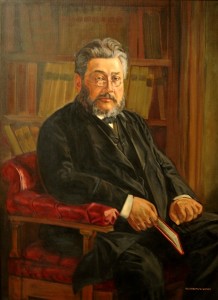
 Charles Spurgeon preaching on 1 John 5:1 makes the point that men believe, not of their own power, but as a result of the work of regeneration in the hearts of men:
We must now pass on to show that wherever it exists it is the proof of regeneration. There never was a grain of such faith as this in the world, except in a regenerate soul, and there never will be while the world standeth. It is so according to the text, and if we had no other testimony this one passage would be quite enough to prove it. “Whosoever believeth that Jesus is the Christ is born of God.”
“Ah!” I hear thee say, poor soul, “the new birth is a great mystery; I do not understand it; I am afraid I am not a partaker in it.”
You are born again if you believe that Jesus is the Christ, if you are relying upon a crucified Saviour you are assuredly begotten again unto a lively hope. Mystery or no mystery, the new birth is yours if you are a believer. Have you never noticed that the greatest mysteries in the world reveal themselves by the simplest indications.
The simplicity and apparent easiness of faith is no reason why I should not regard its existence as an infallible indication of the new birth within. How know we that the new-born child lives except by its cry? Yet a child’s cry—what a simple sound it is! how readily could it be imitated! a clever workman could with pipes and strings easily deceive us; yet was there never a child’s cry in the world but what it indicated the mysteries of breathing, heart-beating, blood-flowing, and all the other wonders which come with life itself.
Do you see yonder person just drawn out of the river? Does she live? Yes, life is there.
Why?
Because the lungs still heave.
But does it not seem an easy thing to make lungs heave? A pair of billows blown into them, might not that produce the motion?
Ah, yes, the thing is easily imitated after a sort; but no lungs heave except where life is. Take another illustration.
Go into a telegraph office at any time, and you will see certain needles moving right and left with unceasing click. Electricity is a great mystery, and you cannot see or feel it; but the operator tells you that the electric current is moving along the wire.
How does he know?
“I know it by the needle.”
How is that?
I could move your needles easily.
“Yes; but do not you see the needle has made two motions to the right, one to the left, and two to the right again? I am reading a message.”
“But,” say you, “I can see nothing in it; I could imitate the clicking and moving very easily.”
Yet he who is taught the art sees before him in those needles, not only electric action, but a deeper mystery still; he perceives that a mind is directing an invisible force, and speaking by means of it.
Not to all, but to the initiated is it given to see the mystery hidden within the simplicity. The believer sees in the faith, which is simple as the movements of the needle, an indication that God is operating on the human mind, and the spiritual man discerns that there is an inner secret intimated thereby, which the carnal eye cannot decipher.
To believe in Jesus is a better indicator of regeneration than anything else, and in no case did it ever mislead. Faith in the living God and his Son Jesus Christ is always the result of the new birth, and can never exist except in the regenerate. Whoever has faith is a saved man.
HT: Mike Porter
 “One person who might think poorly of her witness is a woman whose words were instrumental in my own salvation. I do not know her name and doubt I could recognize her. One day, as I moved into an apartment, she was moving out next door. I carried one box of books to her car. After thanking me, she asked whether I was looking for a church to attend. My body language made it clear that I did not appreciate the question. So she quickly stammered, “If you are ever looking for a church, I would recommend this particular church a few blocks away.” With that, she drove off and I never saw her again. I have often imagined her kicking herself for her weak attempt to witness. But a few months later, when the Holy Spirit had prepared a way for the Lord into my heart, I remembered her words, went to that church, and hearing the gospel there, I believed and was saved.”
 In an article entitled “Old Testament Law and The Charge of Inconsistency,” Dr. Tim Keller, pastor of Redeemer Presbyterean Church in New York writes: