 Mike Riccardi is the Pastor of Local Outreach Ministries at Grace Community Church in Los Angeles. He also teaches Evangelism at The Master’s Seminary. He God’s presence was mediated through fire (Exod 3:6; Deut 5:4, through blazing light (Exod 33:18–23), through visions (Ezek 1:28) and angels (Jdg 6:21–22; cf. 13:21–22), through the temple worship (Pss 27:4; 63:1–2), and even through God’s own Word (1 Sam 3:21). But with the coming of Jesus and the New Covenant era, the glory of God’s presence is now uniquely and supremely manifested “in the face of Christ” (2 Cor 4:6). This makes sense, of course, because Christ is the perfect “image of God” (2 Cor 4:4).
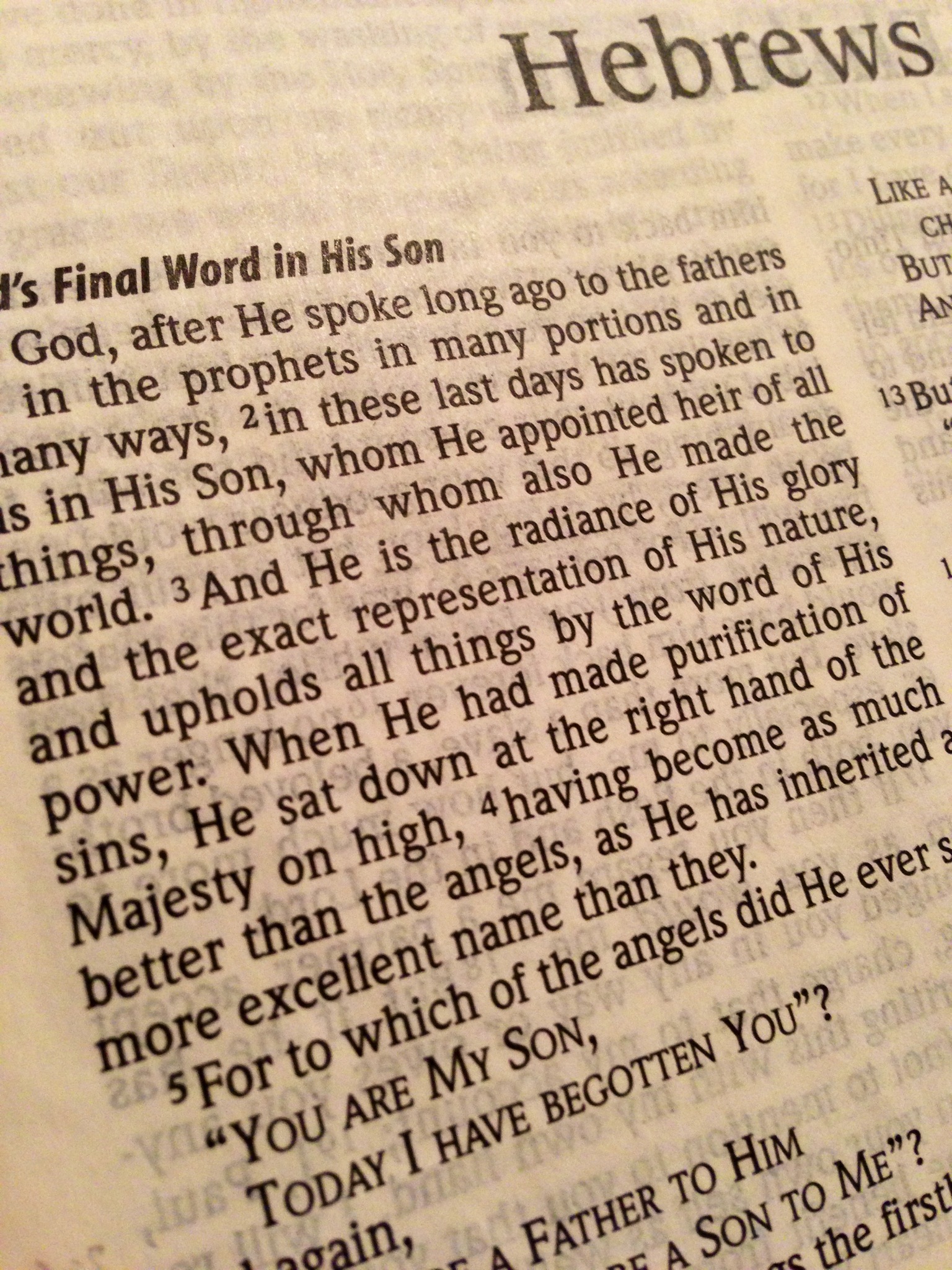
This is precisely the testimony of the opening verses of the Book of Hebrews. Though God had revealed Himself by speaking to the fathers in the prophets in many portions and in many ways, in these last days He has spoken finally and decisively in His Son (Heb 1:1). Christ is therefore the radiance of the Father’s glory (1:3)—the manifestation of the very presence of God, the “effulgence of the divine glory,” as one commentator colorfully puts it.
The Son is also described as the exact representation of the Father’s nature (1:3). The word for “nature” there is hupostasis, which the lexicons tell us speaks of the “essential or basic structure/nature of an entity” and thus refers to the Father’s “substantial nature, essence [and] actual being.” And the phrase “exact representation” is a translation of the Greek term charakt?r, which denotes “a stamp or impress, as on a coin or a seal, in which case the seal or die which makes an impression bears the image produced by it, and . . . all the features of the image correspond respectively with those of the instrument producing it” (Vine’s Expository Dictionary, 577).
Just as the shape, impressions, and intricacies of a coin reveal precisely the nature of the original die, so does the Son reveal the very essence of God Himself. Anthony Hoekema’s conclusion is inescapable: “It is hard to imagine a stronger figure to convey the thought that Christ is the perfect reproduction of the Father. Every trait, every characteristic, every quality found in the Father is also found in the Son, who is the Father’s exact representation.”
This teaching is borne consistent witness throughout the NT. Though no one has seen the Father at any time, Christ the only begotten God in the bosom of the Father has explained Him (John 1:18). Literally, the Son has exegeted the Father, making known to finite humanity in His own person what was otherwise imperceptible. The glory that humanity beholds in Christ is the “glory of the only begotten from the Father” (John 1:14). Paul tells us that Christ is “the image of the invisible God” (Col 1:15), such that, “though God is invisible, in Christ the invisible becomes visible; one who looks at Christ is actually looking at God” (Hoekema, 21). So full is the Father’s revelation of Himself in the Son that Jesus can say to Philip, “He who has seen Me has seen the Father” (John 14:9), for in Him “all the fullness of Deity dwells in bodily form” (Col 2:9). Continue reading