
Atheism – a frivolous exercise in intellectual contempt

HT: Coggin Baptist Church

Ravi Zacharias, regarding the atheistic worldview:

In the field of science when it comes to answering the question of God’s existence—

THERE IS BY NO MEANS A CONSENSUS.

Think about it. If science has definitively disproven the existence of God and the scriptures, then doesn’t it necessarily follow that all reputable scientists be Atheist, or at the very least Agnostic*?

John Polkinghorne is one of the worlds leading quantum physicists and he came to the exact opposite conclusion (as the young man questioning) with the exact same data while being the Dean at Cambridge. The “scientific position” is often portrayed as a united front—An army of the enlightened, ready to pound theism into dust. Do not be deceived. Their unity is a mirage.

David Berlinski, a leading philosopher who has also worked in mathematics and physics, claims to be Agnostic, and borders on Atheism. This excerpt is from His book entitled The Devil’s Delusion (which was written in response to Richard Dawkins’ The God Delusion), and while he is a scientist, his view on what science, atheism, and naturalism* has offered humanity is stunning.

“Has anyone provided a proof of God’s inexistence? Not even close.

Has quantum cosmology* explained the emergence of the universe or why it is here? Not even close.

Have the sciences explained why our universe seems to be fine-tuned to allow for the existence of life? Not even close.

Are physicists and biologists willing to believe in anything so long as it is not religious thought? Close enough.

Has rationalism* in moral thought provided us with an understanding of what is good, what is right, and what is moral? Not close enough.

Has secularism* in the terrible twentieth century been a force for good? Not even close to being close.

Is there a narrow and oppressive orthodoxy of thought and opinion within the sciences? Close enough.

Does anything in the sciences or in their philosophy justify the claim that religious belief is irrational?
Not even ballpark.

Is scientific atheism a frivolous exercise in intellectual contempt? Dead on.”

———————————————————————

* Atheism – system of belief that asserts there is no god. Affirms the only form of existence is the material universe.

* Agnostic – sees any discussion regarding the existence of god as irrelevant because God cannot be proven or disproven. They are neither for, nor against a deity.

* Naturalism – form of atheism that teaches the natural universe is the sum total of reality, which negates human freedom, absolute values, and why we exist.

*Quantum Cosmology – field that attempts to study how the universe came to be.

* Secularism – belief system that denies the existence of God, religion, and supernatural order by maintaining that reality only entails the material world.
Who did it? God or Satan?

firm in your faith, knowing that the same kinds of suffering are being experienced by your brotherhood throughout the world. And after you have suffered a little while, the God of all grace, who has called you to his eternal glory in Christ, will himself restore, confirm, strengthen, and establish you. To him be the dominion forever and ever. Amen” (1 Peter 5:8-11).

This brings us face to face with a real spiritual and theological problem. On several occasions in 1 Peter we are told that it is God who orchestrates our suffering as a way of refining and purifying our faith. See, for example, 1 Peter 1:6-7; 2:21; 3:14,17; 4:12-19 (esp. v. 19!).

So who is responsible for the suffering Christians endure: Satan or God? Yes! The answer is: Both!

Although Satan and God work at cross purposes, they can both desire the same event to occur while hoping to accomplish through it antithetical results. Satan wanted to see Jesus crucified, as did God the Father (Isa. 53:10; Acts 2:23; 4:27-28), but for a different reason. The same is true in the case of Job. What Satan had hoped would destroy Job (or at least provoke him to blasphemy), God used to strengthen him. Continue reading

Isn’t Marriage “Just a Piece of Paper”?

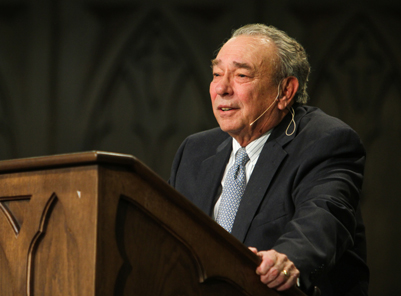
Sproul_28Dr. R. C. Sproul the option of living together, rather than moving into a formal marriage contract, has proliferated in our culture. Christians must be careful not to establish their precepts of marriage (or any other ethical dimension of life) on the basis of contemporary community standards. The Christian’s conscience is to be governed not merely by what is socially acceptable or even by what is legal according to the law of the land, but rather by what God sanctions.

Unfortunately, some Christians have rejected the legal and formal aspects of marriage, arguing that marriage is a matter of private and individual commitment between two people and has no legal or formal requirements. These view marriage as a matter of individual private decision apart from external ceremony. The question most frequently asked of clergymen on this matter reflects the so-called freedom in Christ: “Why do we have to sign a piece of paper to make it legal?”

The signing of a piece of paper is not a matter of affixing one’s signature in ink to a meaningless document. The signing of a marriage certificate is an integral part of what the Bible calls a covenant. A covenant is made publicly before witnesses and with formal legal commitments that are taken seriously by the community. The protection of both partners is at stake; there is legal recourse should one of the partners act in a way that is destructive to the other.

Contracts are signed out of the necessity spawned by the presence of sin in our fallen nature. Because we have an enormous capacity to wound each other, sanctions have to be imposed by legal contracts. Contracts not only restrain sin, but also protect the innocent in the case of legal and moral violation. With every commitment I make to another human being, there is a sense in which a part of me becomes vulnerable, exposed to the response of the other person. No human enterprise renders a person more vulnerable to hurt than does the estate of marriage.

God ordained certain rules regulating marriage in order to protect people. His law was born of love, concern, and compassion for His fallen creatures. The sanctions God imposed on sexual activity outside marriage do not mean that God is a spoilsport or a prude. Sex is an enjoyment He Himself created and gave to the human race. God, in His infinite wisdom, understands that there is no time that human beings are more vulnerable than when they are engaged in this most intimate activity. Thus, He cloaks this special act of intimacy with certain safeguards. He is saying to both the man and the woman that it is safe to give oneself to the other only when there is a certain knowledge of a lifelong commitment behind it. There is a vast difference between a commitment sealed with a formal document and declared in the presence of witnesses, including family, friends, and authorities of church and state, and a whispered, hollow promise breathed in the back seat of a car.

This excerpt is from R.C. Sproul’s Crucial Questions booklet Can I Know God’s Will?