
The God of the Old Testament

have wrestled to reconcile God’s holy justice with the seeming brutality of God’s judgments, especially in the Old Testament.

Before facing the difficulties head on and “staring the Old Testament God in the face,” Sproul rapidly dispatches some of the common yet unacceptable solutions to this problem. Then, instead of choosing some of the easier passages to explain and defend, Sproul takes head-on the most difficult and offensive passages in the Bible:

* The judgment of Nadab and Abihu for offering an unauthorized sacrifice (Lev. 10:1-3).
* The judgment on Uzzah for touching the ark (1 Chron. 13:7-11).
* Capital punishment for multiple crimes.
* The command given to Israel to slaughter thousands of Canaanites.
* The killing of Christ on the cross.

This chapter on God’s holy justice is the most outstanding chapter in an outstanding book, and, I believe, one of the greatest chapters Sproul has ever written. Although he deals with each of the above passages in turn, here’s my attempt to gather together and summarize the common threads in each section:

God’s judgments were pre-announced
In the cases of Nadab, Abihu, and Uzzah, God cannot be accused of unexpected, whimsical, or arbitrary judgment. Rather, God gave clear instructions and unmistakeable prohibitions and, in the case of Uzzah at least, clear and unmistakeable sanctions for disobedience (Ex. 30:9-10; Num. 4:15-20). These were not innocent men and these were not sins of ignorance.

God’s judgments are holy
As God’s justice is according to His holy character, His justice is never divorced from His righteousness. He never condemns the innocent, clears the guilty, or punishes with undue severity.

God’s judgments are delayed
Although the New Testament seems to reduce the number of capital offenses, even the Old Testament represents a massive reduction in capital crimes from original list – instant death for each and every sin.

The OT, therefore, is a record of the grace of God, because every sin is a capital offense and deserving of death. The issue is not why does God punish sin but why does He permit ongoing human rebellion and ongoing human existence. The OT is a record of a God who is patient in the extreme with a rebellious people, delaying the full measure of justice so that grace would have time to work.

God’s judgments are against sin
We don’t understand God’s judgments because we don’t understand sin. Sin is cosmic treason – treason against a perfectly pure sovereign. It misrepresents God whose image we are called to bear, and it violates others – injuring, despoiling, and robbing them. In commanding the Israelites to slaughter the Canaanites, God was not giving injustice to Canaan and justice to Israel; He gave justice to Canaan and mercy to Israel. The Canaanites were not innocent, but a treasonous people who daily insulted God’s holiness (Deut. 9:4-6).

God’s judgments were approved by Jesus
Christ called the Old Testament God, “Father.” It was the Old Testament God who sent His son to save the world, and the Old Testament God’s will that Jesus came to do. It was zeal for the Old Testament God who slew Nadab and Abihu that consumed Christ (John 2:17).

God’s greatest judgment was experienced by Jesus
The most powerful act of divine vengeance in the Bible, and the most violent expression of God’s wrath and justice, is seen at the cross. If we have cause for moral outrage, let it be focused on the cross. Yet, the cross was the most beautiful and the most horrible example of God’s wrath. It was the most just and the most gracious act in history.

God’s judgments destroy entitlement
Since we tend to take grace for granted, God reminded Israel through His judgments that grace must never be assumed. God’s judgments challenge our secret sense of entitlement, and changes the question from “Why doesn’t God save everybody?” to “Why did God save me?” But if we insist on insisting on what we deserve, we will get justice, not mercy.
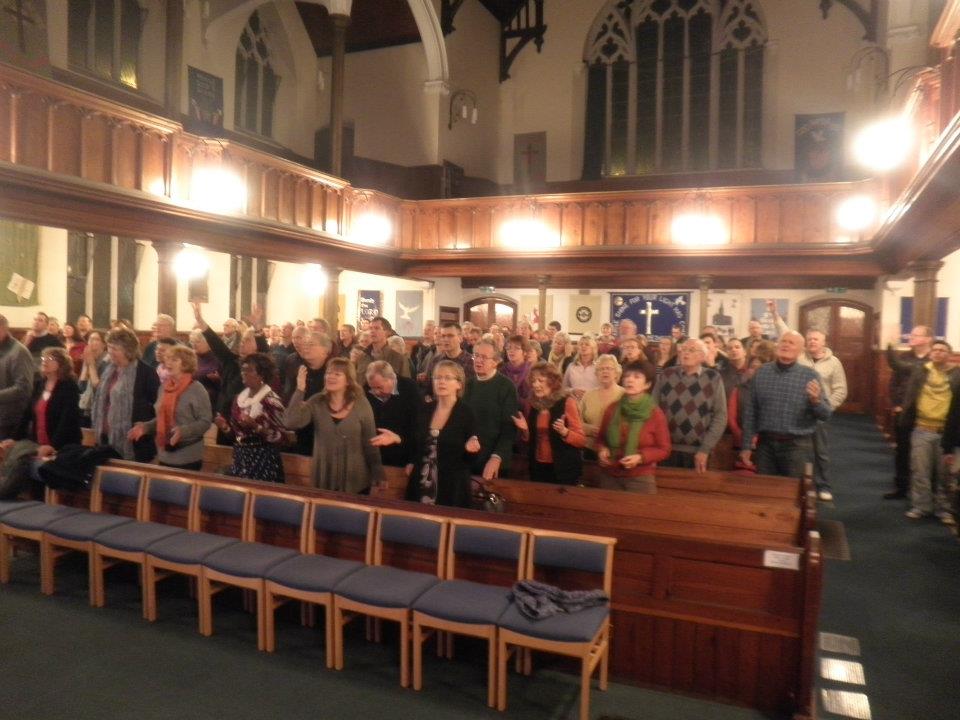
Anglicanism – Then and Now

church08Michael P. Jensen is the author of Sydney Anglicanism: An Apology and (with Tom Frame) Defining Convictions and Decisive Commitments–The Thirty-Nine Articles in Contemporary Anglicanism. He is the rector of St Mark’s Anglican Church, in Sydney, Australia.

In an article entitled “( Things you should really know about Anglicanism” he writes:

1. Since the arrival of Christianity in Britain in the 3rd century, British Christianity has had a distinct flavor and independence of spirit, and was frequently in tension with Roman Catholicism. The Britons were evangelized by Irish missionary monks, and it wasn’t until the 7th century that the Roman church established its authority over Christianity in the British Isles, at the Synod of Whitby. But tensions continued until the 16th century.

2. The break with Rome in the 16th century had political causes, but also saw the emergence of an evangelical theology. The Church of England was not just a church of protest against the pope’s authority and his interference in English affairs. It was also a church that adopted a distinctly evangelical theology. The English Reformation cannot be reduced to the marital strife of Henry VIII.

3. Anglicanism is Reformed. The theology of the founding documents of the Anglican church—the Book of Homilies, the Book of Common Prayer, and the Thirty-Nine Articles of Religion—expresses a theology in keeping with the Reformed theology of the Swiss and South German Reformation. It is neither Lutheran, nor simply Calvinist, though it resonates with many of Calvin’s thoughts.

4. Scripture is the supreme authority in Anglicanism. Article VI, “Of the sufficiency of the Holy Scriptures for Salvation,” puts it this way:

Holy Scriptures containeth all things necessary to salvation: so that whatsoever is not read therein, nor may be proved thereby, is not to be required of any man, that it should be believed as an article of the faith, or be thought requisite or necessary to salvation.

In Anglicanism, Scripture alone is supreme as the saving Word of God. Reason and tradition play an auxiliary role. This was the view of divines like Thomas Cranmer and Richard Hooker. There is a popular myth that Anglicanism views reason, tradition, and Scripture as a three-legged stool of authorities, but it is quite false.

5. Justification by faith alone is at the heart of Anglican soteriology. In its liturgy, its view of the sacraments, in its founding documents, and in the mind of Archbishop Thomas Cranmer, the Church of England holds that works do not save and cannot save a person. Only the blood of Jesus Christ is effective to save.

6. In Anglican thought, the sacraments are “effectual signs” received by faith. For Anglicans, the sacraments—the Lord’s Supper and baptism—do not convey grace in an automatic sense, or by a grace adhering to the objects used in them.

7. The Anglican liturgy—best encapsulated in the 1662 Book of Common Prayer—is designed to soak the congregation in the Scriptures, and to remind them of the priority of grace in the Christian life. There is grace on every page—it is not only the heart of Anglican theology, it is the heart of Anglican spirituality.

8. Anglicanism is a missionary faith, and has sponsored global missions since the 18th century. The sending and funding of missionaries to the far reaches of the globe to preach the gospel has been a constant feature of Anglican life, although this has happened through the various voluntary mission agencies as much as through official channels.

9. Global Anglicanism is more African and Asian than it is English and American. The center of contemporary Anglicanism is found in places like Nigeria, Uganda, and Kenya. In these places there are burgeoning Anglican churches, and a great deal of evangelism and church planting. There are strong Anglican churches too in Asia and elsewhere. Noticeably, where liberal theology has become dominant in Anglicanism—mainly in the “first world”—Anglicanism is rapidly shrinking, and is possibly only a generation from its demise.

Heresy and Heretics

the “Bible Answer Man, ” in his recent book Christianity in Crisis. Hanegraaff’s Charge resulted in a radical outburst of indignant cries directed not at Hinn but at Hanegraaff.

It seems that the only real and intolerable heresy today is the despicable act of calling someone a heretic. If the one accused is guilty of heresy, he or she will probably elicit more sympathy than his accuser. Anyone who cries “Heretic!” today risks being identified as a native of Salem, Massachusetts.

After Hanegraaff made his charge in print, a couple of things happened. One is that Hinn recanted his own teaching that there are nine persons in the Trinity and apologized to his hearers for that teaching. Such recantations are rare in church history, and it is gratifying that at least in this case on that point Hinn repented of his false teaching.

The second interesting footnote to the Hanegraaff-Hinn saga was the appearance of an editorial by the editor of a leading charismatic magazine in which Hanegraaff was castigated for calling Hinn a heretic. At the 1993 Christian Booksellers Association convention, I was present for and witness to a discussion between Hanegraaff and the magazine editor. I asked the editor a few questions. The first was, “Is there such a thing as heresy?” The editor acknowledged that there was. My second question was, “Is heresy a serious matter?” Again he agreed that it was. My next question was obvious. “Then why are you criticizing Hanegraaff for saying that Hinn was teaching heresy when even Hinn admits it now?”

The editor expressed concern about tolerance, charity, the unity of Christians, and matters of that sort. He expressed a concern about witch hunts in the evangelical church. My sentiments about that are clear. We don’t need to hunt witches in the evangelical world. There is no need to hunt what is not hiding. The “witches” are in plain view, every day on national television, teaching blatant heresy without fear of censure.

Consider the case of Jimmy Swaggart. For years Swaggart has publicly repudiated the orthodox doctrine of the Trinity. Swaggart was not challenged (to my knowledge) by his church for his heresy. He was censured for sexual immorality but not heresy. I guess this church regards romping with prostitutes in private a more serious offense than denying the Trinity before the watching world.

As I documented in The Agony of Deceit, Paul Crouch teaches heresy. So do Kenneth Copeland and Kenneth Hagin. These men seem to teach their heresies with impunity.

But what do we mean by heresy? Is every theological error a heresy? In a broad sense, every departure from biblical truth may be regarded as a heresy. But in the currency of Christian thought, the term heresy has usually been reserved for gross and heinous distortions of biblical truth, for errors so grave that they threaten either the essence (esse) of the Christian faith or the well-being (bene esse) of the Christian church.

Luther was excommunicated by Rome and declared a heretic for teaching justification by faith alone. Luther replied that the church had embraced a heretical view of salvation. The issue still burns as to who the heretic is.

In Luther’s response to Erasmus’ Diatribe, he acknowledged that many of the points at issue were trifles. They did not warrant rupturing the unity of the church. They could be “covered” by the love and forbearance that covers a multitude of sins. When it came to justification, however, Luther sang a different tune. He called justification the article upon which the church stands or falls, a doctrine so vital that it touches the very heart of the Gospel. A church that rejects justification by faith alone (and anathematizes it as a deadly heresy) is nolonger an orthodox church. Luther wasn’t shadow boxing on that issue; nor was the Reformation a mere misunderstanding between warring factions in the church. No teapot was big enough to contain the tempest it provoked.

In graduate school in Holland, it was the custom of my tutor, Professor G.C. Berkouwer, to lecture on one doctrine per year. In 1965 he departed from his normal policy and lectured on “The History of Heresy in the Christian Church.”

Berkouwer canvassed the most important struggles the church faced against heresy. It was Marcion’s heretical canon that made it necessary for the church to formalize the contents of the true canon of sacred Scripture. It was Arius’s adoptionism that necessitated the conciliar decrees of Nicaea. It was the heresies of Eutyches (monophysitism) and Nestorius that provoked the watershed ecumenical council of Chalcedon in 451. The heresies of Sabellius, Apollinarius, the Socinians, and others have driven the church through the ages to define the limits of orthodoxy.

One of the major points in Berkouwer’s study was the historical tendency for heresies to beget other heresies, particularly heresies in the opposite direction. For example, efforts to defend the true humanity of Jesus often led to the denial of His deity. Zeal to defend the deity of Christ often led to a denial of His humanity. Likewise the zeal for the unity of the Godhead and monotheism have led to the denial of the personal distinctions in the being of God, whereas zeal for personal distinctives have led to tritheism and a denial of the essential unity of God. Likewise, efforts to correct the heresy of legalism have produced the antinomian heresy and vice versa.

We live in a climate where heresy is embraced and proclaimed with the greatest of ease. I can’t think of any of these major heresies that I haven’t heard repeatedly and openly on national tv by so-called “evangelical preachers” such as Hinn, Crouch, and the like. Where our fathers saw these issues as matters of life and death, indeed of eternal life and death, we have so surrendered to relativism and pluralism that we simply don’t care about serious doctrinal error. We prefer peace to truth and accuse the orthodox of being divisive when they call a heretic a heretic. It is the heretic who divides the church and disrupts the unity of the body of Christ.