

Raised for our Justification

sproul-77In an article entitled “Resurrection and Justification” Dr. R. C. Sproul writes:

How is the resurrection of Christ linked to the idea of justification in the New Testament? To answer this question, we must first explore the use and meaning of the term justification in the New Testament. Confusion about this has provoked some of the fiercest controversies in the history of the church. The Protestant Reformation itself was fought over the issue of justification. In all its complications, the unreconciled and unreconcilable difference in the debate came down to the question of whether our justification before God is grounded in the infusion of Christ’s righteousness into us, by which we become inherently righteous, or in the imputation, or reckoning, of Christ’s righteousness to us while we are still sinners. The difference between these views makes all the difference in our understanding of the Gospel and of how we are saved.

One of the problems that led to confusion was the meaning of the word justification. Our English word justification is derived from the Latin justificare. The literal meaning of the Latin is “to make righteous.” The Latin fathers of church history worked with the Latin text instead of the Greek text and were clearly influenced by it. By contrast, the Greek word for justification, dikaiosune, carries the meaning of “to count, reckon, or declare righteous.”

But this variance between the Latin and the Greek is not enough to explain the debates over justification. Within the Greek text itself, there seem to be some problems. For example, Paul declares in Romans 3:28, “Therefore we conclude that a man is justified by faith apart from the deeds of the law.” Then James, in his epistle, writes, “Was not Abraham our father justified by works when he offered Isaac his son on the altar” (2:21) and “You see then that a man is justified by works, and not by faith only” (2:24).

On the surface, it appears that we have a clear contradiction between Paul and James. The problem is exacerbated when we realize that both use the same Greek word for justification and both use Abraham to prove their arguments.

This problem can be resolved when we see that the verb “to justify” and its noun form, “justification,” have shades of meaning in Greek. One of the meanings of the verb is “to vindicate” or “to demonstrate.”

Jesus once said, ” ‘Wisdom is justified by all her children’ ” (Luke 7:35). He did not mean that wisdom has its sins remitted or is counted righteous by God by having children, but that a wise decision may be vindicated by its consequences.

James and Paul were addressing different questions. James was answering the question: “What does it profit, my brethren, if someone says he has faith but does not have works? Can faith save him?” (2:14). He understood that anyone can profess to have faith, but true faith is demonstrated as authentic by its consequent works. The claim of faith is vindicated (justified) by works. Paul has Abraham justified in the theological sense in Genesis 15 before he does any works. James points to the vindication or demonstration of Abraham’s faith in obedience in Genesis 22.

The Resurrection involves justification in both senses of the Greek term. First, the Resurrection justifies Christ Himself. Of course, He is not justified in the sense of having His sins remitted, because He had no sins, or in the sense of being declared righteous while still a sinner, or in the Latin sense of being “made righteous.” Rather, the Resurrection serves as the vindication or demonstration of the truth of His claims about Himself.

In his encounter with the philosophers at Athens, Paul declared: ” ‘Truly, these times of ignorance God overlooked, but now commands all men everywhere to repent, because He has appointed a day on which He will judge the world in righteousness by the Man whom He has ordained. He has given assurance of this to all by raising Him from the dead’ ” (Acts 17:30-31).

Here Paul points to the Resurrection as an act by which the Father universally vindicates the authenticity of His Son. In this sense, Christ is justified before the whole world by His resurrection.

However, the New Testament also links Christ’s resurrection to our justification. Paul writes, “It shall be imputed to us who believe in Him who raised up Jesus our Lord from the dead, who was delivered up because of our offenses, and was raised because of our justification” (Rom. 4:24-25).

It is clear that in His atoning death Christ suffered on our behalf, or for us. Likewise, His resurrection is seen not only as a vindication of or surety of Himself, but as a surety of our justification. Here justification does not refer to our vindication, but to the evidence that the atonement He made was accepted by the Father. By vindicating Christ in His resurrection, the Father declared His acceptance of Jesus’ work on our behalf. Our justification in this theological sense rests on the imputed righteousness of Christ, so the reality of that transaction is linked to Christ’s resurrection. Had Christ not been raised, we would have a mediator whose redeeming work in our behalf was not acceptable to God.

However, Christ is risen indeed!

This post was originally published in Tabletalk magazine.
The “loss” of salvation and the blasphemy against the Holy Spirit

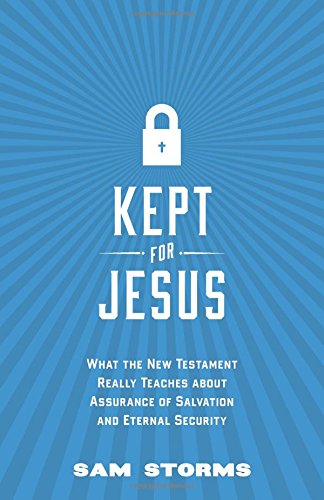
keptDr. Sam Storms has written a new book called “Kept for Jesus: What the New Testament Really Teaches about Assurance of Salvation and Eternal Security” (Crossway, 2015), where he looks at every passage in the New Testament that addresses assurance, security, and perseverance. I highly recommend it. He has also written a bonus chapter, available as a pdf here, where he answers a number of questions including these two:

1) “My son just turned thirty and told us today that he no longer believes in Jesus. He says he’s an atheist. What happened to him? Has he lost his salvation?”

We’ll call this young man Charley. Perhaps Charlene would be a more suitable name in your case. In any case, his (her?) life presents us with a painful and difficult dilemma.

Charley was born into a Christian family. His parents were devout followers of Jesus, and both of his siblings, an older brother and a younger sister, came to faith in Christ and have remained vibrant and deeply committed to him.

Charley was raised in the church and was usually present whenever the doors were open, whether at a Sunday service, a youth meeting, special events throughout the week, or a summer retreat. When he turned twelve, he professed faith in Jesus, largely through the influence of his parents and older brother. He was baptized soon thereafter and was discipled by his youth pastor over the course of the next few years. Charley’s faith appeared to be quite vibrant and joyful. He endured the same trials and temptations as do virtually all teenaged boys, but he never wandered far or failed to repent when he sinned. He prayed every day and read his Bible and was growing in his understanding of God.

Following graduation from high school, he went to college and fell in with a different group of friends. They challenged his faith and insisted that he was being naïve to believe in Jesus. It wasn’t long before Charley stopped attending church and eventually declared himself to be an atheist. He grew increasingly angry at the institutional church and nurtured a deep resentment toward those who had influenced him while he was growing up, having become convinced that they had hidden the truth from him and only wanted to control his life.

Charley is now thirty, twice divorced, an alcoholic, and painfully bitter and unpleasant to be around. He wants nothing ever again to do with Christianity.

So what’s up with Charley? What happened?

Some believe Charley was truly saved as a young boy but subsequently apostatized and in doing so lost or forfeited his salvation. Others also believe Charley was genuinely saved and always will be, but they believe that his reckless and unrepentant lifestyle will result in the loss of rewards in the age to come.

In ‘Kept for Jesus’ I argue for what is known as the Reformed or Calvinistic view. Those who embrace this perspective interpret Charley’s experience in one of two ways.

Some Reformed believers would argue that if Charley was truly saved at the age of twelve, he is still saved at the age of thirty and will, by God’s grace and the convicting work of the Holy Spirit, eventually come to his spiritual senses and return to the Lord. This may happen only after Charley endures severe discipline from his heavenly Father, but eventually God will bring him back. In some cases, people like Charley are disciplined straightway into heaven; that is to say, the discipline of the Lord results in their physical death. They die prematurely, under the discipline of God, but they are saved eternally.

Others who hold the Reformed view contend that the likely explanation for Charley’s departure from his professed faith in Christ is that he was never genuinely born again in the first place. His so-called faith was spurious. His life of apparent obedience was prompted by factors other than a genuine love for Jesus. He was self-deluded and deceived everyone who knew him. If he had been truly born again, he would have persevered in his faith.

2) “Is it possible that Charley was really born again and that he has blasphemed the Holy Spirit? Can a Christian commit blasphemy of the Spirit?”

This question is provoked by a well-known passage in Matthew’s Gospel in which Jesus responds to the religious leaders who had accused him of drawing on the power of Satan to heal a young boy. Jesus says:

Therefore I tell you, every sin and blasphemy will be forgiven people, but the blasphemy against the Spirit will not be forgiven. And whoever speaks a word against the Son of Man will be forgiven, but whoever speaks against the Holy Spirit will not be forgiven, either in this age or in the age to come. (Matt. 12:31–32)

For Jesus to declare that whoever blasphemes the Holy Spirit will never be forgiven, neither now nor in the age to come, comes as a jolt. This ominous declaration doesn’t occur in a vacuum. Something happened to provoke it. So let’s look at the context. Continue reading

It is finished!

John 19: 28 After this, knowing that all was now finished, said (to fulfill the Scripture), “I thirst.” 29 A jar full of sour wine stood there, so they put a sponge full of the sour wine on a hyssop branch and held it to his mouth. 30 When Jesus had received the sour wine, he said, “It is finished,” and he bowed his head and gave up his spirit.

Three words in English. One word in Greek: ?????????? (tetelestai).

What did Jesus mean when (on the cross) He declared, “It is finished!”? The answer is both multi-faceted and spectacular.