

Scripture’s Authority, Sufficiency and Finality

sinclairferIn an article entitled “The Authority, Finality of Scripture” originally published in The Banner of Truth magazine August-September 2014, Dr. Sinclair Ferguson writes:

If God has given us the Scriptures to be the canon or rule for our lives, it follows that we must regard them as the supreme authority for our lives. Paul tells us that they are ‘breathed out’ by God. There can be no more authoritative word than one that comes to us on divine breath.

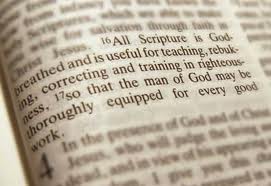
The Scriptures are also a sufficient authority for the whole of the Christian life. They are ‘profitable for teaching, for reproof, for correction, and for training in righteousness, that the man of God may be competent, equipped for every good work’ (2 Tim. 3:16).

The Scriptures do not tell us everything about everything. They provide no instruction about computer programming, or how best to organise a library, the correct way to swing a golf club, or how to play chess. They do not tell us how far away the sun is from the earth, what DNA is, how best to remove an appendix surgically, the best coffee to drink, or the name of the person we should marry.

That is not an expression of any deficiency on their part. For there is a focus and a goal to the sufficiency of the Scriptures. Everything I need to learn in order to live to the glory of God and enjoy him forever I will find in the application of Scripture.

Yet this narrow focus broadens out into everything. For one thing, Scripture teaches us something about everything. Since the Bible gives us grounds for believing we live in a universe, Christians understand that everything has the characteristic of createdness, of derivativeness, and also that everything fits into the grand design of God.

So Scripture is sufficient to give me a rational ground for thinking about anything and everything on the assumption that this world and everything in it make sense. Further, no matter what my calling or abilities, the Scriptures are sufficient to teach me principles that will enable me to think and act in a God-honouring way when I am engaged in any activity or vocation.

Inerrancy

In this context it is appropriate for us to ask an important and much debated question: If Scripture is our final authority, exactly how reliable is it as the authority on which we should base the whole of our lives?

If, convinced that the Bible is the word of God, we ask that question from a theological point of view there seems to be only one reasonable answer: Scripture is completely reliable. For the God who has ‘breathed out’ Scripture is trustworthy in everything he does and says. He is the God who cannot lie (Titus 1:2; Heb. 6:18; cf. Num. 23:19); he speaks the truth in everything he says (Prov. 30:5). The notion that he would be untruthful and err is contradictory to everything Scripture tells us about him.

However, Scripture also tells us that the word of God comes through the minds and mouths of men. Does this not mean that it will inevitably contain some mistakes? After all, ‘To err is human.’ If so, to use an old illustration, is it not more appropriate to think of the Bible as though it were a slightly scratched gramophone record? Or, in more contemporary terms, is the Bible not like a digitized version of an old recording— despite deficiencies, the music can still be heard, and if we listen with care we can make out the words quite well.

But two obvious considerations need to be remembered.

First, strictly speaking, ‘to err’ is not so much human as it is fallen. Second, not everything said by humans involves error. Life revolves round the fact that people speak the truth, that what they say is not riddled with mistakes. A person can go through the whole day without making a single erroneous statement. And societies function well only where a premium is placed on truth telling. Much of what we say and write is, in a fairly obvious sense, error free.

It is surely then within the power of God to preserve the authors of Scripture from error.

So the assumption that the Scriptures inevitably contain errors because written by men is false.

But there is a further consideration, in addition to that of the logic of our theology. The books of Scripture specifically affirm the truthfulness of what is written; those who appear in their narratives share that perspective. Jesus himself spoke of God’s word as ‘truth’. Almost in passing he stated that ‘Scripture cannot be broken’ (John 10:35)—and it is often in such passing comments that our real convictions come to the surface. Continue reading
Limited Inerrancy?

NJ: P & R Publishing, 2013, pages 31-37.

Is Sola Scriptura compatible with a view of Scripture that limits inerrancy to matters of faith and practice? Theoretically it would seem to be possible if “faith and practice” could be separated from any part of Scripture. So long as biblical teaching regarding faith and practice were held to be normative for the Christian community, there would appear to be no threat to the essence of Christianity. However, certain problems exist with such a view of Scripture that do seriously threaten the essence of Christianity.

The first major problem we encounter with limited inerrancy is the problem of canon reduction. The canon or “norm” of Scripture is reduced de facto to that content relating to faith and practice. This immediately raises the hermeneutical question concerning what parts of Scripture deal with faith. As evangelicals wrestle among themselves in intramural debates, they must keep one eye focused on the liberal world of biblical scholarship, for the principle of the reduction of canon to matters of “faith” is precisely the chief operative in Rudolf Bultmann’s hermeneutic. Bultmann thinks we must clear away the prescientific and faulty historical “husk” of Scripture to get to the viable kernel of “faith.” Thus, although Bultmann has no inerrant kernel or kerygma to fall back on, his problem of canon reduction remains substantially the same as that of those who limit inerrancy to faith and practice.

Before someone cries foul or cites the informal fallacy of argumentum ad hominem (abusive) or the “guilt by association” fallacy, let this concern be clarified. I am not saying that advocates of limited inerrancy are cryptic or even incipient Bultmannians, but that there is one very significant point of similarity between the two schools: canon reductionism. Evangelical advocates of limited inerrancy are not expected to embrace Bultmann’s mythical view of New Testament supernaturalism. But their method has no inherent safeguard from an arbitrary delimitation of the scope of the biblical canon.

The second serious problem, closely related to the first, is the problem of the relationship of faith and history, perhaps the most serious question of contemporary New Testament scholarship. If we limit the notion of inerrancy to matters of faith and practice, what becomes of biblical history? Is the historical substratum of the gospel negotiable? Are only those portions of the biblical narrative that have a clear bearing on faith inerrant? How do we escape de-historicizing the gospel and relegating it to a level of supratemporal existential “decision?” We know that the Bible is not an ordinary history book but a book of redemptive history. But is it not also a book of redemptive history? If we exclude the realm of history from the category of inspiration or inerrancy either in whole or in part, do we not inevitably lose the gospel? Continue reading

Can We Trust the New Testament Text?

Bible18Matt Waymeyer teaches New Testament and Bible exposition at The Master’s Seminary. After graduating from The Master’s Seminary (M.Div, he served as a senior pastor before returning to teach full time. Matt is the author of Revelation 20 and the Millennial Debate and A Biblical Critique of Infant Baptism, and is currently pursuing his Th.D. in systematic theology. In an article entitled “Can we trust the New Testament text?” he writes:

Several years ago I was walking in a park and met a man who identified himself as a pantheist. As I shared the Gospel with him, he raised a series of objections to the Christian faith, the first of which concerned the reliability of Scripture. “The Bible was going along fine,” he explained, “until King James came along and changed it all, and now we have no idea what the original actually said!”

The man’s objection was obviously more than a little misinformed, but it does raise a legitimate question: If the original manuscripts of the Bible no longer exist—and if the existing manuscripts do not completely agree with one another—how can we have confidence in the Scriptures we possess today? Can we really trust the Bible as it has been handed down to us? Can we really insist that it is nothing less than the inerrant Word of God?

In response to this question, I would like to focus specifically on the New Testament and suggest three reasons why the differences between the manuscripts should not shake our confidence in the reliability of the biblical text. Those three reasons are the abundance of existing manuscripts, the insignificance of most textual variants, and the preservation of primary biblical doctrines.

The Abundance of Existing Manuscripts

The New Testament is by far the most remarkably preserved text of the ancient world, both in terms of the number of existing manuscripts as well as the temporal proximity between the earliest manuscripts and the original they represent. We currently possess more than 5,500 Greek manuscripts containing part or all of the New Testament, as well as more than 20,000 ancient translations of the New Testament into other languages, all abundant numbers in comparison with other literature of the ancient world. In addition, we possess more than one million quotations of the New Testament in the writings of the early church fathers, covering almost the entirety of the New Testament. This unprecedented number of manuscripts, translations, and patristic citations greatly enhances our ability to identify the original reading where differences exist. Continue reading