
Limited Inerrancy?

NJ: P & R Publishing, 2013, pages 31-37.

Is Sola Scriptura compatible with a view of Scripture that limits inerrancy to matters of faith and practice? Theoretically it would seem to be possible if “faith and practice” could be separated from any part of Scripture. So long as biblical teaching regarding faith and practice were held to be normative for the Christian community, there would appear to be no threat to the essence of Christianity. However, certain problems exist with such a view of Scripture that do seriously threaten the essence of Christianity.

The first major problem we encounter with limited inerrancy is the problem of canon reduction. The canon or “norm” of Scripture is reduced de facto to that content relating to faith and practice. This immediately raises the hermeneutical question concerning what parts of Scripture deal with faith. As evangelicals wrestle among themselves in intramural debates, they must keep one eye focused on the liberal world of biblical scholarship, for the principle of the reduction of canon to matters of “faith” is precisely the chief operative in Rudolf Bultmann’s hermeneutic. Bultmann thinks we must clear away the prescientific and faulty historical “husk” of Scripture to get to the viable kernel of “faith.” Thus, although Bultmann has no inerrant kernel or kerygma to fall back on, his problem of canon reduction remains substantially the same as that of those who limit inerrancy to faith and practice.

Before someone cries foul or cites the informal fallacy of argumentum ad hominem (abusive) or the “guilt by association” fallacy, let this concern be clarified. I am not saying that advocates of limited inerrancy are cryptic or even incipient Bultmannians, but that there is one very significant point of similarity between the two schools: canon reductionism. Evangelical advocates of limited inerrancy are not expected to embrace Bultmann’s mythical view of New Testament supernaturalism. But their method has no inherent safeguard from an arbitrary delimitation of the scope of the biblical canon.

The second serious problem, closely related to the first, is the problem of the relationship of faith and history, perhaps the most serious question of contemporary New Testament scholarship. If we limit the notion of inerrancy to matters of faith and practice, what becomes of biblical history? Is the historical substratum of the gospel negotiable? Are only those portions of the biblical narrative that have a clear bearing on faith inerrant? How do we escape de-historicizing the gospel and relegating it to a level of supratemporal existential “decision?” We know that the Bible is not an ordinary history book but a book of redemptive history. But is it not also a book of redemptive history? If we exclude the realm of history from the category of inspiration or inerrancy either in whole or in part, do we not inevitably lose the gospel? Continue reading
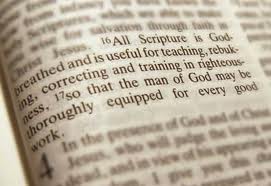

Can We Trust the New Testament Text?

Bible18Matt Waymeyer teaches New Testament and Bible exposition at The Master’s Seminary. After graduating from The Master’s Seminary (M.Div, he served as a senior pastor before returning to teach full time. Matt is the author of Revelation 20 and the Millennial Debate and A Biblical Critique of Infant Baptism, and is currently pursuing his Th.D. in systematic theology. In an article entitled “Can we trust the New Testament text?” he writes:

Several years ago I was walking in a park and met a man who identified himself as a pantheist. As I shared the Gospel with him, he raised a series of objections to the Christian faith, the first of which concerned the reliability of Scripture. “The Bible was going along fine,” he explained, “until King James came along and changed it all, and now we have no idea what the original actually said!”

The man’s objection was obviously more than a little misinformed, but it does raise a legitimate question: If the original manuscripts of the Bible no longer exist—and if the existing manuscripts do not completely agree with one another—how can we have confidence in the Scriptures we possess today? Can we really trust the Bible as it has been handed down to us? Can we really insist that it is nothing less than the inerrant Word of God?

In response to this question, I would like to focus specifically on the New Testament and suggest three reasons why the differences between the manuscripts should not shake our confidence in the reliability of the biblical text. Those three reasons are the abundance of existing manuscripts, the insignificance of most textual variants, and the preservation of primary biblical doctrines.

The Abundance of Existing Manuscripts

The New Testament is by far the most remarkably preserved text of the ancient world, both in terms of the number of existing manuscripts as well as the temporal proximity between the earliest manuscripts and the original they represent. We currently possess more than 5,500 Greek manuscripts containing part or all of the New Testament, as well as more than 20,000 ancient translations of the New Testament into other languages, all abundant numbers in comparison with other literature of the ancient world. In addition, we possess more than one million quotations of the New Testament in the writings of the early church fathers, covering almost the entirety of the New Testament. This unprecedented number of manuscripts, translations, and patristic citations greatly enhances our ability to identify the original reading where differences exist. Continue reading

Charismatics and the Word of Faith Movement

globe_azOn Saturday, March 28, I traveled to Globe, Arizona to attend the 2015 Bible Conference at Sovereign Grace Baptist Church. The theme was the truth about the Word of Faith Movement / Pentecostalism / Prophecy / Tongues, and Healing on demand. The Guest speakers were Phil Johnson and Justin Peters. It was a rich time together in the word of God and a real privilege to meet host Pastor John Skaggs and the kind people of Sovereign Grace Baptist Church. The teaching sessions were excellent. I recommend them highly:

Session 1: Phil Johnson: Why I am a Cessationist

Session 2: Phil Johnson: Beware the Greed Mongers: An expose of the Prosperity Doctrine

Session 3: Justin Peters: Clouds Without Water (1)

Session 4: Justin Peters: Clouds Without Water (2)

Session 5: Justin Peters: Clouds Without Water (3)

Session 6: Justin Peters: Clouds Without Water (4)