
Errors in the Bible?

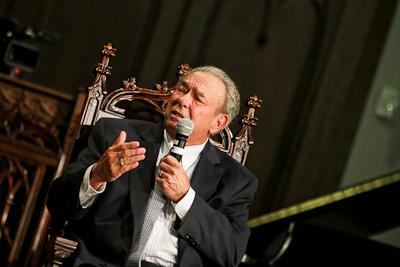
Sproul0003The following is a short excerpt, adapted from R.C. Sproul’s Foreword in The Inerrant Word by John MacArthur, ©2016. Original source here:

“The Bible is the Word of God, which errs.” From the advent of neoorthodox theology in the early twentieth century, this assertion has become a mantra among those who want to have a high view of Scripture while avoiding the academic liability of asserting biblical infallibility and inerrancy. But this statement represents the classic case of having one’s cake and eating it too. It is the quintessential oxymoron.

Let us look again at this untenable theological formula. If we eliminate the first part, “The Bible is,” we get “The Word of God, which errs.” If we parse it further and scratch out “the Word of” and “which,” we reach the bottom line:

“God errs.”

The idea that God errs in any way, in any place, or in any endeavor is repugnant to the mind as well as the soul. Here, biblical criticism reaches the nadir of biblical vandalism.

How could any sentient creature conceive of a formula that speaks of the Word of God as errant? It would seem obvious that if a book is the Word of God, it does not (indeed, cannot) err. If it errs, then it is not (indeed, cannot be) the Word of God.

To attribute to God any errancy or fallibility is dialectical theology with a vengeance.

Perhaps we can resolve the antinomy by saying that the Bible originates with God’s divine revelation, which carries the mark of his infallible truth, but this revelation is mediated through human authors, who, by virtue of their humanity, taint and corrupt that original revelation by their penchant for error. Errare humanum est (“To err is human”), cried Karl Barth, insisting that by denying error, one is left with a docetic Bible—a Bible that merely “seems” to be human, but is in reality only a product of a phantom humanity.

Who would argue against the human proclivity for error? Indeed, that proclivity is the reason for the biblical concepts of inspiration and divine superintendence of Scripture. Classic orthodox theology has always maintained that the Holy Spirit overcomes human error in producing the biblical text.

Barth said the Bible is the “Word” (verbum) of God, but not the “words” (verba) of God. With this act of theological gymnastics, he hoped to solve the unsolvable dilemma of calling the Bible the Word of God, which errs. If the Bible is errant, then it is a book of human reflection on divine revelation—just another human volume of theology. It may have deep theological insight, but it is not the Word of God.

Critics of inerrancy argue that the doctrine is an invention of seventeenth-century Protestant scholasticism, where reason trumped revelation—which would mean it was not the doctrine of the magisterial Reformers. For example, they note that Martin Luther never used the term inerrancy. That’s correct. What he said was that the Scriptures never err. Neither did John Calvin use the term. He said that the Bible should be received as if we heard its words audibly from the mouth of God. The Reformers, though, not using the term inerrancy, clearly articulated the concept.

Irenaeus lived long before the seventeenth century, as did Augustine, Paul the apostle, and Jesus. These all, among others, clearly taught the absolute truthfulness of Scripture.

The church’s defense of inerrancy rests upon the church’s confidence in the view of Scripture held and taught by Jesus himself. We wish to have a view of Scripture that is neither higher nor lower than his view.

The full trustworthiness of sacred Scripture must be defended in every generation, against every criticism. That is the genius of The Inerrant Word: Biblical, Historical, Theological, and Pastoral Perspectives. We need to listen closely to this recent defense.

Open Air Preachers

“Now, you men in the open-air are often bamboozled; the devil’s barristers are sure to come to you, he has a great number of them constantly retained in his service. The one thing you have to do is to bear witness to the truth. If you enquire in your own mind, ‘How shall I answer this man cleverly, so as to get a victory over him?’ you will not be wise. A witty answer is often a very proper thing; at the same time, a gracious answer is better. Try to say to yourself: ‘It does not, after all, matter whether that man proves me to be a fool or not, for I know that already I am content to be thought a fool for Christ’s sake, and not to care about my reputation. I have to bear witness to what I know, and by the help of God I will do so right boldly. If the interrupter questions me about other things, I shall tell him that I do not come to bear witness about other matters, but this one thing I do. To one point I will speak, and to no other.'”

– C. H. Spurgeon

Catechism

riddlebargerDr. Kim Riddlebarger is a graduate of California State University in Fullerton (B.A., Roman Catholicism: Evangelical Protestants Analyze What Unites & Divides Us, and Christ The Lord: The Reformation & Lordship Salvation, and is currently the pastor of Christ Reformed Church in Anaheim, California.

He writes:

The Importance and Practice of Catechism

“Fathers – Instruct Your Children

The Importance of Catechism

Growing up in American fundamentalism, as I did, the very word “catechism” brought to my mind images of the liberalism of mainline Protestant denominations, or some mysterious Roman Catholic ritual that could have no biblical support whatsoever. As a Bible church person, I was taught from my earliest youth that catechism was at best a worthless practice, if not downright dangerous to the soul. But if you were to have asked me just what exactly catechism was, I’m not sure that I could have given you an answer. Growing up with such misconceptions, I often viewed my friends who attended catechism classes as people who could not possibly be born again and therefore, in desperate need of evangelization. For unlike their misguided and dead church, our church had no creed but Christ, and we needed no such man-made guides to faith since we depended upon the Bible alone. Whatever catechism was, I wanted no part of it!

The burgeoning evangelical men’s movement, demonstrated by the huge amount of interest garnered by such groups as Promise Keepers, has raised a whole host of legitimate questions about the role of Christian men in society, the work-place and the home. This is certainly an important and indeed, a healthy trend. But I wonder if the answers to such questions are perhaps best found in the wisdom of earlier generations, rather than from among our own contemporaries. Many of these same questions have been asked before and the answers given to them by our predecessors and fathers in the faith were not only based upon a thorough knowledge of Scripture (which Gallup and Barna remind us is sadly lacking in our own age), but additionally, were forged through a kind of wisdom and life experience gained during an era in which Christians were less apt to simply react to the secular agenda and uncritically imitate its glitz, glamour and noise. Evangelical Protestants of previous generations, it seems, were often more careful about confusing the sacred and the secular than our own leaders, and they often dealt with such weighty issues theologically and historically. Inevitably, when we look to the theological wisdom of the previous generations regarding the role of men in society, the work-place and the home, we come back to the importance of the practice of catechism.

Catechism (from the Greek word catechesis) is simply instruction in the basic doctrines of the Christian faith. Instead of replacing or supplanting the role of the Bible in Christian education, catechism ideally serves as the basis for it. For the practice of catechism, as properly understood, is the Christian equivalent of looking at the box top of a jig-saw puzzle before one starts to put all of those hundreds of little pieces together. It is very important to look at the big picture and have it clearly in mind, so that we do not bog down in details, or get endlessly sidetracked by some unimportant or irrelevant issue. The theological categories given to us through catechism, help us to make sense out of the myriad of details found in the Scriptures themselves. Catechism serves as a guide to better understanding Scripture. That being noted however, we need to remind ourselves that Protestants have always argued that creeds, confessions and catechisms are authoritative only in so far as they faithfully reflect the teaching of Holy Scripture. This means that the use of catechisms, which correctly summarize biblical teaching, does not negate or remove the role of Holy Scripture. Instead, these same creeds, confessions and catechisms, as summary statements of what the Holy Scriptures themselves teach about a particular doctrine, should serve as a kind of spring-board to more effective Bible study. When this is the case, these confessions, creeds and catechisms are invaluable tools to help us learn about the important themes and doctrines that are in Scripture. Continue reading