
 Article by Michael Reeves (original source he was quite right, money, sex, or fame, we live for and love what captures our hearts.
But what kind of God could outstrip the attractions of all other things? Could any unitary, single-person god do so? Hardly, or at least not for long. Single-person gods must, by definition, have spent eternity in absolute solitude. Before creation, having no other persons with whom they could commune, they must have been entirely alone.
Love for others, then, cannot go very deep in them if they can go for eternity without it. And so, not being essentially loving, such gods are inevitably less than lovely. They may demand our worship, but they cannot win our hearts. They must be served with gritted teeth.
How wonderfully different it is with the triune God. In John 17:24, Jesus speaks of how the Father loved Him even before the creation of the world. That is the triune, living God: a Father, whose very being has eternally been about loving His Son, pouring out the Spirit of love and life on Him. Here is a God who is love, who is so full of life and blessing that for eternity He has been overflowing with it. As the Puritan preacher Richard Sibbes put it: “Such a goodness is in God as is in a fountain, or in the breast that loves to ease itself of milk.” Here in the triune God, in other words, is an infinitely satisfying God, one who is the very fountainhead of all goodness, truth, and beauty.
That means that with the triune God there is great good news. For here is no mean and grasping God, but a Lord of grace and mercy—one, in fact, who offers a salvation sweeter than any non-triune God could ever imagine.
Just imagine for a moment a single-person god. Having been alone for eternity, would it want fellowship with us? It seems most unlikely. Would it even know what fellowship was? Almost certainly not. Such a god might allow us to live under its rule and protection, but little more. Think of the uncertain hope of the Muslim or the Jehovah’s Witness: they may finally attain paradise, but even there they will have no real fellowship with their god. Their god would not want it.
But if God is a Father, whose very life has been about loving and delighting in His precious Son, then you begin to see a God who would have far more intimate and marvelous aims, aims to draw us into His life and joy, to embrace us with the very love He has for His dear Son.
Indeed, this God does not offer some kind of “he loves me, he loves me not” relationship whereby I have to try to keep myself in His favor by behaving impeccably. No, “to all who did receive him, who believed in his name, he gave the right to become children of God” (John 1:12)—and so with the security to enjoy His love forever.
The eternally beloved Son comes to us to share with us the very love that the Father has always lavished on Him. He comes to share with us and bring us into the life that is His, that we might be brought before the Most High, not just as forgiven sinners, but as dearly beloved children who share by the Spirit the Son’s own “Abba!” cry.
In other words, the God who is infinitely more beautiful than all the gods of human religion offers an infinitely more beautiful salvation. Here is a God who can win back wandering hearts by the mere opening of eyes to who He is, who can give the deepest hope and comfort to the stumbling saint.
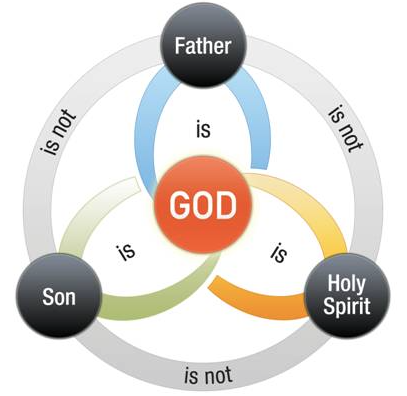
The Trinity, then, is not some awkward add-on to God, the optional extra nobody should want. No, God is beautiful, desirable, and life-giving precisely because He is the Father, the Son, and the Spirit. Only here can be found the God who is love and who shares with us His very own life and joy. Only here can be found the God whom it is eternal life to know.
John Calvin once wrote that if we try to think about God without thinking about the Father, Son, and Spirit, then “only the bare and empty name of God flits about in our brains, to the exclusion of the true God.” Quite so, and that means that if we content ourselves with speaking of God vaguely or abstractly, without the Father, Son, and Spirit, we will never know the life, beauty, and comfort of knowing the true God.
Here and here alone is the God for whom our hearts were made, the God who can win our hearts away from the desires that enslave us, the God who is endlessly, unsurpassably satisfying.