
The Counsel of His Own Will

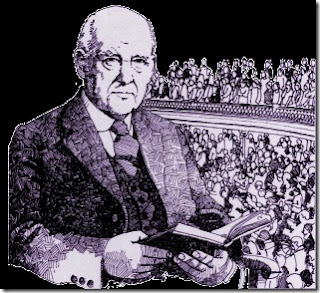
martynlloydjonesdrawing_thumbDr. Martyn Lloyd Jones:

Listen to the original sermon who first trusted in Christ. In whom ye also trusted, after that ye heard the word of truth, the gospel of your salvation: in whom also after that ye believed, ye were sealed with that holy Spirit of promise, which is the earnest of our inheritance until the redemption of the purchased possession, unto the praise of his glory.’ – Ephesians 1:11–14

We continue our discussion of the Apostle’s great statement. He has announced that the great secret which God has revealed concerning His purpose is that in this present age, and in Christ, He has reunited the discordant parts, the separate parts, into which sin has divided the world and the whole cosmos. God is restoring the original harmony, in heaven and on earth, and He is doing so in and through our Lord Jesus Christ. In the dispensation of the fulness of times it is His purpose that He might ‘gather together in one all things in Christ, both which are in heaven and which are on earth, even in him.’ In these verses we are considering the ways in which God is doing this, and have already given attention to the first, and indeed in many senses the chief way, namely, the formation and the growth of the Christian Church. The Church is the new Israel, the spiritual Israel, the true seed of Abraham, and she consists of Jews and Gentiles. But the unity is established, as we have seen, by making these different people Christians, and the Apostle incidentally tells us a number of things about the Christian. We have already considered two of them.

Now we come to consider, in the third place, the way in which all this has happened to us, how this has ever become true of us, knowing ourselves as we do. How does anyone become a Christian? How does anyone enter into this position in which he is ‘in Christ’ and a ‘joint-heir’ with Christ? Fortunately the Apostle deals with that subject also. He is not content with saying that this is true of us, he tells us how it has become true. And he does so, of course, because this was something at which he never ceased to wonder. As we proceed we find Paul using a number of terms which we have already encountered. We met them in verses 4 and 5. They include certain great terms and phrases which are to be found throughout the New Testament, terms which are absolutely essential to a true and ultimate understanding of the Gospel: ‘In whom also we have obtained an inheritance, being predestinated according to the purpose of him who worketh all things after the counsel of his own will.’ In verses 4 and 5 we find: ‘According as he hath chosen us in him before the foundation of the world, that we should be holy and without blame before him in love: having predestinated us unto the adoption of children by Jesus Christ to himself.’ Such are the terms. We are here face to face with high doctrine, with some of the great profundities of the Christian faith and the Christian messages. Someone may ask: Why does the Apostle repeat these terms here, having already used them in verses 4 and 5? The explanation is not only simple but very important. In verses 4 and 5 the Apostle was taking a general view of God’s purpose, he was looking at it, as it were, from that eternal standpoint. Now he is not merely looking at it in general, but also in its particular application to us. There, it was the great scheme itself; here, it is the scheme as applied to us. But he still uses the same terms as he used there. They apply not only to the thought but also to the application.

Many Christian people never study these terms, never dwell on them, never turn them over in their minds. Let me prove that contention by asking a question. How often have you heard anyone going slowly, and term by term, through this great chapter? Or, how often have you read them yourself in this way? Are we not in danger of avoiding these great terms because of certain associations which they have? This is something of which we, as Christian people, need to be very wary at this present hour, for certain aspects of New Testament truth are just not being considered at all because of an element of controversy attached to them. Large numbers of Christian people are totally ignorant of prophetic truth, for instance, because their attitude to it is determined by the fact that it leads to argument and wrangling about various theories. They imagine that that is a wise and sound position to take up. But what they are actually doing is deliberately to ignore God’s Word; they are deliberately by-passing certain aspects and elements of God’s revealed Truth. God means us to study and to face everything in His word whether it is difficult or simple, whether involved in controversy of otherwise. To say ‘peace at any price’ at the expense of God’s revealed truth is surely an insult to God. These matters have to be faced, whether it is the truth concerning prophecy of whether it be the truth concerning these high matters of doctrine which the Apostle puts before us in these verses, as he has already done in verses 4 and 5. Continue reading
The Millennium of Revelation 20

hoekemaExcerpt from The Bible and the Future by Anthony A. Hoekema

IN THIS CHAPTER AN ATTEMPT WILL BE MADE TO SET FORTH in some detail the amillennial view of the millennium described in Revelation 20. Before we look closely at Revelation 20, we should first concern ourselves with the question of the interpretation of the book of Revelation as a whole. The system of interpretation of the book of Revelation which seems most satisfactory to me (though it is not without its difficulties) is that known as progressive parallelism, ably defended by William Hendriksen in More Than Conquerors, his commentary on Revelation.452 According to this view, the book of Revelation consists of seven sections which run parallel to each other, each of which depicts the church and the world from the time of Christ’s first coming to the time of his second coming.

The first of these sections is found in chapters 1-3. John sees the risen and glorified Christ walking in the midst of seven golden lamp-stands. In obedience to Christ’s command John now proceeds to write letters to each of the seven churches of Asia Minor. The vision of the glorified Christ together with the letters to the seven churches obviously form a unit. As we read these letters we are impressed with two things. First, there are references to events, people, and places of the time when the book of Revelation was written. Second, the principles, commendations, and warnings contained in these letters have value for the church of all time. These two observations, in fact, provide a clue for the interpretation of the entire book. Since the book of Revelation was addressed to the church of the first century A.D., its message had reference to events occurring at that time and was therefore meaningful for the Christians of that day. But since the book was also intended for the church through the ages, its message is still relevant for us today.

The second of these seven sections is the vision of the seven seals found in chapters 4-7. John is caught up to heaven and sees God sitting on his radiant throne. He then sees the Lamb that had been slain taking the scroll sealed with seven seals from the hand of the one sitting on the throne, indicating that Christ has won a decisive victory over the forces of evil, and is thus worthy of opening the seals. The seals are now broken, and various divine judgments on the world are described. In this vision we see the church suffering trial and persecution against the background of the victory of Christ. When one asks, How do we know when one of these seven parallel sections ends (except for the first one, which forms an obvious unit), the answer is that each of the seven ends with an indication that the end-time has come. Such an indication may be given in terms of a reference to the final judgment at the end of history, or to the final blessedness of God’s people, or to both. At the end of this section we have both. There is a reference to the final judgment in chapter 6:15-17, “Then the kings of the earth and the great men and the generals and the rich and the strong, and every one, slave and free, hid in the caves and among the rocks of the mountains, calling to the mountains and rocks, ‘Fall on us and hide us from the face of him who is seated on the throne, and from the wrath of the Lamb; for the great day of their wrath has come, and who can stand before it?'”

But there is also a description of the final blessedness of those who have come out of the great tribulation in chapter 7:15-17, “Therefore are they before the throne of God, and serve him day and night within his temple; and he who sits upon the throne will shelter them with his presence. They shall hunger no more, neither thirst any more; the sun shall not strike them, nor any scorching heat. For the Lamb in the midst of the throne will be their shepherd, and he will guide them to springs of living water; and God will wipe away every tear from their eyes.”

The third section, found in chapters 8-11, describes the seven trumpets of judgment. In this vision we see the church avenged, protected, and victorious. This section ends with a clear reference to the final judgment: “The nations raged, but thy wrath came, and the time for the dead to be judged, for rewarding thy servants, the prophets and saints, and those who fear thy name, both small and great, and for destroying the destroyers of the earth” (11:18). Continue reading

Article: The Sin of Soft

Doug Wilson article (original source lest ye be wearied and faint in your minds” (Heb. 12:3).

Comes now the Ninth Short-Circuit Court of Appeals, upholding legislation in California that bans licensed counselors, pastors included, mind you, from helping young people who want to deal biblically with same-sex attraction. And since tyranny is never content with just a little bit, the law also bans counseling that seeks to steer young people away from gender confusion. Confusion. It’s not just a good idea. It’s the law.Reparative

And this reveals, in high relief, the ratcheting techniques used by the forces of totalitolerance. A howl was set up against reparative therapy, causing even some stalwart Christian leaders to back away from it, and now, since we have ceded that ground, they are proceeding to take it. It is now against the law in California for a godly pastor to urge a teenagers to mortify his perverse desires, and how did we get here?

Incidentally, taking a stand for reparative counseling does not obligate you to endorse anything and everything someone might do in the name of reparative therapy, any more than a stand for free speech means that you agree with every stupid op-ed piece ever written. There could be hucksters out there running Acme Reparative Clinics, and I don’t care because this was supposed to be a free country. Because not only is Acme out there giving us a bad name, but the apostle Paul is out there too.

“Know ye not that the unrighteous shall not inherit the kingdom of God? Be not deceived: neither fornicators, nor idolaters, nor adulterers, nor effeminate, nor abusers of themselves with mankind, Nor thieves, nor covetous, nor drunkards, nor revilers, nor extortioners, shall inherit the kingdom of God. And such were some of you: but ye are washed, but ye are sanctified, but ye are justified in the name of the Lord Jesus, and by the Spirit of our God” (1 Cor. 6:9–11).

Some of you used to be gay, he says, but you called on the Lord, and prayed it away. Notice the tense of the verbs. Such were some of you. But you are washed. This does not mean that various temptations to lust just vanish, presto. But it does mean that it is no more permissible for Christians to claim a gay celibate identity than it is for them to claim an identity of celibate pedophilia, or the identity of being an incorrigible celibate flirt.

So what would we think of a celibate flirt? Suppose we were talking to a man who said he was maintaining the biblical standard of fidelity in marriage, but who said that he was also committed to the innocent recreation of flirting his head off with numerous women. All that matters, says he, is that the illicit and prohibited coitus does not in fact occur. That being excluded, all he ever does is tell a few inappropriate jokes, lower his voice confidentially, exchange a few knowing glances, and so on. Is he sinning? Continue reading