
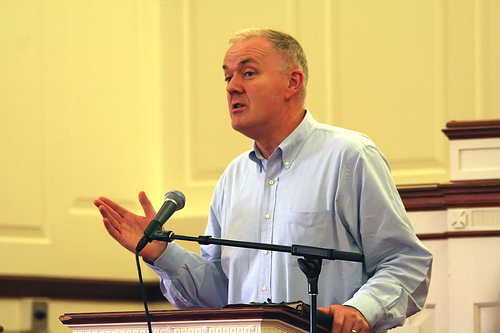
Martin Luther on Preaching

derek-thomasArticle: Simple and Straightforward: Martin Luther on Preaching

This excerpt is taken from Derek Thomas’ contribution in The Legacy of Luther.

According to Fred Meuser, it would be hard to imagine that Luther’s preaching was dull and devoid of rhetorical passion. It is equally hard to fathom, then, that Luther felt the need to chastise some who did not listen well, saying that some fell asleep and some even snored during the sermon, adding that they sometimes coughed whenever he preached on justification, only to wake up again whenever he told a story. Times do not seem to have changed. All the more reason, then, for the Reformer to keep his sermons relatively simple and straightforward.

Those who have studied Luther’s theological works find themselves in deep waters. Luther’s theology is complex at best. Concepts such as his theology of the cross (theologia crucis), the doctrine of consubstantiation, and the exact distinction between law and gospel (did Luther advance in his understanding of the so-called third use of the law, as some have suggested?) continue to occupy scholars of Luther to this day. Is it surprising, then, that Luther’s preaching was essentially simple and plain? Not really. According to Hughes Oliphant Old, Luther “made no attempt to be a great orator.” Old expands, “[Luther] had none of the rhetorical culture that Basil, Chrysostom, or Augustine had. Luther was a popular preacher with a natural mastery of language. He taught preachers of the Reformation to preach in the language of the people.”

Garry Williams cites a similar statement that Luther makes in his Table Talk:

In the pulpit we are to lay bare the breasts and nourish the people with milk. . . . Complicated thoughts and issues we should discuss in private with the eggheads [Klueglinge]. I don’t think of Dr. Pomeraneus, Jonas, or Philip [Melanchthon] in my sermon. They know more about it than I do. So I don’t preach to them. I just preach to Hansie and Betsy.

Although Luther had been schooled in classical rhetoric as part of the awakening of the Renaissance movement in late-medieval Europe, the Reformer seemed deliberately to avoid its more elaborate affectations, employing in its place a more conversational style. He was, for example, particularly scornful of the use of Hebrew in the pulpit. Though able to converse in both Greek and Hebrew with the best of Renaissance scholarship—scholarship that had triumphed in returning to the sources for meaning (ad fontes)—Luther did not employ Greek and Hebrew terms in his sermons. Williams cites Luther’s acerbic comment about Zwingli: “How I do hate people who lug in so many languages as Zwingli does; he spoke Greek and Hebrew in the pulpit at Marburg.”

Despite these warnings, Luther was firmly committed to the study of the original languages and urged that all preachers have the same passion:

Though the faith and the Gospel may be proclaimed by simple preachers without the languages, such preaching is flat and tame, men grow at last wearied and disgusted and it falls to the ground. But when the preacher is versed in the languages, his discourse has freshness and force, the whole of Scripture is treated, and faith finds itself constantly renewed by a continual variety of words and works.

On another occasion, Luther is even stronger in urging the use of the original languages:

It is a sin and shame not to know our own book or to understand the speech and words of our God; it is a still greater sin and loss that we do not study languages, especially in these days when God is offering and giving us men and books and every facility and inducement to this study, and desires his Bible to be an open book. O how happy the dear fathers would have been if they had our opportunity to study the languages and come thus prepared to the Holy Scriptures! What great toil and effort it cost them to gather up a few crumbs, while we with half the labor—yes, almost without any labor at all—can acquire the whole loaf! O how their effort puts our indolence to shame.

Commenting on these statements of Luther, John Piper makes the following deduction:

Now that is a discouraging overstatement for many pastors who have lost their Greek and Hebrew. What I would say is that knowing the languages can make any devoted preacher a better preacher—more fresh, more faithful, more confident, more penetrating. But it is possible to preach faithfully without them—at least for a season. . . . The test of our faithfulness to the Word, if we cannot read the languages, is this: Do we have a large enough concern for the church of Christ to promote their preservation and widespread teaching and use in the churches? Or do we, out of self-protection, minimize their importance because to do otherwise stings too badly?

Luther’s insistence upon simplicity of language is, in part at least, a byproduct of the free delivery of his sermons; his sermons were extemporaneous rather than read from a manuscript. This fact alone almost guarantees that the language employed is simpler, ensuring that if a complex thought is uttered, sufficient explanation is given to elucidate it, drawn from (among other things) eye contact with one’s listeners that often reveals understanding or perplexity. One puzzled look from a listener, or clear signs that no one is actually listening, will urge simplicity of language—repeating a thought in different language until the point is made clear.


Is the Reformation Over? A Statement of Evangelical Convictions

reformation-200x150The following is a statement released Nov. 1, 2016 by Reformanda Initiative on the state of the Protestant Reformation, which will mark its 500th anniversary next year. Reformanda Initiative is an organization primarily composed of European evangelicals, but not limited to that demographic, which seeks to inform evangelicals of the ongoing nature of the Reformation.

On the eve of the 500th anniversary of the Protestant Reformation, Evangelical Christians around the world have the opportunity to reflect afresh on the legacy of the Reformation, both for the worldwide church of Jesus Christ and for the development of gospel work. After centuries of controversies and strained relationships between Evangelicals and Catholics, the ecumenical friendliness of recent times has created ripe conditions for some leaders in both camps to argue that the Reformation is all but over (that the primary theological disagreements that led to the rupture in Western Christianity in the 16th century have been resolved).

Why Some Argue the Reformation Is Over

Two main reasons are generally cited in support of the claim that the Reformation is over:

1. The challenges for Christians worldwide (e.g., secularism and Islam) are so daunting that Protestants and Catholics can no longer afford to remain divided. A unified witness (with perhaps the Pope as the leading spokesman?) would greatly benefit global Christianity. ?

2. The historical theological divisions (e.g., salvation through faith alone, the ultimate authority of the Bible, the primacy of the bishop of Rome) are considered matters of legitimate difference in emphasis, but not sharp points of division and contrast that prevent unity.

The cumulative force of these arguments has softened the way some Evangelicals understand and evaluate the Roman Catholic Church.

It is also important to note that in the last century, global Evangelicalism has grown at an explosive rate while Roman Catholicism has not. The fact that millions of Catholics have become Evangelicals in recent years has not gone unnoticed by Roman Catholic leaders. They are seeking to respond strategically to this loss of their faithful by adopting traditional Evangelical language (e.g. conversion, gospel, mission, and mercy) and establishing ecumenical dialogues with churches they once condemned. There are now more friendly relationships and dialogue between Catholics and Protestants where once there was persecution and animosity. But the question still remains: have the substantive differences between Catholics and Protestants/ Evangelicals disappeared?

Is the Reformation Over?

In all its varieties and at times conflicting tendencies, the Protestant Reformation was ultimately a call to (1) recover the authority of the Bible over the church and (2) appreciate afresh the fact that salvation comes to us through faith alone.

As was the case five centuries ago, Roman Catholicism is a religious system that is not based on Scripture alone. From the Catholic perspective, the Bible is only one source of authority, but it does not stand alone, nor is it the highest source. According to this view, tradition precedes the Bible, is bigger than the Bible, and is not revealed through Scripture alone but through the ongoing teaching of the Church and its current agenda, whatever that may be. Because Scripture does not have the final say, Catholic doctrine and practice remains open-ended, and therefore confused at its very core.

The Roman Catholic theological method is powerfully illustrated by Rome’s promulgation of three dogmas (i.e., binding beliefs) with no biblical support whatsoever. They are the 1854 dogma of Mary’s immaculate conception, the 1870 dogma of papal infallibility, and the 1950 dogma of Mary’s bodily assumption. These dogmas do not represent biblical teaching, and in fact clearly contradict it. Within the Catholic system, this does not matter because it does not rely on the authority of Scripture alone. It may take two millennia to formulate a new dogma, but because Scripture does not have the final say, the Catholic Church can eventually embrace such novelties.

On the doctrine of salvation, many are under the impression that there is a growing convergence regarding justification by faith and that tensions between Catholics and Evangelicals have eased considerably since the 16th century. At the Council of Trent (1545–1563), the Roman Catholic Church reacted strongly against the Protestant Reformation by declaring “anathema” (cursed) those who upheld justification by faith alone, as well as affirmed the teaching that salvation is a process of cooperating with infused grace rather than an act grounded in grace alone by faith alone.

Some argue that the Joint Declaration on the Doctrine of Justification signed by the Roman Catholic Church and the Lutheran World Federation in 1999 has bridged the divide. While the document is at times friendly towards a more biblical understanding of justification, it explicitly affirms the Council of Trent’s view of justification. All of its condemnations of historic Protestant/Evangelical convictions still stand; they just do not apply to those who affirm the blurred position of the Joint Declaration.

As was the case with Trent, in the Joint Declaration, justification is a process enacted by a sacrament of the Church (baptism); it is not received by faith alone. It is a journey that requires contribution from the faithful and an ongoing participation in the sacramental system. There is no sense of the righteousness of God being imputed by Christ to the believer, and thus there can be no assurance of salvation. Moreover, the Roman Catholic Church’s view is revealed by its continued use of indulgences (the remission of the temporal punishment for sin allotted by the Church on special occasions). It was the theology of indulgences that triggered the Reformation, but this system has been invoked most recently by Pope Francis in the 2015–2016 Year of Mercy. This shows that the Roman Catholic Church’s basic view of salvation, which is dependent on the mediation of the Church, the distribution of grace by means of its sacraments, the intercession of the saints, and purgatory, is still firmly in place, even after the Joint Declaration.

Looking Ahead

What is true of the Roman Catholic Church as a doctrinal and institutional reality is not necessarily true of individual Catholics. God’s grace is at work in men and women who repent and trust in God alone, who respond to God’s gospel by living as Christian disciples who seek to know Christ and make him known.

However, because of its unchecked dogmatic claims and complex political and diplomatic structure, much more care and prudence should be exercised in dealing with the institutional Catholic Church. Current initiatives to renew aspects of Catholic life and worship (e.g., the accessibility of the Bible, liturgical renewal, the growing role of the laity, the charismatic movement) do not indicate, in themselves, that the Roman Catholic Church is committed to substantive reform in accordance with the Word of God.

In our global world, we encourage cooperation between Evangelicals and Catholics in areas of common concern, such as the protection of life and the promotion of religious freedom. This cooperation extends to people of other religious orientations and ideologies as well. Where common values are at stake regarding ethical, social, cultural, and political issues, efforts of collaboration are to be encouraged. However, when it comes to fulfilling the missionary task of proclaiming and living out the gospel of Jesus Christ to the whole world, Evangelicals must be careful to maintain clear gospel standards when forming common platforms and coalitions.

The position we have articulated is a reflection of historic Evangelical convictions with its passion for unity among believers in Jesus Christ according to the truth of the gospel.[1] The issues that gave birth to the Reformation 500 years ago are still very much alive in the 21st century for the whole church. While we welcome all opportunities to clarify them, Evangelicals affirm, with the Reformers, the foundational convictions that our final authority is the Bible and that we are saved through faith alone.

Notes:

[1] These fundamental convictions are expressed in official papers by the two global Evangelical organizations, the World Evangelical Fellowship and the Lausanne Movement. After addressing such topics as Mariology, authority in the church, the papacy and infallibility, justification by faith, sacraments and the Eucharist, and the mission of the church, the World Evangelical Fellowship’s summary comment is, “Cooperation in mission between Evangelicals and Catholics is seriously impeded because of ‘unsurmountable’ obstacles.”

“World Evangelical Fellowship: Evangelical Perspective on Roman Catholicism” (1986) in Paul G. Schrotenboer (ed.), Roman Catholicism: A Contemporary Evangelical Perspective (Grand Rapids: Baker, 1987, p. 93).
We see this view mirrored in the 1980 “Lausanne Occasional Paper on Christian Witness to Nominal Christians among Roman Catholics” and a comment by the primary author of the Lausanne Covenant, John Stott: “We are ready to co-operate with them (Roman Catholics, Orthodox or liberal Protestants) in good works of Christian compassion and social justice. It is when we are invited to evangelize with them that we find ourselves in a painful dilemma for common witness necessitates common faith, and co-operation in evangelism depends on agreement over the content of the gospel.

Lausanne Committee for World Evangelization, “Lausanne Occasional Paper 10 on Christian Witness to Nominal Christians among Roman Catholics” (Pattaya, Thailand, 1980); John Stott, Make the Truth Known: Maintaining the Evangelical Faith Today (Leicester, UK: UCCF Booklets, 1983, pp. 3–4).

A Tribute to Pam

harrypamCelebrating the life of Pam Greenwood:

After my years of “theological training” at Bible College, I had the amazing privilege of becoming the Associate Minister of Harry Greenwood. This meant among other things, traveling the world in ministry, preaching with Harry in places like India, Australia, New Zealand and the U.S.A. (where I now serve as a pastor in Phoenix, Arizona)… and it meant living in Harry and Pam’s home.

Just as an aside, because of some detail in the schedule that I cannot recall, I remember Harry having to fly out to Australia 3 days before Pam and I. That meant I had the awesome responsibility of accompanying Pam and being her protector for the 26 hours of plane flights and airports, until we were all together again in Australia. When Harry and my eyes met in the Sydney airport, and he could see his darling wife Pam arriving alongside me safe and sound, with all the many bags in tow, he gave me a glance that said “well done kid. You done good! Thank you.” It remains one of the proudest moments of my life. I knew how privileged I was in watching over Harry’s treasure, and on this occasion at least, I had not dropped the ball.

As you might imagine, in a short space of time, living in Harry and Pam’s house (Lindens in Chard, Somerset) meant that I was quickly given a lifetime of insights as to how Christian ministry flows out from the home to the world outside. My recollections of Pam are marked indelibly on my mind, with such great affection. I saw Pam as my ‘mother in the Lord.”

I fondly remember Pam, each day without fail, reading her Amplified Bible. Often times she would take out her pen and write something in the margin on the page. Continue reading