
Eschatology – The Consummation: A Biblical Scenario

The High King of Heaven: Discovering the Master Keys to the Great End Time Debate by Dean Davis (Redemption Press, 2014).

THE CONSUMMATION: A BIBLICAL SCENARIO

We have come to the end of our journey. Having traversed many a biblical foothill, having scaled many an eschatological mountain, we have reached the summit. Now it is time to take in the view.

From the beginning our goal has been to behold—with clarity and conviction—the Blessed Hope of the Church.

To this end we embarked on our journey by looking closely at the Kingdom of God. First, we discerned its true nature: that it is, in essence, a direct spiritual reign of God, through Christ, by the Spirit; and it is also the realm that that reign creates. Next, we discerned its structure: that the Kingdom enters history in two simple stages: the Kingdom of the Son (already here), followed by the Kingdom of the Father (not yet here), with the two stages being separated by a single Parousia of Christ at the end of the present evil age. To our surprise and joy, we found that this careful NT investigation of the Kingdom actually enabled us to discern the true biblical outline of all Salvation History.

Building upon this, we next went in search of the proper NT principles for interpreting OT Kingdom prophecy (OTKP). This enabled us to discover and articulate what we called The New Covenant Hermeneutic, the NT method for understanding the OT in general, and OTKP in particular. We then applied that hermeneutic with good success to some of the most important and challenging OTKP’s, showing that in the end they all stubbornly resist the premillennial approach, but wonderfully open up and fall into place when viewed beneath the light of the simple, two-staged idea of the Kingdom taught in the Didactic NT.1

Thus encouraged, we ventured into that most “Old Testament” of New Testament books, the Revelation. We began by carefully examining its purpose, structure, and literary genre. This opened us up to the possibility that Revelation 20 might be the last of six “mystical” depictions of the course, character, and consummation of the spiritual reign of the High King Heaven, the exalted Lord Jesus Christ. And when we actually studied Revelation 20, we saw that this interpretation was by far the best.

Drawing near to our goal, we turned once again to the NT, this time to see if its teaching on the Consummation confirmed our suspicions about the true (amillennial) shape of Salvation History. We looked carefully at the Christ-exalting design of the Consummation. We discerned its Christ-centered structure. And we closely examined the top 16 eschatological texts of the DNT. Through all of this, we finally reached our destination. We beheld—with clarity and certainty—the Christ-centered unity of the Consummation. We saw that Christ will indeed come again once at the end of the present evil age, to raise the dead, judge the world in righteousness, destroy the present earth and its works by fire, and create new heavens and the new earth, the eternal home of the redeemed.

In sum, over many highways and byways, over many paths and peaks, we have sought and found the one true Blessed Hope of the Church.

And now, from high atop Mt. Pisgah, let us survey the Promised Land one final time.

A Consummation Structured for Hope

Above all things, God has structured the Consummation with a view to enhancing the glory of his Son (John 5:23). But in so doing, he has also structured it with a view to illuminating, encouraging, motivating, equipping, and empowering the Church Militant. In short, he has designed it so that his pilgrim people may have hope.

On this crucial theme we recall the words of the apostle Paul:

For the grace of God that brings salvation has appeared to all men, teaching us that, denying ungodliness and worldly lusts, we should live soberly, righteously, and godly in the present age, looking for the blessed hope and glorious appearing of our great God and Savior, Jesus Christ, who gave Himself for us, that He might redeem us from every lawless deed and purify for Himself His own special people, zealous for good works. –Titus 2:11-14

Frankly acknowledging the challenges of Christian discipleship in an age dominated by the powers of evil, the apostle strongly exhorts God’s people to live in a manner worthy of their calling. However, in order to encourage them to rise to those challenges, he also gives them a great hope. Very aptly, he calls it the Blessed Hope. There is just one of them: the glorious appearing of our great God and Savior, Jesus Christ. However, there are many reasons why it is blessed. It is blessed because God has made it so simple, so easy to envision, and so easy to proclaim. It is blessed because when the Savior appears, he will do so many wonderful things, things that God has revealed in Scripture so that his saints can “look for” them with eager anticipation. And it is blessed because the contemplation of each of these things is meant to fill them with courage, confidence, and joy as they journey on to the borders of Canaan, where, at long last, they will enter the Promised Land (Acts 3:19, 1 Peter 1:3-9, Rev. 12:13:17).

Therefore, as we bring our own journey to a close, let us take a few moments to remember what we have learned about our Blessed Hope. And as we do, let us consider how God has designed each of its elements to awaken in our hearts a special kind of hope; and how the sum of those hopes makes our one Blessed Hope blessed indeed! Continue reading
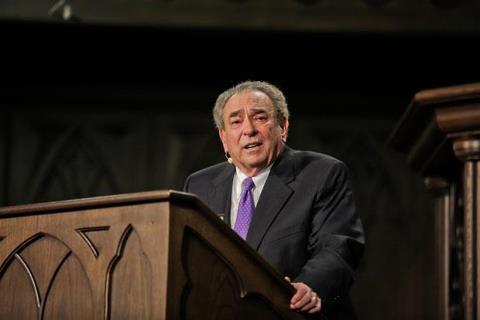
Fueling Reformation

sproul_3Article: Fueling Reformation by Dr. R. C. Sproul (original source how can anybody possibly schedule a revival? True revivals are provoked by the sovereign work of God through the stirring of His Holy Spirit in the hearts of people. They happen when the Holy Spirit comes into the valley of dry bones (Ezek. 37) and exerts His power to bring new life, a revivification of the spiritual life of the people of God.

This kind of thing cannot be manipulated by any human program. Historically, no one scheduled the Protestant Reformation. The Welsh revival was not on anyone’s agenda, nor was the American Great Awakening penciled into someone’s date book. These epic events in church history resulted from the sovereign work of God, who brought His power to bear on churches that had become virtually moribund.

But we have to understand the difference between revival and reformation. Revival, as the word suggests, means a renewing of life. When evangelism is a priority in the church, such outreach will often bring about revival. However, these revivals of spiritual life do not always result in reformation. Reformation indicates changing forms of church and society. Revivals grow into reformations when the impact of the gospel begins to change the structures of the culture. Revival can produce a multitude of new Christians, but these new Christians have to grow into maturity before they begin to make a significant impact on the surrounding culture.

Reformation can involve a change for the better. We must not be so naïve as to think that all change is necessarily good. Sometimes when we feel that we are in the doldrums or that progress has been stultified, we cry out for change, forgetting for the moment that change may be regressive rather than progressive. If I drink a vial of poison, it will change me, but not for the better. Nevertheless, change is often good.

In our day, we have seen the rise of what has been called the “New Calvinism,” which tends to focus primarily on the so-called five points of Calvinism. This movement within the church has attracted a great deal of attention, even in the secular media.

Yet it would be wise to not identify Calvinism exhaustively with those five points. Rather, the five points function as a pathway or a bridge to the entire structure of Reformed theology. Charles Spurgeon himself argued that Calvinism is merely a nickname for biblical theology. He and many other titans of the past understood that the essence of Reformed theology cannot be reduced to five particular points that arose centuries ago in Holland in response to controversy with the Arminians, who objected to five specific points of the system of doctrine found in historic Calvinism. For the purposes of this article, it might be helpful to look at both what Reformed theology is and is not.

Reformed theology is not a chaotic set of disconnected ideas. Rather, Reformed theology is systematic. The Bible, being the Word of God, reflects the coherence and unity of the God whose Word it is. To be sure, it would be a distortion to force a foreign system of thought upon Scripture, making Scripture conform to it as if it were some kind of procrustean bed. That is not the goal of sound systematic theology. Rather, true systematic theology seeks to understand the system of theology that is contained within the whole scope of sacred Scripture. It does not impose ideas upon the Bible; it listens to the ideas that are proclaimed by the Bible and understands them in a coherent way.

Reformed theology is not anthropocentric. That is to say, Reformed theology is not centered on human beings. The central focal point of Reformed theology is God, and the doctrine of God permeates the whole of Reformed thought. Thus, Reformed theology, by way of affirmation, can be called theocentric. Indeed, its understanding of the character of God is primary and determinant with respect to its understanding of all other doctrines. That is to say, its understanding of salvation has as its control factor — its heart — a particular understanding of God’s sovereign character.

Reformed theology is not anticatholic. This may seem strange since Reformed theology grew directly out of the Protestant movement against the teaching and activity of Roman Catholicism. But the term catholic refers to catholic Christianity, the essence of which may be found in the ecumenical creeds of the first thousand years of church history, particularly those of the early church councils, such as the Council of Nicea in the fourth century and the Council of Chalcedon in the fifth century. That is to say, those creeds contain common articles of faith shared by all denominations that embrace orthodox Christianity, doctrines such as the Trinity and the atonement of Christ. The doctrines affirmed by all Christians are at the heart and core of Calvinism. Calvinism does not depart on a search for a new theology and reject the common base of theology that the whole church shares.

Reformed theology is not Roman Catholic in its understanding of justification. This is simply to say that Reformed theology is evangelical in the historical sense of the word. In this regard, Reformed theology stands strongly and firmly with Martin Luther and the magisterial Reformers in their articulation of the doctrine of justification by faith alone, as well as the doctrine of sola Scriptura. Neither of these doctrines is explicitly declared in the five points of Calvinism; yet, in a sense, they become part of the foundation for the other characteristics of Reformed theology.

All this is to say that Reformed theology so far transcends the mere five points of Calvinism that it is an entire worldview. It is covenantal. It is sacramental. It is committed to transforming culture. It is subordinate to the operation of God the Holy Spirit, and it has a rich framework for understanding the entirety of the counsel of God revealed in the Bible.

So it should go without saying that the most important development that will bring about reformation is not simply the revival of Calvinism. What has to happen is the renewal of the understanding of the gospel itself. It is when the gospel is clearly proclaimed in all of its fullness that God exercises His redeeming power to bring about renewal in the church and in the world. It is in the gospel and nowhere else that God has given His power unto salvation.

If we want reformation, we have to start with ourselves. We have to start bringing the gospel itself out of darkness, so that the motto of every reformation becomes post tenebras lux — “after darkness, light.” Luther declared that every generation must declare freshly the gospel of the New Testament. He also said that anytime the gospel is clearly and boldly proclaimed, it will bring about conflict, and those of us who are inherently adverse to conflict will find it tempting to submerge the gospel, dilute the gospel, or obscure the gospel in order to avoid conflict. We, of course, are able to add offense to the gospel by our own ill-mannered attempts to proclaim it. But there is no way to remove the offense that is inherent to the gospel message, because it is a stumbling block, a scandal to a fallen world. It will inevitably bring conflict. If we want reformation, we must be prepared to endure such conflict to the glory of God.