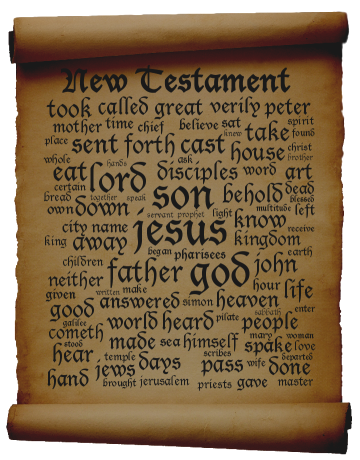
 By Timothy Paul Jones – (original source you’ll find the Gospels according to Matthew, Mark, Luke, and John leading the list. But did this quartet of early Christians actually have any connection with the books that bear their names? Were Matthew, Mark, Luke, and John really the ones who wrote the Gospels? If so, how do we know?
Your first reply might be, Because their names are on the books!—and you would be correct. These four names have appeared on the manuscripts of these four Gospels for well over a thousand years.
But these names may not have been present on the original manuscripts of the Gospels.
In fact, when it comes to who wrote the Gospels, some scholars are quite convinced that Matthew, Mark, Luke, and John couldn’t possibly have been the authors of these four books. According to one such scholar,
[The New Testament Gospels] were written thirty-five to sixty-five years after Jesus’ death, … not by people who were eyewitnesses, but by people living later. …
Where did these people get their information from? … After the days of Jesus, people started telling stories about him in order to convert others to the faith. … When … Christians recognized the need for apostolic authorities, they attributed these books to apostles (Matthew and John) and close companions of apostles (Mark, the secretary of Peter; and Luke the traveling companion of Paul). …
Because our surviving Greek manuscripts provide such a wide variety of (different) titles for the Gospels, textual scholars have long realized that their familiar names (e.g., “The Gospel According to Matthew”) do not go back to a single “original” title, but were added later by scribes.
B. Ehrman, Jesus, Apocalyptic Prophet of a New Millennium (Oxford: Oxford University Press, 1999), 248-249; B. Ehrman, Lost Christianities (Oxford: Oxford University Press, 2005), 235; B. Ehrman and W. Craig, “Is There Historical Evidence for the Resurrection of Jesus?: A Debate between William Lane Craig and Bart Ehrman” (March 28, 2006).
If these claims are correct, early Christians did not link the four New Testament Gospels to Matthew, Mark, Luke, and John because these individuals actually wrote the Gospels. The Gospels were, according to Bart Ehrman and many others, originally anonymous. According to this reconstruction, early Christians forged apostolic links in the second century in order to make these documents seem more authoritative. Ehrman’s proof for this supposition is the “wide variety” of different titles found among the Gospel manuscripts.
But does this reconstruction of who wrote the Gospels actually make the best sense of the historical evidence?
With this question in mind, let’s take a careful and critical look at the likelihood that the four New Testament Gospels actually originated with Matthew, Mark, Luke, and John. Consider with me the crucial question of who wrote the Gospels.
Those Mysterious Missing Anonymous Manuscripts
The earliest Gospel manuscripts in which the titles have survived seem to have been copied in the late second and early third centuries (P66 and perhaps P4 and P75); that’s a century or more after the Gospels were originally written. And that’s part of the reason that some scholars make the claim that the New Testament Gospels were originally anonymous.
But does this absence of titles provide evidence that the Gospels circulated anonymously?
I’m not convinced that it does.
In the first place, many of the earliest Gospel manuscripts have not survived sufficiently intact for us to know whether or not the manuscripts originally included titles. The portions of the manuscripts that would have preserved the titles have crumbled into dust or become separated from the rest of the manuscripts over the centuries. Titles of ancient manuscripts were frequently inscribed on flyleaves at the beginning or end of a manuscript. In other cases, titles were written on tags—known as a sillyboi—and sewn to the closing edges of documents. It’s quite likely that these tags and flyleaves deteriorated or that they were simply lost over the centuries. As such, the absence of titles on the surviving portions of manuscripts does not mean that no names were originally present on these manuscripts. Continue reading →

 “2017 will clarify for many why they are not Roman Catholics, and how they will relate to Rome. For many, the walls will fall, and they will swim the Tiber. For others, they will be confirmed in their bigotry and their rejection of Rome based upon bad arguments, false history, and their own form of overpowering tradition. But for many of the truly faithful, the issues will be seen with clarity, and their rejection of Rome will be accompanied not only by a new found fervor for the truths of sola scriptura, soli Deo gloria, sola fide, etc., but that fervor will be joined with a deep desire to see Roman Catholics come to know the gospel that actually saves and gives peace. If your opposition to Rome does not result in your reaching out in love and truth to them, longing to see them come to know the grace that truly saves, then your opposition is a clanging cymbal, and it means nothing.” – Dr. James White