 Here at King’s Church, we practice “Family Integrated Worship,” where families attend our Sunday worship service together (rather than children or teens attending their own meetings separate from their parents). The only exception we see to this (both now and in the future) is to provide a safe place for the under 3’s in a nursery. However, we do not wish to segregate older children and teens from the rest of the congregation – sending them off to different rooms or buildings. Instead, on earth, as it is in heaven, young and old together, with one voice in unity, we the gathered people of God seek to proclaim His praises and hear His word together.
We do not make the claim that our way of worshiping is the only valid way to do Church on the Lord’s Day. Indeed, we believe there are times when it is entirely appropriate for specialized ministry to take place. One Biblical example of this is that older women are exhorted to teach the younger women (Titus 2:3-5), which presumably means that men are excluded from such a gathering.
However, while in no way wishing to be divisive or suggest, even for a moment, that we are the only Church in town obeying God, we practice “Family Integrated Worship” because of certain convictions we have.
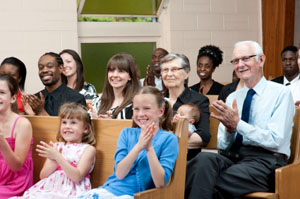
At church together.
As we examine the Biblical data we find that throughout the centuries, this has been the normal way in which the people of God have gathered. This is clear from both the Old and New Testaments.
Deuteronomy 31: 11-13 reads, “When all Israel comes to appear before the LORD your God at the place that he will choose, you shall read this law before all Israel in their hearing. Assemble the people, men, women, and little ones, and the sojourner within your towns, that they may hear and learn to fear the LORD your God, and be careful to do all the words of this law, and that their children, who have not known it, may hear and learn to fear the LORD your God, as long as you live in the land that you are going over the Jordan to possess.”
Joshua 8:35 says, “There was not a word of all that Moses commanded that Joshua did not read before all the assembly of Israel, and the women, and the little ones, and the sojourners who lived among them.”
Ezra 10: 1 While Ezra prayed and made confession, weeping and casting himself down before the house of God, a very great assembly of men, women, and children, gathered to him out of Israel, for the people wept bitterly.
These and other scriptures testify to the fact that when God’s people assembled, it was normal for children to be included.
In the New Testament, children were present during Christ’s preaching and teaching ministry (Matthew 14:13-21).
When Paul wrote to the Church at Ephesus, he included a message for the children (Eph. 6:1-3). In doing so, a clear assumption was in his mind; that when his letter was read to the gathered Church, children would be present in the service to hear it. The same assumption can be found in Colossians 3:20, where we read, “Children, obey your parents in everything, for this pleases the Lord.”
In recent decades, many have practiced a very different model for doing Church, something called “age segregated worship” where the family is split up, fragmented and isolated from each other in the service. We have now had a great deal of time to assess the long term effects and fruit of such ministry. The results are in and what we have observed has not been good. While church growth did occur, at least initially in the short term; when teens become adults we see a severe lack of participation in the life of the local church. The percentage of teens in youth ministry who make the transition to regular, ongoing participation in the local Church as adults, is alarmingly low. That is tragic and heart breaking!
In the light of this, we need to ask an important question:
Could it be that the model we have used may be a big factor in this?
More at this link.