
What You Probably Were Not Told About Charles Darwin

Article: What Your Biology Teacher Didn’t Tell You About Charles Darwin by Phil Moore (original source here)

Phil Moore leads Everyday Church in London. He also serves as a Bible teacher and evangelist within the Newfrontiers family of churches. He is the author of the Straight to the Heart series of devotional commentaries. Phil is married to Ruth, and they have four young children. Together, they love eating strange and exotic food, watching movies with lots of popcorn, and reading books by Roald Dahl.
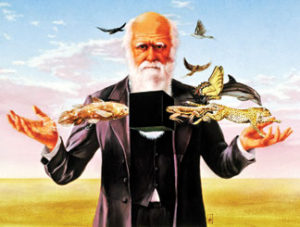
Charles Darwin is a great British hero. That’s hardly surprising, since he was one of the most influential thinkers of the past 200 years. I happened to live opposite Darwin’s former lodgings when I was a student at Cambridge University, so I looked out each morning on a blue plaque hailing him as one of the greatest Britons who ever lived. I’m not saying he didn’t deserve that commemorative plaque, but I should point out that he wasn’t a British hero but a British villain. You don’t need to be a Bible-thumping evangelical to question whether Darwin’s thinking deserves to be given a bit more thought.

Whatever your views on origins and evolution, we can hopefully all agree that, at present, we give far too much honor to the British thinker who justified genocide.

Devaluation of Humans

Darwin didn’t hide his view that his evolutionary thinking applied to human races as well as to animal species. The full title of his seminal 1859 book was On the Origin of Species by Means of Natural Selection, or the Preservation of Favored Races in the Struggle for Life. He followed up more explicitly in The Descent of Man, where he spelled out his racial theory:

The Western nations of Europe . . . now so immeasurably surpass their former savage progenitors [that they] stand at the summit of civilization. . . . The civilized races of man will almost certainly exterminate and replace the savage races through the world.

Thankfully, most British people today are embarrassed by the racist rhetoric that undergirded the late-Victorian British Empire. What’s astonishing is how little they understand that Charles Darwin and his theory of evolution provided the doctrine behind its white supremacism. Whereas the British Empire of the early 19th century had been dominated by Christian reformers such as William Wilberforce, who sold slave badges that proclaimed, “Am I not a man and a brother?”, Darwin’s writings converted an empire with a conscience into an empire with a scientific philosophy.

Four years after Darwin published The Origin of Species, James Hunt turned it into a justification for slavery. In his 1863 paper, “On the Negro’s Place in Nature,” he asserted: “Our Bristol and Liverpool merchants, perhaps, helped to benefit the race when they transported some of them to America.”

Christian reformers had spent decades in the early 19th century teaching Britain to view non-European races as their equals before God. In a matter of years, Darwin swept not only God off the table, but also the value of people of every race with him.

Enabling Genocide

Victorian Britain was too willing to accept Darwinian evolution as its gospel of overseas expansion. Darwin is still celebrated on the back of the British £10 note for his discovery of many new species on his visit to Australia; what’s been forgotten, though, is his contemptible attitude—due to his beliefs about natural selection—toward the Aborigines he found there. When The Melbourne Review used Darwin’s teachings to justify the genocide of indigenous Australians in 1876, he didn’t try and stop them. When the Australian newspaper argued that “the inexorable law of natural selection [justifies] exterminating the inferior Australian and Maori races”—that “the world is better for it” since failure to do so would be “promoting the non-survival of the fittest, protecting the propagation of the imprudent, the diseased, the defective, and the criminal”—it was Christian missionaries who raised an outcry on behalf of this forgotten genocide. Darwin simply commented, “I do not know of a more striking instance of the comparative rate of increase of a civilized over a savage race.”

Meanwhile, several thousand miles away, Cecil Rhodes was gleefully embracing Darwin’s thinking as justification for white expansion across southern Africa. He was so inspired by Darwinian evolutionist Winwood Reade’s The Martyrdom of Man that he later confessed, “That book has made me what I am.”

What it made him was the architect of one of the most brutal and immoral acts of European expansion and genocide in history. Rhodes wrote in 1877:

I contend that we are the finest race in the world and that the more of the world we inhabit the better it is for the human race. . . . It is our duty to seize every opportunity of acquiring more territory and we should keep this one idea steadily before our eyes that more territory simply means more of the Anglo-Saxon race, more of the best, the most human, most honorable race the world possesses.

If what Rhodes believed sounds shocking to you—and I hope it does—then understand that he was simply stating what he drew from the works of both Darwin and Francis Galton, Charles Darwin’s cousin, who extrapolated his cousin’s thinking to pioneer racial eugenics.

Select Your Choice

I’ve used British examples because I’m British, and it seems more polite to point out the errors in my own national worldview than in that of other nations. I could’ve pointed out how Darwin’s thinking was used by late 19th-century Americans to justify acts of genocide against Native Americans. I could’ve pointed out how Hitler and his Nazi philosophers used it to justify wars of expansion and horrific holocaust. I could’ve pointed out how Communist Russia used Darwinian evolution to justify its liquidation of non-Russian people groups within the Soviet empire. I could’ve pointed out how it was used by Serbs to justify their genocide against Croatians and Kosovans.

But I don’t have to. The British example is enough to make us question whether Charles Darwin was truly a British hero at all. At least we should strip him of his place on our £10 banknote and stop protecting his thinking from the scrutiny it deserves in school classrooms, in TV documentaries, and in the corridors of power.

Because whether or not you agree with his thoughts on evolution, you should at the very least want to discover he was wrong.

Whom would you rather discover was right all along? The Christian reformers of the early 19th century, like William Wilberforce and the Earl of Shaftesbury, who argued from belief in divine creation that slaves should be freed and that children shouldn’t be forced to work themselves to death in factories for having been born to the wrong parents? Or Charles Darwin, who argued from belief in a godless beginning to the universe that natural selection is a virtue and that, consequently, acts of genocide are part and parcel of the way the world was always supposed to be?

In the words of Jesus himself, “By their fruits you will be able to judge their teaching.”

Three Days and Three Nights

Article by TurretinFan: Three Days and Three Nights – Hebrew Idiom for Three Consecutive Calendar Days (original source here)

Jonah’s use of “three days and three nights” repeated by Jesus in prophesying his own death, burial, and resurrection has led to some confusion. As you may recall, in Jonah, it is written:

Jonah 1:15-17
So they took up Jonah, and cast him forth into the sea: and the sea ceased from her raging. Then the men feared the Lord exceedingly, and offered a sacrifice unto the Lord, and made vows. Now the Lord had prepared a great fish to swallow up Jonah. And Jonah was in the belly of the fish three days and three nights.

Similarly, Jesus states:

Matthew 12:38-41
Then certain of the scribes and of the Pharisees answered, saying, Master, we would see a sign from thee. But he answered and said unto them, An evil and adulterous generation seeketh after a sign; and there shall no sign be given to it, but the sign of the prophet Jonas: for as Jonas was three days and three nights in the whale’s belly; so shall the Son of man be three days and three nights in the heart of the earth. The men of Nineveh shall rise in judgment with this generation, and shall condemn it: because they repented at the preaching of Jonas; and, behold, a greater than Jonas is here.

Some people have taken this expression as expressing emphasis on both daylight and and dark periods, instead of understanding the expression as simply meaning three consecutive calendar days.

Interestingly enough, the same expression is found in one other place, where it is fairly clear that three calendar days is meant:

1 Samuel 30:1 & 11-14
And it came to pass, when David and his men were come to Ziklag on the third day, that the Amalekites had invaded the south, and Ziklag, and smitten Ziklag, and burned it with fire; … And they found an Egyptian in the field, and brought him to David, and gave him bread, and he did eat; and they made him drink water; and they gave him a piece of a cake of figs, and two clusters of raisins: and when he had eaten, his spirit came again to him: for he had eaten no bread, nor drunk any water, three days and three nights. And David said unto him, To whom belongest thou? and whence art thou? And he said, I am a young man of Egypt, servant to an Amalekite; and my master left me, because three days agone I fell sick. We made an invasion upon the south of the Cherethites, and upon the coast which belongeth to Judah, and upon the south of Caleb; and we burned Ziklag with fire.

The point of “three days and three nights” is just that the Egyptian had been continuously without food and water for three calendar days. The point is not the day and light portions, but the continuity. We see that from the fact that David returned “on the third day” (vs. 1) and from the fact that the Egyptian had only fallen sick “three days agone.”

The way that “on the third day” worked for the Hebrew way of counting days can be seen from Jesus’ own use:

Luke 13:32 And he said unto them, Go ye, and tell that fox, Behold, I cast out devils, and I do cures to day and to morrow, and the third day I shall be perfected.

Similarly, in Leviticus:

Leviticus 19:6 It shall be eaten the same day ye offer it, and on the morrow: and if ought remain until the third day, it shall be burnt in the fire.

Even in 1 Samuel, we see the same way of counting:

1 Samuel 20:5 And David said unto Jonathan, Behold, to morrow is the new moon, and I should not fail to sit with the king at meat: but let me go, that I may hide myself in the field unto the third day at even. Continue reading

Defending Sola Scriptura

Dr. James White:

This quotation was posted on the CRI Bible Answer Man FB page today. I’d like to respond to it.

“No one believes literally in sola scriptura.”

Yes, actually, we do—we just define it properly, which is not done by Frederica Mathewes-Green, an Eastern Orthodox writer. What is more, I have, repeatedly, accurately defined sola scriptura while a guest on the Bible Answer Man broadcast. In any case, I believe, “literally,” that the θεόπνευστος revelation of God known as the Scriptures (the ONLY example of what we KNOW to be θεόπνευστος) is the sole infallible rule of faith for the church. I believe as Gregory of Nyssa, long ago:

“..we make the Holy Scriptures the canon and the rule of every dogma; we of necessity look upon that, and receive alone that which may be made conformable to the intention of those writings.” (On the Soul and Resurrection).

But as we will see, Frederica Mathewes-Green, and Mr. Hanegraaff, confuses the issue.

“Everyone believes that the bible (sic) has to be responsibly interpreted. Everyone believes that some interpretations of the bible (sic) are better, more accurate, than others.”

Yes, everyone believes the Bible must be responsibly interpreted—that is, when you seek to understand the intention of the original author, in the original language, original context, etc., and seek to then harmonize that with the Scriptures as a whole, you are clearly seeking to avoid turning the Bible into your own personal playground from which you can derive any meaning you wish. Yes, there are proper rules to hermeneutics and exegesis. But what Frederica Mathewes-Green does not understand is that this is in no way detrimental to a strong and full belief in sola scriptura.

Instead, the EO position is that rather than honoring the Word by exegeting it consistently and harmoniously with both the near and far contexts, we must avoid the danger of the Bible and place it under a higher authority, specifically, the Tradition defined by the Church. In the Orthodox context, this is the tradition as codified as it existed about seven or eight centuries after the death of Christ. Whether that Tradition itself was accurate at that time we cannot say, for the Orthodox system has no means of self-correction once it subjects that which is θεόπνευστος to that which is plainly not.

Just as Rome’s claim to infallibility results in sola ecclesia, the church in monologue and hence fundamentally unreformable on the deepest level, so too the Orthodox commitment to the Tradition that has become entrenched from just over a thousand years ago leads to sola traditio, sola musterio. Neither system can fundamentally be corrected by the voice of the Shepherd, muted under the thick cloth of Tradition.

“And everyone believes that leaving a wholly untaught person free to invent his own interpretation of the bible (sic) is dangerous.”

Hundreds of years ago the framers of the Westminster Confession of Faith wrote,

1.6. The whole counsel of God concerning all things necessary for His own glory, man’s salvation, faith and life, is either expressly set down in Scripture, or by good and necessary consequence may be deduced from Scripture: unto which nothing at any time is to be added, whether by new revelations of the Spirit, or traditions of men. Nevertheless, we acknowledge the inward illumination of the Spirit of God to be necessary for the saving understanding of such things as are revealed in the Word: and that there are some circumstances concerning the worship of God, and government of the Church, common to human actions and societies, which are to be ordered by the light of nature, and Christian prudence, according to the general rules of the Word, which are always to be observed.

1.7. All things in Scripture are not alike plain in themselves, nor alike clear unto all: yet those things which are necessary to be known, believed, and observed for salvation are so clearly propounded, and opened in some place of Scripture or other, that not only the learned, but the unlearned, in a due use of the ordinary means, may attain unto a sufficient understanding of them.

The problem with Frederica Mathewes-Green’s words is that she is conflating what are necessarily distinct categories. The “unlearned and unstable” distort the Scriptures to their own destruction, this is quite true (2 Peter 3:16). But the problem here is not with the inspired Word, but with the “unlearned and unstable” interpreter.

It is not the Bible that is dangerous, it is the rebel sinner who dares to handle it improperly. The answer to this problem is not to safeguard the Bible by subjecting it to a traditional coffin of fossilized ritual and belief! It is to contrast its misuse and abuse with careful, God-honoring exegesis and proclamation. It would be like someone pointing out that guns can be dangerous, therefore, we should only have paintings of guns done by a particular group of artists who can properly “interpret” the gun for us.

No, the problem is with the user, not the object that is used. The answer is the proper training of the user, not the fundamental redefinition of the object being used. Further, a painted gun cannot function as the real thing. When evil men are breaking into your home, the painting will be of no benefit to you. And when the Scriptures are subjected to the stifling strictures of an aged tradition (note I do not for a moment accept the claim that it is an *apostolic* tradition), it likewise loses its usefulness.