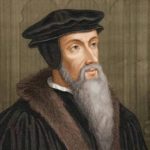
 Article by Dr. Sam Storms entitled 10 Things You Should K ow About the Life of John Calvin (original source here)
Everyone everywhere is talking about Martin Luther in 2017. It is, as you know, the 500th anniversary of the “launch” of the Protestant Reformation. But we would do well to give equal consideration to John Calvin. So today we look at 10 things everyone should know about his life. I will later follow up on this with 10 things we should know about his theology.
(1) Calvin was born on July 10, 1509, at Noyon in Northeastern France. Unlike Luther, Calvin was born into the professional class and received an excellent early education. His name has come to us via a process: Cauvin is French; Calvinus is the Latinized form; Calvin is the Anglicized form.
(2) At the age of 13-14 he attended the University of Paris where he came under the influence of three men: Nicolas Cop; Olivetan (both of whom had a positive impact on him with respect to his eventual break with Rome); and John Major, an anti-reformer who ironically introduced Calvin to the writings of Wycliffe, Hus, and Luther. He received his masters degree in 1528 and then studied law at the University of Orleans under pressure from his father and because of a growing discontent with the Roman Catholic Church. In 1532, at the age of twenty-two, he received his doctorate in civil law. He later studied Classics in Paris and was also well-educated in theology, ancient languages and rhetoric.
(3) Some place his conversion as late as 1534 and others as early as 1527-28. Unlike Luther, his was not a dramatic experience, but not for that reason any less revolutionary. He does describe his move from the teachings of Rome to biblical Christianity as a change “from papal superstitions to evangelical faith, from mechanical ceremonies to trust and faith, and from scholastic traditionalism to biblical simplicity” (Schaff, VIII:306).
At another point he calls it a “sudden conversion” but not in the sense of a Damascus road experience. Rather it was the climactic fall of a city by a final assault following a long siege. When “I was obstinately addicted to the superstitions of the papacy,” he writes, “God subdued and reduced my heart to docility.” Speaking of the sovereignty of God’s work, he writes: “Thou didst shine upon me with the brightness of Thy Spirit. . . . Thou didst arouse my soul.”
(4) Calvin did not at first desire a break with Rome, but envisioned a purification of the church from within. This was not to be. Calvin’s friend, Nicolas Cop, was elected Rector of the University on Oct. 10, 1533 and delivered the inaugural lecture on All Saint’s Day, Nov. 1, before a large assembly. The speech, written primarily by Calvin, was a plea for reformation and an attack on both Catholic theology and theologians. Of the latter Calvin wrote: “They teach nothing of faith, nothing of the love of God, nothing of the remission of sins, nothing of grace, nothing of justification; or if they do so, they pervert and undermine it all by their laws and sophistries. I beg you, who are here present, not to tolerate any longer these heresies and abuses.”
The reaction was violent. Cop fled to Basel. Calvin is reported to have descended from a window by means of bed-sheets and escaped from Paris disguised as a vine-dresser with a hoe upon his shoulder. His rooms were ransacked and his papers seized.
(5) Calvin was influenced by friends and colleagues to break completely with Rome, which he did in 1534. The next two years were spent as a wandering student and evangelist. He settled in Basel, hoping to spend his life in quiet study. There he began writing The Institutes under the assumed name of Marianus Lucanius (either to avoid publicity or persecution). In March of 1536 the first edition, which contained only 6 chapters (an exposition of the Decalogue, the Apostles Creed, the Lord’s Prayer, with brief comments on baptism and the Lord’s Supper, the other sacraments, Christian liberty, church government, and church discipline) was ready for publication. He became famous overnight.
(6) Calvin returned to Paris in 1536 to settle some old financial matters. He decided to go from there to Strasbourg to be a scholar, but as he later explained it: “God thrust me into the game!” He was detoured during the journey to Geneva because of the war then raging between Francis I and Charles V. An old friend, du Tillet, recognized him in the hotel and immediately informed William Farel (1489-1565). When Calvin resisted Farel’s pleas to join him in the work of reformation in Geneva, the latter shouted: “Therefore, I proclaim to you in the name of Almighty God whose command you defy: Upon your work there shall rest no blessing! Therefore, let God damn your rest, let God damn your work!” As if under searing fire, Calvin’s defiance melted. And as he offered his hand to the preacher, a tear rolled over his caved-in cheek. “I obey God!” was his cry.
(7) Upon arriving in Geneva, he began to lecture on the Pauline epistles, wrote a constitution for the church, introduced congregational psalm singing, wrote a confession of faith, a children’s catechism, and insisted on the weekly observance of the Lord’s Supper (but eventually had to settle for monthly). Trouble erupted when he and Farel sought to administer both church and civil discipline. The two were literally kicked out of town in April of 1538. Calvin was determined to return to Basel and resume his studies, but Martin Bucer (who was won to the Reformation while listening to Luther at the Leipzig debate) persuaded him to go to Strasbourg where he remained from 1538-1541.
(8) Calvin often said he didn’t care what a wife looked like as long as she was of a Christian spirit and could interact with him intellectually. In another place he wrote:
“I am none of those insane lovers who embrace also the vices of those they are in love with, when they are smitten at first sight with a fine figure. This only is the beauty which attracts me: if she is chaste, if not too nice or fastidious, if economical, if patient, if there is hope that she will be interested about my health.”
He finally married Idelette de Bure in 1540 who brought two children with her from a previous marriage (her first husband was an Anabaptist whom Calvin had led to the Lord). She died in 1549. They had three children, all of whom died in infancy.
(9) Once again under pressure from Farel, Calvin returned to Geneva in 1541 and ministered there until his death in 1564. Upon his return, Calvin was given a free hand. He drafted a document containing rules for ecclesiastical operations called Church Order. This attempt to enforce discipline would again threaten his position in the city. He faced opposition from numerous fronts.
The so-called Patriots or Children of Geneva belonged to the oldest and most influential families of Geneva. They resented Calvin’s efforts at moral reform and viewed them as encroachments on personal freedom (Calvin resisted such practices as dancing and late-night carousing). They disliked the fact that Calvin was a foreigner (he did not become a citizen until 1559) and resented the refugees of religious persecution that flocked to him for shelter.
The Libertines lobbied for the very vices Calvin resisted. Being somewhat gnostic, they appealed to the freedom of the spirit as an excuse for indulging the flesh. Calvin described them as “the most execrable and pernicious sect the world has ever known.” The libertines boasted in their license. For them, the “communion of saints” meant the common possession of all goods, even other men’s wives. They engaged in adultery and widespread sexual immorality while claiming the right to sit at the Lord’s Table.
(10) Calvin’s physical afflictions read like a medical journal. He suffered from painful stomach cramps, intestinal influenza, and recurring migraine headaches. He was subject to a persistent onslaught of fevers that would often lay him up for weeks at a time. He experienced problems with his trachea, in addition to pleurisy, gout, and colic. He suffered from hemorrhoids that were often aggravated by an internal abscess that would not heal. He had severe arthritis and acute pain in his knees, calves, and feet. Other maladies included nephritis (acute, chronic inflammation of the kidney caused by infection), gallstones, and kidney stones. He once passed a kidney stone so large that it tore the urinary canal and led to excessive bleeding.
Due to his rigorous preaching schedule (he preached twice on Sunday and every day of the week, every other week) he would often strain his voice so severely that he experienced violent fits of coughing. On one occasion he broke a blood-vessel in his lungs and hemorrhaged. When he reached the age of 51 it was discovered that he was suffering from pulmonary tuberculosis, which ultimately proved fatal. Much of his study and writing was done while bed-ridden. In the final few years of his life he had to be carried to work.
His friends and physicians insisted he ease off the pace of ministry. “What! Would you have the Lord find me idle when he comes?” He preached his last sermon on February 6, 1564. He had to be carried to and from the pulpit. He dictated his will on April 25th. It read, in part, as follows:
“In the name of God, I, John Calvin, servant of the Word of God in the church of Geneva, weakened by many illnesses . . . thank God that He has shown not only his mercy toward me, His poor creature, and . . . has suffered me in all sins and weaknesses, but what is more, that He has made me a partaker of His grace to serve Him through my work, . . . I confess to live and die in this faith which He has given me, inasmuch as I have no other hope or refuge than His predestination upon which my entire salvation is grounded. I embrace the grace which He has offered me in our Lord Jesus Christ and accept the merits of His suffering and dying that through them all my sins are buried.”
Calvin’s coat of arms, a hand holding a heart, is testimony to his compassionate and self-sacrificial spirit. It is encircled by his motto: Cor meum tibi offero Domine prompte et sincere. Freely translated it means: “My heart for Thy cause I offer Thee, Lord, promptly and sincerely.”

 Article: Dr. Sam Storms – The Most Serious and Severe Departure From The Faith In Our Day (original source here)
 THE PULPIT