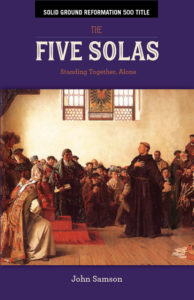
 Iron Sharpens Iron – July 5, 2017 Chris Arnzen interviews John Samson on his new booklet “The Five Solas: Standing Together, Alone!” at this link.
2 Hour Interview
Reply

Iron Sharpens Iron – July 5, 2017 Chris Arnzen interviews John Samson on his new booklet “The Five Solas: Standing Together, Alone!” at this link.
 Interview with J. I. Packer (original source here)
Modern Reformation: Dr. Packer, you’ve done a great deal of writing and speaking on the subject of the need for a new reformation, a new awareness of the sovereignty and grace of God in our day. How do you assess the condition of the state of evangelicalism as it presently exists, and what do you think we can do about that condition.
J. I. Packer: I see evangelical strength in America needing desperately to be undergirded by Reformation convictions, otherwise the numeric growth of evangelicals, which has been such a striking thing in our time, is likely never to become a real power, morally and spiritually, in the community that it ought to be. I mean by Reformation truth, a God-centered way of thinking, an appreciation of his sovereignty, an appreciation of how radical the damage of sin is to the human condition and community, and with that, an appreciation of just how radical and transforming is the power of the Lord Jesus Christ in his saving grace. If you don’t see deep into the problem, you don’t see deep into the solution. My fear is that a lot of evangelicals today are just not seeing deep enough in both the problem and the need. But Reformation theology takes you down to the very depth of the human problem. And actually, the Reformation itself was a recovery of the tremendous contribution that the great St. Augustine made back at the turn of the 4th and 5th centuries. He was the man who, more than anyone else in Christendom, saw to the heart of the real problem. He saw how much damage sin had done, how completely we were oriented away from God by nature. He is the one who left us that phrase “original sin” which he got from the text of Psalm 51:5, “Surely I was sinful at birth, sinful from the time my mother conceived me.” He also saw in response to our sinful condition, how great a work of transformation was needed by the grace of God in human lives. The sixteenth century reformers stood on Augustine’s shoulders at this point. Of course they clarified the great truth that justification by faith is the way in which the grace of God reaches us. We need, even today, a Christianity that was as deep and strong as that. And this, it seems to me, is where modern evangelicalism is lacking.
MR: Would you say that there is a connection or a similarity between the man-centered theology of evangelicalism and the general humanistic spirit? Continue reading
Article by Turretinfan: Is Justification Forensic?
Some opponents of reformation theology attempt to deny that the term justification can be used in the context of declaration of righteousness, as opposed to infusion of righteousness. For those folks, the passages that contrast justification with condemnation should help. Surely none of these people will think that condemnation is the infusion of unrighteousness. Rather, they will recognize that condemnation is a judicial declaration of unrighteousness.
By contrast, therefore, it can be seen that justification is a declaration of righteousness. We see this several times in Scripture, both in the English of the KJV, as well as in the Clementine Latin Vulgate, so our Roman Catholic opponents have no room to complain:
1 Kings 8:32
(KJV) Then hear thou in heaven, and do, and judge thy servants, condemning the wicked, to bring his way upon his head; and justifying the righteous, to give him according to his righteousness.
(CLV) tu exaudies in cælo : et facies, et judicabis servos tuos, condemnans impium, et reddens viam suam super caput ejus, justificansque justum, et retribuens ei secundum justitiam suam.
(LXX) καὶ σὺ εἰσακούσει ἐκ τοῦ οὐρανοῦ καὶ ποιήσεις καὶ κρινεῖς τὸν λαόν σου Ισραηλ ἀνομηθῆναι ἄνομον δοῦναι τὴν ὁδὸν αὐτοῦ εἰς κεφαλὴν αὐτοῦ καὶ τοῦ δικαιῶσαι δίκαιον δοῦναι αὐτῷ κατὰ τὴν δικαιοσύνην αὐτοῦ.
Job 9:20
(KJV) If I justify myself, mine own mouth shall condemn me: if I say, I am perfect, it shall also prove me perverse.
(CLV) Si justificare me voluero, os meum condemnabit me ; si innocentem ostendero, pravum me comprobabit.
(LXX) ἐὰν γὰρ ὦ δίκαιος, τὸ στόμα μου ἀσεβήσει· ἐάν τε ὦ ἄμεμπτος, σκολιὸς ἀποβήσομαι.
Proverbs 17:15
(KJV) He that justifieth the wicked, and he that condemneth the just, even they both are abomination to the Lord.
(CLV) Qui justificat impium, et qui condemnat justum, abominabilis est uterque apud Deum.
(LXX) ὃς δίκαιον κρίνει τὸν ἄδικον, ἄδικον δὲ τὸν δίκαιον, ἀκάθαρτος καὶ βδελυκτὸς παρὰ θεῷ.
Matthew 12:37
(KJV) For by thy words thou shalt be justified, and by thy words thou shalt be condemned.
(CLV) Ex verbis enim tuis justificaberis et ex verbis tuis condemnaberis.
(NA28) ἐκ γὰρ τῶν λόγων σου δικαιωθήσῃ, καὶ ἐκ τῶν λόγων σου καταδικασθήσῃ.
Romans 5:16
(KJV) And not as it was by one that sinned, so is the gift: for the judgment was by one to condemnation, but the free gift is of many offences unto justification.
(CLV) Et non sicut per unum peccatum, ita et donum. Nam judicium quidem ex uno in condemnationem : gratia autem ex multis delictis in justificationem.
(NA28) καὶ οὐχ ὡς δι’ ἑνὸς ἁμαρτήσαντος τὸ δώρημα· τὸ μὲν γὰρ κρίμα ἐξ ἑνὸς εἰς κατάκριμα, τὸ δὲ χάρισμα ἐκ πολλῶν παραπτωμάτων εἰς δικαίωμα.
Romans 5:18
(KJV) Therefore as by the offence of one judgment came upon all men to condemnation; even so by the righteousness of one the free gift came upon all men unto justification of life.
(CLV) Igitur sicut per unius delictum in omnes homines in condemnationem : sic et per unius justitiam in omnes homines in justificationem vitæ.
(NA28) Ἄρα οὖν ὡς δι’ ἑνὸς παραπτώματος εἰς πάντας ἀνθρώπους εἰς κατάκριμα, οὕτως καὶ δι’ ἑνὸς δικαιώματος εἰς πάντας ἀνθρώπους εἰς δικαίωσιν ζωῆς·