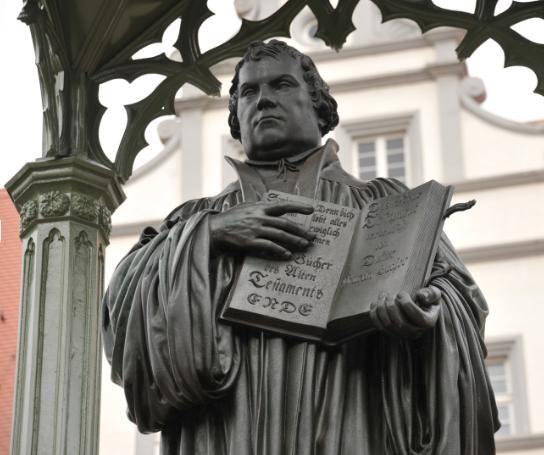
 Article: Was Luther Insane? by Dr. R. C. Sproul (original source here)
With the advent of modern psychoanalysis, it’s become popular to evaluate the psyches of famous historical figures: people like Alexander the Great, Moses, Nero, and others. One of the favorite targets of study is Martin Luther. Erik Erikson, for example, emphasized that Martin Luther was not only neurotic, but psychotic as well. This accusation implies that one of our great heroes of the faith is one whose sanity is seriously questioned.
Why do some thinkers come to the conclusion that Martin Luther was a madman? To be fair, even a cursory glance at the readings of Luther reveal a man of tempestuous spirit, personal intensity, and profound passion. There are certain events in his life that seem not only strange, but at times even bizarre. We can understand, to some degree, why some people think Luther might not have been sane.
We know Luther was preoccupied with a foreboding sense of his own death, having predicted it at least six times falsely. We know also that Luther went through several peculiar episodes, such as his being knocked from his horse by lightning, which led him to become a monk. Some think this episode explains his neurosis or psychosis. We also know the story of his pilgrimage to Rome and his going through emotional turmoil in climbing the stairs of the Scala Sancta on his knees. We know of first experience in celebrating the Mass. When he came to the part when he had to say, “Hoc est corpus meum,” the words lodged in his throat. There was an awkward silence as his family and friends waited. Luther stood there quivering, unable to complete the saying. He was terrified of the thought that he was holding in his hands the transubstantiated body and blood of Christ. A strange experience indeed for a man of great poise and presence—but not enough to deem him insane.
Luther was also obstinate and single-minded in his debates with Johann Eck and Thomas Cajetan. These debates led to the confrontation at Worms, where Luther dared to defy the church on a major point of doctrine. We know how Hollywood portrays Luther’s stance at Worms. When he’s called upon to recant, Luther stands with his chest out and says: “Unless I am convinced by sacred Scripture or by evident reason, I shall not recant. For my conscience is held captive by the Word of God, and to act against conscience is neither right nor safe. Here I stand, I can do no other. God help me.” He then jumps on his horse and rides off to start the Reformation.
Perhaps it happened like that, but have you ever read the prayer Luther wrote the night before that meeting? Do you remember what happened in his first encounter before the princes of the church and of the state? When they asked him to recant, he stood there meekly. He looked at the princes, and he said in a hesitant voice, “Could I have twenty-four hours to think it over?” They granted him this time. He went back to the privacy of his own chambers, and he composed a prayer. If ever a man was broken before God and experienced a sense of utter helplessness and loneliness against the forces of this world, it was Luther at that moment.
But even that moment isn’t why people think he was crazy. The biggest reason for questioning Luther’s sanity has to do with his period of intense scrupulosity in the confessional. It was customary and required of the young monks of the monastery to go through daily confession. As a matter of prescribed procedure, the monks would come into the confessional in the morning, and they would confess the sins of the last twenty-four hours, receive the absolution of the priest, and go about the day’s labors. This would typically take each monk two or three minutes.
Not Luther. He would go into the confessional and recite the previous day’s sins not for five minutes, but for two hours, three hours, sometimes even four hours—reciting in detail every sin he could remember. Luther felt the imminent wrath and judgment of God. If it was crazy to feel this imminence, then Luther was undoubtedly a crazy man. He would come back from the confessional tormented after spending hours confessing his sins. As soon as he got back to his room, he would remember a sin he had forgotten to confess. This is a neurotic preoccupation with guilt, and so they say Luther was crazy. But was he really?
One of the things about Luther that’s often overlooked is that before the episode of his being knocked from his horse, Luther had already distinguished himself as one of the most brilliant students of law in all of Europe. His father was furious when Luther left a promising career in law to waste his life on religion. The keen analytical ability of Luther’s mind in understanding the demands of law were applied to Scripture.
Luther’s logic worked like this: “If the great commandment is to love God with all of your heart, mind, soul, and strength, and your neighbor as much as yourself, then what’s the great transgression? The failure to love God with all of your heart, mind, soul, and to love every human being in this world as much as you love yourself. To fail to do that is to commit an act of cosmic treason against the Lord God Almighty. That’s not a peccadillo. That’s enough to send me to hell forever, and so I tremble with every slightest act that transgresses the holiness of God and the sanctity of those who are created in His image.”
Logically and theologically then, Luther was the sanest man in Europe. He understood the demands of the law of God, and it seemed to be driving him crazy. That is, until his brilliant mind, in his preparation of lectures for Romans, turned its attention to Romans 3: “For by works of the law no human being will be justified in his sight, since through the law comes knowledge of sin.” Then Luther read a word that is the most precious word in all of Scripture. It’s the gospel in one word—but: “But now the righteousness of God has been manifested apart from the law.” Then he read the conclusion in verse 28: “For we hold that one is justified by faith apart from works of the law.”
Luther said, “When that message made an impact on my mind and penetrated my understanding, the gates of paradise swung open and I walked in. The just shall live by faith.” Luther moved from torment to peace, from neurosis to confidence, from seeming insanity to sanity, giving him the strength and the courage to change the world.
Therefore, I hope that during this significant 500th anniversary of the Reformation, you are sane like Luther. On the one hand, Luther understood the holiness of the law of God, and on the other hand, he understood his utter and complete dependence upon the righteousness of Christ for peace and justification.
It’s one thing to understand justification by faith in the head. It’s another thing to get it in your bloodstream—to let it flow into the lives of everyone you meet. By this and by God’s grace, we can ensure that this gospel may never be hidden or obscured again.