

The Doctrine of Particular Redemption

Ten Lines of Evidence for the Doctrine of Particular Redemption

Excerpt from A New Systematic Theology of the Christian Faith, 2nd ed. by Robert Reymond

The Particularistic Vocabulary of Scripture

The Scriptures themselves particularize who it is for whom Christ died. The beneficiaries of Christ’s cross work are denominated in the following ways: “The house of Israel, and the house of Judah,” that is, the church or “true Israel” (Jer. 31:31; Luke 22:20; Heb. 9:15); his “people” (Matt. 1:21); his “friends” (John 15:13); his “sheep” (John 10:11, 15); his “body,” the “church” (Eph. 5:23–26; Acts 20:28); the “elect” (Rom. 8:32–34); the “many” (Isa. 53:12; Matt. 20:28; 26:28; Mark 10:45); “us” (Tit. 2:14); and “me” (Gal. 2:20).

It is true, of course, that logically a statement of particularity in itself does not necessarily preclude universality. This may be shown by the principle of subalternation in Aristotelian logic, which states that if all S is P, then it may be inferred that some S is P, but conversely, it cannot be inferred from the fact that some S is P that the remainder of S is not P. A case in point is the “me” of Galatians 2:20: the fact that Christ died for Paul individually does not mean that Christ died only for Paul and for no one else.

But it should also be evident that one of these particularizing terms—the “elect”—clearly carries with it the implication that some are excluded from the saving intention and salvific work of Christ. And certain details in the other passages suggest that the designated people for whom Christ died stand in a divinely distinguished gracious relationship to him different in kind from the relationship in which other people stand to him, because of which relationship he did his cross work for them. For example, Christ declared that he, as the good Shepherd, would lay down his life for his sheep (John 10:11, 15). But how does it come about that one is his sheep? By believing on him? Not at all. Jesus said to the Jews, not (as it is often represented): “You are not my sheep because you do not believe,” but: “You do not believe because [ὅτι, hoti] you are not my sheep. My sheep listen to [believe] my voice; I know them, and they follow me” (John 10:26–27).6 From this we may infer that unless one is already in some sense one of his sheep he does not believe, and also that it is because one is already in some sense one of his sheep that he believes on him. But if one is already in some sense one of his sheep prior to faith, on the basis of which prior “shepherd-sheep” relationship Christ does his cross work for the sheep and the sheep in turn believes on him, then that relationship itself can only be the result of distinguishing grace and thus a relationship different from that which the others sustain to him.

Another example is Ephesians 5:25, where Paul teaches, first, that Christ loved the church and gave himself for it. From this juxtaposition of these two verbs, it may be inferred both that the church enjoyed a special existence and a standing before Christ such that he “loved” her prior to his “giving” himself for it, and that his love for his church was the motivating power behind his “giving” himself for it. Second, Paul teaches that the husband is to love his wife just as (καθὼς, kathōs) Christ loved the church and gave himself for it. But if Christ does not love his church in a special way, different in kind from the way he loves all other people, and if the husband is to love his wife just as Christ loved the church, then the husband is to love all other women in the same way that he loves his wife—surely a grotesque ethic! For Paul’s comparison to have any meaning for his readers, Christ’s love for his church must be construed as a special particularizing, distinguishing love.

Hence the particularizing terms can and do indicate an exclusive group for whom Christ died, a fact which proponents of a universal atonement can deny only by ignoring details in the contexts in which the particularizing terms occur.

God’s Redemptive Love Not Inclusive of Fallen Angels

It is clear that the Triune God’s redemptive love is not unlimited or universal from the undeniable fact that it does not embrace fallen angels (Heb. 2:16). There are “elect angels” (1 Tim. 5:21) who clearly were elected on supra-lapsarian grounds since they were not chosen from a mass of angels viewed as fallen, and accordingly there are fallen angels concerning whose redemption no divine efforts have been or will be expended, although they are creatures as much in need of redemption as are fallen men (2 Pet. 2:4; Jude 6). It is freely granted that the fallen angels belong to a different creation order from that of humankind and that God has sovereignly determined to deal with (at least some) fallen people differently from the manner in which he has dealt with fallen angels. But the nonredemptive nature of his dealings with fallen angels raises the possibility at least that God’s redemptive love for fallen humanity may not necessarily be unlimited and universal either.

The Irreversible Condition of Lost Men Already in Hell When Christ Died
Unless one is prepared to say that Christ gave all the dead a second chance to repent (some would say a “first chance”), it is impossible to suppose that Christ died with the intention of saving those whose eternal destiny had already been sealed in death, who were at the time of his death already in hell. He clearly did not die with the intention of saving them. Continue reading

All Of Us Are Eleventh-Hour Laborers

Article: We Are All Eleventh-Hour Laborers by Dr. Jerry Bridges who was the author of more than a dozen books, a popular speaker, and a staff member of The Navigators in Colorado Springs, Co. Dr. Bridges went to be with the Lord in March 2016. This post was originally published in Tabletalk magazine. (source)

Chapter divisions in the Bible are usually helpful as they allow us to find our way around the Scriptures. Occasionally, however, they can hinder our understanding of a passage if they cause us to look at it apart from its context. This often is the case with the parable of the laborers in the vineyard (Matt. 20:1–16). Because of the chapter division at the end of Matthew 19, we fail to understand the parable in its context of Jesus’ teaching in 19:16–30.

Because that section of Matthew has already been treated in another article, we will not look at it now, except to observe that the occasion of the parable is Peter’s question in Matthew 19:27: “See, we have left everything and followed you. What then will we have?” Like many of us today, Peter thought he related to God on the basis of merit, and he was already adding up his merit points.

The parable is part of Jesus’ reply to Peter, which begins in chapter 19, verse 28. The message of the parable can be summarized in this statement: The operative principle in the kingdom of heaven is not merit but grace. We readily understand this principle in the context of our salvation. We know Paul’s words: “For by grace you have been saved through faith. …not as a result of works, so that no one may boast” (Eph. 2:8–9), but many believers assume that we earn God’s blessings by our works — apart from God’s grace.

The parable of the laborers in the vineyard, however, teaches us that not only our salvation, but also our entire Christian lives are to be lived on the basis of God’s grace. Then the parable also teaches us about two amazing qualities of grace: the abundant generosity of His grace, and His sovereignty in dispensing it.

Consider first the abundant generosity of His grace. The master hired laborers for his vineyard first at 6 a.m., then periodically throughout the day. Finally, he hired some at 5 p.m. to work only one hour. This man, who obviously represents God, was both fair and generous. To the first group of laborers he was fair, as he readily agreed to pay a denarius, the ordinary wage for a day’s labor. Then he was progressively more generous to each group of laborers hired throughout the day. The master could have paid them what they earned, but he chose to pay them according to their need, not according to their work. He paid according to grace, not debt.

The parable focuses particularly on those workers who were hired at the eleventh hour. They were treated extremely generously, each receiving twelve times what he had earned on an hourly basis. Why did the landowner hire these laborers at the eleventh hour? Was it because an extra push was needed to complete the work? More likely, since Jesus was not teaching about Jewish agriculture, but about the kingdom of heaven, those eleventh hour workers were hired because they needed to receive a day’s wages. Laborers of that day lived a day-to-day existence. That is why the Law required land owners to pay hired men at the end of each day (Deut. 24:15).

This is the way God treats us. Over and over again, the Bible portrays God as gracious and generous, blessing us not according to what we have “earned” but according to our needs — and often beyond our needs. He has already blessed us with all spiritual blessings in Christ Jesus (Eph. 1:3), and He promises to supply every temporal need, again in Christ Jesus (Phil. 4:19).

The truth is, we cannot “earn” anything from God apart from His grace. As Jesus said elsewhere, when we have done all that we are commanded, we should say, “We have only done what was our duty” (Luke 17:10). We have not obligated God or earned His blessings. Rather, all blessings come to us “in Christ,” that is, by His grace.

God, however, is not only generous with His grace; He is sovereign in dispensing it. We often speak of “sovereign grace.” In one sense that is a redundant expression. Grace, by definition, must be sovereign. The master of the vineyard expressed it this way, “Am I not allowed to do what I choose with my belongings?”

Many are troubled by the apparent unfairness of the landowner. After all, it does seem unfair to pay one-hour workers the same as was paid to those who worked a full twelve hours, who had “borne the burden of the day and the scorching heat.” But the one-hour laborers did not think the master was unfair; rather, they considered him very generous. If we are troubled by the apparent unfairness, it is because we tend to identify with the twelve-hour workers. And the more committed we are to serious discipleship, the more apt we are to fall into the trap of envying those who enjoy the blessings of God more than we.

The truth is, we are all eleventh-hour laborers. None of us have even come close to loving God with all of our heart, soul, and mind. None of us have come close to loving our neighbor as ourselves (Matt. 22:37–39). So let us learn to be thankful for all God gives to us and not begrudge blessings He gives to others.

Mere Christianity

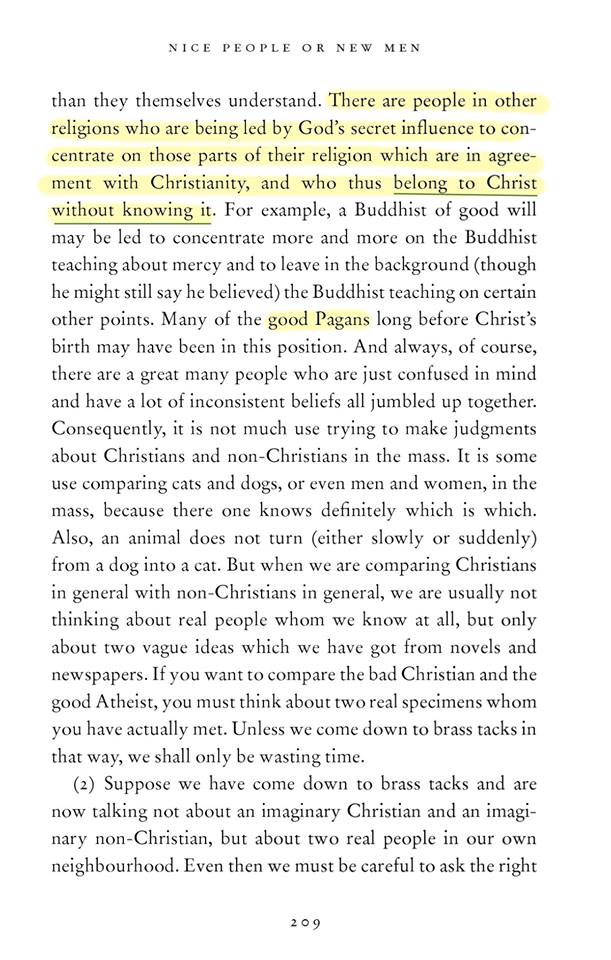
Phil Johnson writes: I’d class “Mere Christianity” as Lewis’s worst non-fiction book, hands down. In it, he says,

“There are people in other religions who are being led by God’s secret influence to concentrate on those parts of their religion which are in agreement with Christianity, and who thus belong to Christ without knowing it. For example, a Buddhist of good will may be led to concentrate more and more on the Buddhist teaching about mercy and to leave in the background (though he might still say he believed) the Buddhist teaching on certain other points. Many of the good Pagans long before Christ’s birth may have been in this position. And always, of course, there are a great many people who are just confused in mind and have a lot of inconsistent beliefs all jumbled up together. Consequently, it is not much use trying to make judgments about Christians and non-Christians in the mass.”