
The Letter Kills But The Spirit Gives Life

Charles Hodge on 2 Corinthians 3:6:

An Exposition of the Second Epistle to the Corinthians. Grand Rapids: Eerdmans, n.d., 56-58 (Language modernized by Nate Milne where necessary).

For the letter (i.e., the law) kills, but the spirit (i.e., the gospel) gives life. This is the reason why God has made Paul the minister of the Spirit. “God had made us able minsters not of the law but of the gospel, for the law kills, but the gospel gives life.” This passage and the following context present two important questions. First, “In what sense does the law kill?” And second, “How is it that the apostle attributes to the Mosaic system this purely legal character, when he elsewhere so plainly teaches that the gospel was witnessed or taught both in the law and the prophets?”

As to the former of these questions, the answer furnished by the Scriptures is plain. The law demands perfect obedience. It says, “Do this and live” (Rom. 10:5; Gal. 3:12), and “Cursed is everyone who does not continue in all things written in the book of the law to do them” (Gal. 3:10). As no man renders this perfect obedience, the law condemns him. It pronounces on him the sentence of death. This is one way in which it kills.

In the second place, it produces the knowledge or consciousness of sin, and of course of guilt, that is, of just exposure to the wrath of God. Thus again it slays. And thirdly, by presenting the perfect standard of duty, which cannot be seen without awakening the sense of obligation to be conformed to it, while it imparts no disposition or power to obey, it exasperates the soul and thus again it brings forth fruit unto death. All these effects of the law are systematically presented by the apostle in Romans 6 & 7, and Galatians 3.

The second question is more difficult. Every reader of the New Testament must be struck with the fact that the apostle often speaks of the Mosaic law as he does of the moral law considered as a covenant of works; this is, presenting the promise of life on the condition of perfect obedience. He represents it saying, “Do this and live;” as requiring works, and not faith, as the condition of acceptance (Rom. 10:5-10; Gal. 3:10-12). He calls it a ministration of death and condemnation. He denies that it can give life (Gal. 3:21). He tells those who are of the law (that is, Judaizers) that they had fallen from grace; that is, had renounced the gratuitous method of salvation, and that Christ should profit them nothing (Gal. 5:2, 4).

In short, when he uses the word law, and says that by the law is the knowledge of sin, that it can only condemn, that by its works no flesh can be justified, he includes the Mosaic law; and in the epistle to the Galatians all these things are said with special reference to the law of Moses.

On the other hand, however, he teaches that the plan of salvation has been the same from the beginning; that Christ was the propitiation for the sins committed under the old covenant; that men were saved then as now by faith in Christ; that this mode of salvation was revealed to Abraham and understood by him, and taught by Moses and the prophets. This view is presented repeatedly in Paul’s epistles, and is argued out in due form in Rom. 3:21-31; Rom. 4; & Gal. 3.

To reconcile these apparently conflicting representations it must be remembered that the Mosaic economy was designed to accomplish different objects, and is therefore presented in Scripture under different aspects. What, therefore, is true of it under one aspect, is not true under another.

1. The law of Moses was, in the first place, a re-enactment of the covenant of works. A covenant is simply a promise suspended upon a condition. The covenant of works, therefore, is nothing more than the promise of life suspended on the condition of perfect obedience. The phrase is used as a concise and convenient expression of the eternal principles of justice on which God deals with rational creatures, and which underlie all dispensations, the Adamic, Abrahamic, Mosaic, and Christian. Our Lord said to the lawyer who asked what he should do to inherit eternal life, “‘What is written in the law? What do you read?’ And he, answering, said, ‘You shall love the Lord your God with all your heart, and with all your soul, and with all your strength, and with all your mind; and your neighbor as yourself.’ And he said unto him, ‘You have answered rightly, do this and you shall live’” (Luke 10:26-28). This is the covenant of works. It is an immutable principle that where there is no sin there is no condemnation, and where there is sin there is death. This is all that those who reject the gospel have to fall back upon. It is this principle which is rendered so prominent in the Mosaic economy as to give it is character of law. Viewed under this aspect is is the ministration of condemnation and death.

2. The Mosaic economy was also a national covenant; that is, it presented national promises on the condition of national obedience. Under this aspect also it was purely legal.

3. But, as the gospel contains a renewed revelation of the law, so the law of Moses contained a revelation of the gospel. It presented in its priesthood and sacrifices, as types of the office and work of Christ, the gratuitous method of salvation through a Redeemer. This necessarily supposes that faith and not works was the condition of salvation. It was those who trusted, not those free from sin, who were saved. Thus Moses wrote of Christ (John 5:46); and thus the law and the prophets witnessed of a righteousness of faith (Rom. 3:21). When therefore the apostle spoke of the old covenant under its legal aspect, and especially when speaking to those who rejected the gospel and clung to the law of Moses as law, then he says, it kills, or is the ministration of condemnation. But when viewing it, and especially when speaking of those who viewed it as setting forth the great doctrine of redemption through the blood of Christ, the represented it as teaching his own doctrine.

The law, in every form, moral or Mosaic, natural or revealed, kills. In demanding works as the condition of salvation, it must condemn all sinners. But the gospel, whether as revealed in the promise to Adam after his fall, or in the promise to Abraham, or in the writings of Moses, or in its full clearness in the New Testament, gives life. As the old covenant revealed both the law and the gospel, it either killed or gave life, according to the light in which it was viewed. And therefore Paul sometimes says it does the one, and sometimes the other.

But the spirit gives life. The spirit, or the gospel, gives life in a sense correlating to that in which the letter (i.e., the law) kills.

1. By revealing a righteousness adequate to our justification, and thus delivering us from the sentence of death.

2. By producing the assurance of God’s love and the hope of his glory in the place of a dread of his wrath.

3. By becoming, through the agency of the Holy Spirit, an inward principle or power transforming us into the image of God; instead of a mere outward command.
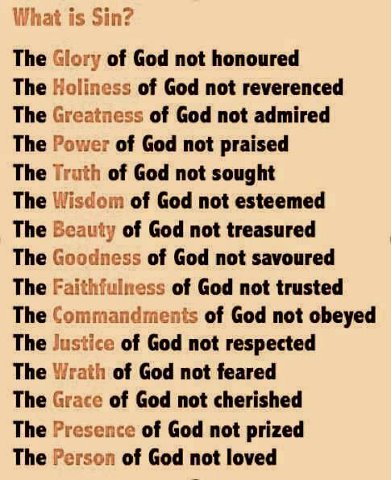
After You Have Sinned… Remember This…

Adriel Sanchez is pastor of North Park Presbyterian Church, a congregation in the Presbyterian Church in America (PCA). In addition to his pastoral responsibilities, he also serves the broader church as a contributor on the White Horse Inn radio program. He and his wife Ysabel live in San Diego with their three children. Here is an article he wrote entitled, “4 Things To Remember After You Have Sinned” – original source here.

Have you ever felt like God turned his back on you because of your sin? Our failures, especially when they’re repeated, can leave us in a place of confusion. After we sin, we can begin to feel as if the light of God’s grace is no longer shining in our lives. Here are four things that God does when we have failed:

1. When we sin, God is advocating for us.
An advocate is someone who stands beside you and supports you. According to the apostle John, it’s precisely when we feel as though God has left us that he’s right there beside us!

My little children, I am writing these things to you so that you may not sin. But if anyone does sin, we have an advocate with the Father, Jesus Christ the righteous. (1 John 2:1)

When we sin, we have Christ in our corner as an advocate, pleading our case before the Father. This should give you comfort that God is for you and your repentance. If God heard the voice of Moses when he pleaded on behalf of the Israelites after they had committed idolatry by worshipping a golden calf (Exod. 32:11), will he not listen to the pleadings of his beloved Son on your behalf?

2. When we sin, God is praying for us.
The shame that accompanies sin sometimes makes it difficult for us to approach God in prayer. It feels as though “God has wrapped himself with a cloud so that no prayer can pass through” (Lam. 3:44). Take comfort in the fact that there is One who is holy, innocent, undefiled, set apart from sinners, and exalted above the heavens, who always lives to make intercession for you (see Heb. 7:24–25). Above the iron clouds that seem impenetrable, Jesus stands praying. Through him you can approach God in prayer even after you have failed (Heb. 4:16); and since he lives to make intercession for you, even when you are silent, Jesus speaks (Rom. 8:34). And not only Jesus, but God the Spirit also intercedes on your behalf:

Likewise the Spirit helps us in our weakness. For we do not know what to pray for as we ought, but the Spirit himself intercedes for us with groanings too deep for words. And he who searches hearts knows what is the mind of the Spirit, because the Spirit intercedes for the saints according to the will of God. (Rom. 8:26–27)

3. When we sin, God disciplines us.
At first this can sound frightening, but it is meant to remind you of how much God loves you.

My son, do not despise the LORD’s discipline or be weary of his reproof, for the LORD reproves him whom he loves, as a father the son in whom he delights. (Prov. 3:11–12)

The sense of heaviness that often accompanies our sin may very well be God’s fatherly hand leading us to repentance. David, the king of Israel, wrote of his experience prior to confessing his sin.

For when I kept silent, my bones wasted away through my groaning all day long. For day and night your hand was heavy upon me; my strength was dried up as by the heat of summer. (Ps. 32:3–4; italics added)

When David came to the point of confession, however, he could proclaim, “You forgave the iniquity of my sin!” (v. 5). When God disciplines you, it is for your good, so that you might share in his holiness (Heb. 12:10) and not be condemned with the world (1 Cor. 11:32). Don’t let the discipline of God lead you to despair, but let it be another indication of his kindness over you.

4. When we sin, God offers to feed us.
One of the most heartbreaking stories in the Bible is the story of when Peter denied Jesus. Jesus had never turned his back on Peter, but during Jesus’ hour of greatest need, Peter abandoned him. When a crowd confronted Peter about whether he knew Jesus, “[Peter] began to invoke a curse on himself and to swear, ‘I do not know the man.’” Peter then remembered that Jesus had foretold his sin, and began to sob (see Matt. 26:74–75). While Jesus was dying, Peter hid in cowardice.

Maybe you have shared in those tears and experienced the pain of betraying the Lord who has never done you wrong. It’s in this moment that we expect Jesus to say, “I’ve had enough of you!” But what did Jesus say to Peter and the rest of the disciples who had deserted him after his resurrection? “Come and have breakfast” (John 21:12). The apostle John tells us that Jesus cooked a meal for his fickle followers and invited them to eat with him. After you have sinned, Jesus offers to feed you, too. When the church gathers to take communion, Jesus is setting a table for you to come and be nourished by Him once again—a table where you can experience his love and forgiveness anew.

If you have been tempted to believe that God is done with you because of your failures, consider your advocate, Jesus, who is praying for you and guides you with his pierced hands. Hear Jesus inviting you to breakfast: “Come, and eat!” The food he gives is not bacon and eggs but body and blood; his body and blood, given to nourish you even after you fall.

May the knowledge that God is still for you give you the grace to get up and give thanks, even when you feel weighed down by your sin.

Evidences of a Young Earth

Original source here including the links provided in the article)

Without millions and billions of years, evolutionary history completely falls apart. Here are just a few of many credible evidences from various branches of science that tell of a world much younger than evolutionists claim.

Evidence 1 Geology: Radiocarbon in Diamonds
Far from proving evolution, carbon-14 dating actually provides some of the strongest evidence for creation and a young earth. Radiocarbon (carbon-14) cannot remain naturally in substances for millions of years because it decays relatively rapidly. For this reason, it can only be used to obtain “ages” in the range of tens of thousands of years.

Scientists from the RATE (Radioisotopes and the Age of the Earth) project examined diamonds that evolutionists consider to be 1–2 billion years old and related to the earth’s early history. Diamonds are the hardest known substance and extremely resistant to contamination through chemical exchange.

Yet the RATE scientists discovered significant detectable levels of radiocarbon in these diamonds, dating them at around 55,000 years—a far cry from the evolutionary billions!

For more information, see Radiocarbon in Diamonds Confirmed. To learn more about diamonds and their formation, read this article by Dr. Andrew Snelling.

Evidence 2 Astronomy: Recession of the Moon
The gravitational pull of the moon creates a “tidal bulge” on earth that causes the moon to spiral outwards very slowly. Because of this effect, the moon would have been closer to the earth in the past. Based on gravitational forces and the current rate of recession, we can calculate how much the moon has moved away over time.

If the earth is only 6,000 years old, there’s no problem, because in that time the moon would have only moved about 800 feet (250 m). But most astronomy books teach that the moon is over four billion years old, which poses a major dilemma—less than 1.5 billion years ago the moon would have been touching the earth!

For more information, see Lunar Recession (based on this article) as well as The Age of the Universe, Part 2. We also recommend Video on Demand: Our Created Moon.

Evidence 3 Geology: Earth’s Decaying Magnetic Field
Like other planets, the earth has a magnetic field that is decaying quite rapidly. We are now able to measure the rate at which the magnetic energy is being depleted and develop models to explain the data.

Secular scientists invented a “dynamo model” of the earth’s core to explain how the field could have lasted over such a long period of time, but this model fails to adequately explain the data for the rapid decay and the rapid reversals that it has undergone in the past. (It also cannot account for the magnetic fields of other planets, such as Neptune and Mercury.)

However, the creationist model (based on the Genesis Flood) effectively and simply explains the data in regard to the earth’s magnetic field, providing striking evidence that the earth is only thousands of years old—and not billions.

For more information, see The Earth’s Magnetic Field and the Age of the Earth and section two of The Age of the Universe, Part 2.

Evidence 4 Biology: Dinosaur Soft Tissue
In recent years, there have been many findings of “wondrously preserved” biological materials in supposedly ancient rock layers and fossils. One such discovery that has left evolutionists scrambling is a fossilized Tyrannosaurus rex femur with flexible connective tissue, branching blood vessels, and even intact cells!

According to evolutionists, these dinosaur tissues are more than 65 million years old, but laboratory studies have shown that there is no known way—and likely none possible—for biological material to last more than thousands of years.

Could it be that evolutionists are completely wrong about how recently these dinosaurs lived?

To learn more, see “Ostrich-Osaurus” Discovery? and The Scrambling Continues. We also recommend the article Fossilized Biomaterials Must Be Young by Brian Thomas of ICR.

Evidence 5 Anthropology: Human Population Growth
It’s amazing what basic mathematics can show us about the age of the earth. We can calculate the years of human existence with the population doubling every 150 years (a very conservative figure) to get an estimate of what the world’s population should be after any given period of time.

A biblical age of the earth (about 6,000 years) is consistent with the numbers yielded by such a calculation. In contrast, even a conservative evolutionary age of 50,000 years comes out to a staggering, impossibly high figure of 10 to the 99th power—greater than the number of atoms in the universe!

Clearly, the claim that humans have inhabited the earth for tens of thousands of years is absurd!

For a better look at these calculations, see Billions of People in Thousands of Years?

Evidence 6 Geology: Tightly Folded Rock Strata
When solid rock is bent, it normally cracks and breaks. Rock can only bend without fracturing when it is softened by extreme heating (which causes re-crystalization) or when the sediments have not yet fully hardened.

There are numerous locations around the world (including the famous Grand Canyon) where we observe massive sections of strata that have been tightly folded, without evidence of the sediments being heated.

This is a major problem for evolutionists who believe these rock layers were laid down gradually over vast eons of time, forming the geologic record. However, it makes perfect sense to creationists who believe these layers were formed rapidly in the global, catastrophic Flood described in Genesis.

To find out more, see Rock Layers Folded, Not Fractured.

Does the age of the earth really matter?
While each of these evidences reveals reasons why the earth cannot be billions of years old, the real issue is not the age of the earth. Instead, the real issue is authority. God’s infallible Word must be our ultimate authority, not the unstable foundation of human reasoning. Are we trying to fit our interpretations of the world (e.g., evolution) into Scripture, or will we simply let God speak for Himself through His Word?

If we can’t trust the first chapters of Genesis, why should we believe when Scripture says that faith in Jesus Christ as the only way of salvation? (Romans 10:9; Acts 4:12; John 14:6)

But when we take Scripture as written, it’s clear that the earth can’t be more than a few thousand years old—and from a biblical worldview, the scientific evidence agrees!