
Does Man Have a Free Will?

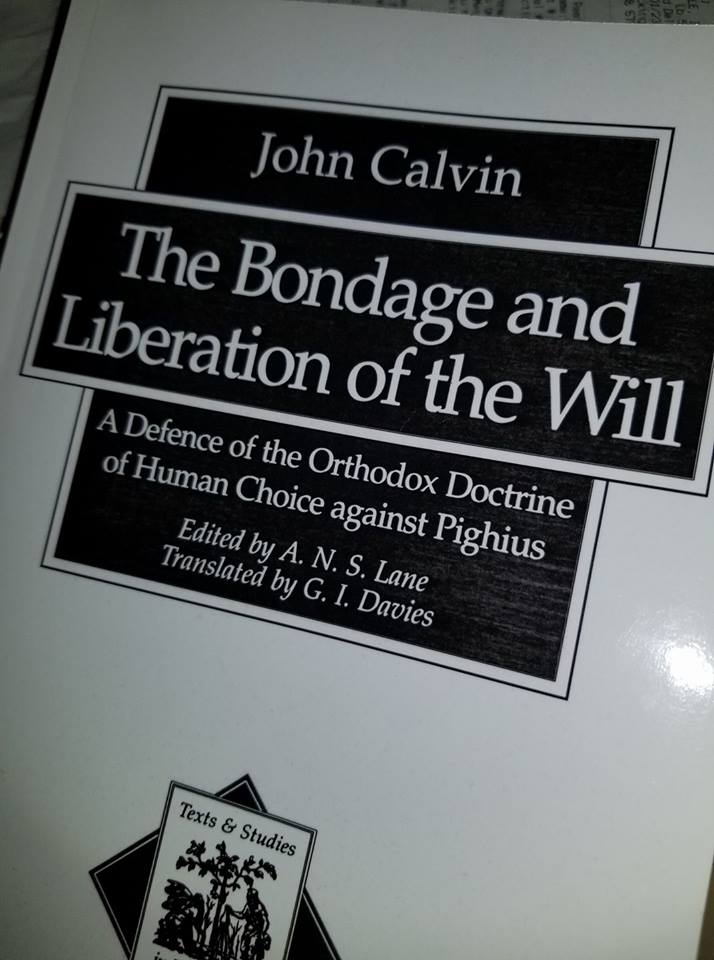
In his very helpful book, The Bondage and Liberation of the Will, John Calvin stated that there are four expressions regarding the will which differ from one another:

“namely that the will is free, bound, self-determined, or coerced. People generally understand a free will to be one which has in its power to choose good or evil …[But] There can be no such thing as a coerced will, since the two ideas are contradictory. But our responsibility as teachers is to say what it means, so that it may be understood what coercion is. Therefore we describe [as coerced] the will which does not incline this way or that of its own accord or by an internal movement of decision, but is forcibly driven by an external impulse. We say that it is self-determined when of itself it directs itself in the direction in which it is led, when it is not taken by force or dragged unwillingly. A bound will, finally, is one which because of its corruptness is held captive under the authority of its evil desires, so that it can choose nothing but evil, even if it does so of its own accord and gladly, without being driven by any external impulse.

According to these definitions we allow that man has choice and that it is self-determined, so that if he does anything evil, it should be imputed to him and to his own voluntary choosing. We do away with coercion and force, because this contradicts the nature of the will and cannot coexist with it. We deny that choice is free, because through man’s innate wickedness it is of necessity driven to what is evil and cannot seek anything but evil. And from this it is possible to deduce what a great difference there is between necessity and coercion. For we do not say that man is dragged unwillingly into sinning, but that because his will is corrupt he is held captive under the yoke of sin and therefore of necessity will in an evil way. For where there is bondage, there is necessity. But it makes a great difference whether the bondage is voluntary or coerced. We locate the necessity to sin precisely in corruption of the will, from which follows that it is self-determined.

(John Calvin, The Bondage and Liberation of the Will: A Defence of the Orthodox Doctrine of Human Choice against Pighius pp 69, 70)

Why Did You Start King’s Church?

I received an email today asking me about why I started King’s Church, Phoenix, AZ, especially knowing it would be a very small start up situation. I will edit some of what they wrote so that they are not identified in any way, but they are wondering about their own situation and whether or not a new Church should be started near them.

They wrote: You mentioned (in a Dividing Line teaching) that King’s Church began in your home. I am wondering if you have any link to a testimony you have given as to why King’s Church began in your home. Was there a need for it? A church plant from another church?

My Response:

Hi —–,

No, I don’t have a link to any testimony regarding starting King’s Church.

Need? Well there is always the need for sound, biblical churches in any locality, and of course, there is biblical precedent for a church to meet in a house (Rom. 16:5; Col. 4:15), but the reason King’s Church started was just a burning and lasting conviction (for more than a year) that this is what I should do. In a nutshell, I felt starting the Church was “the call of God” on my life.

It is vital that this is in place in the heart and mind of the pastor. I cannot stress that enough. If the man can live his life without doing this, he should not start the Church.

There is no doubt the enemy will not leave a biblically sound church alone but will seek its destruction for sure. That is true, no matter what the size, but a small church starting can easily be hit by even a few people leaving. The winds and waves can be strong and even severe at times. There needs to be a long term commitment from the pastor that this is his life’s work – he is not there to merely “try” this, or to see if it works… he is there for the rest of his life (if needed) to establish this – BECAUSE HE CANNOT SLEEP AT NIGHT IF HE DOES NOT DO THIS!

Then there needs to be a life that backs that commitment up. Just about everything in life starts small and as a seed. Scripture says “Do not despise the day of small things.” (Zech. 4:10) We are told this for the simple reason that it is VERY easy to do exactly that – despise something that is small. This is especially true in the U.S.A. when so much is measured by its size. Lets always remember though, a large oak tree is simply an acorn that held its ground.

The call of God to pastor and specifically to start a church is difficult to explain and very subjective (I realize) – but in my own case, this conviction only seemed to grow over time and I felt it was confirmed by other pastors both locally and far away who provided much encouragement for me to do so. I think that is important. Many believe they have gifts suited for a task but it is the Body of Christ who can confirm whether this is true or whether someone is self-deceived. By way of analogy, in a worldly setting, a lot of people think they are amazing singers, only to be exposed on “American Idol” as having a “talent” the Lord wouldn’t mind them burying.

Bear in mind too that I had decades of pastoral experience both in the UK and here, specifically in start up churches, so this proposed new venture would be done with my eyes wide open, so to speak – knowing some of the hardships and issues we may well encounter before we began.

While we were not a church plant, I was assured that other pastors would be behind me, at least in prayer, so I would not be on my own. It would be the best scenario if we were a church plant, and had access to resources beyond our own, but such was not the case. But at least I could get good advice from fellow pastors. They also expressed their willingness for me to talk with them at any time.

I say this because I don’t think it is wise to be totally on your own in starting a Church. The road is never an easy one, and it is imperative to have others you can turn to for advice along the way.

I hope something in what is above can be helpful to you.

God bless,

John

(I received this reply)

“Absolutely helpful! Praise God and thank you…”

The New Interprets the Old

John Fonville:

In his famous statement, “The New is in the Old concealed; the Old is in the New revealed,” Saint Augustine expressed the priority of the New Testament over the Old Testament- the New Testament explains the Old Testament.

My seminary denied this key hermeneutical principle. For example, it is claimed that to make “the New Testament the final authority on the Old Testament denies the perspicuity (“clarity”) of the Old Testament as a perfect revelation in itself.”

This is an incredible (not in the good sense) statement that simply fails to properly recognize the nature of the progressive unfolding story (revelation) of the Old Testament. The Old Testament itself witnesses to the fact that it is a story that doesn’t stand on its own-that it is incomplete and begs for fulfillment. Old Testament scholar, Graeme Goldsworthy (not loved by my seminary), observes that it is impossible from the Old Testament alone to understand the full meaning of God’s acts and promises that it records.

Jesus says that He gives the Old Testament its meaning. Thus, Jesus Himself affirms that we need the Old Testament to understand what He says about Himself. And Jesus drives us back to the Old Testament to read and understand it through “Christian eyes.” He teaches us that the Old Testament leads us to Him (John 5:39, 46).

Thus, Goldsworthy notes that in seeking to understand the Scriptures, we do not start at Genesis 1 and work our way forward until we discover where the story is leading. Instead, we start with Christ-the gospel-and He directs us to read and understand the Old Testament in light of the gospel.

The gospel interprets the Old Testament by showing us its meaning and goal. The Old Testament increases our understanding of the gospel by showing us what Christ fulfills for us.

Perhaps Saint Augustine was right after all?