John 3:16 tells us that God’s love for the world was the motivation behind Him giving His Son. This sermon asks and answers the question, “In what way did God give His Son?”
The Father’s Giving of the Son
Reply

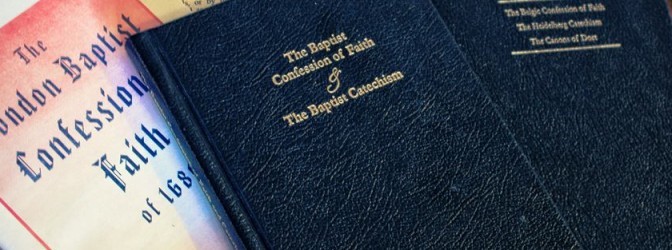 Article: A Case for Robust Confessions of Faith in the Churches by Tom Hicks, Senior Pastor of First Baptist Church of Clinton, LA. (original source here)
A question often arises as to whether the church should have a minimal confession of faith or a robust and encyclopedic confession of faith. Some argue that a church’s formal confession should be short so that Christians with a variety of views on secondary doctrines may all join the church, while the pastor is free to teach anything he believes the Bible means. But I submit that it is the biblical responsibility of the church as a whole, not just the pastor, to confess its understanding of the meaning of the whole Bible, and that the pastor is to submit to the confession of the church. The Bible says that “the church” is “a pillar and buttress of the truth” (1 Tim 3:12). Some worry that subscribing to a robust confession of faith is unworkable in a local church, but I disagree.
Historically in America, most early Baptist churches had comprehensive confessions of faith, two of the most influential of which were the Philadelphia Confession among Baptists in the North and the Charleston Confession among Baptists in the South. Both of those confessions are based on the Second London Baptist Confession of Faith. Practically speaking, in our day, the churches need a robust confession in order to promote greater health and to remain faithful to Christ amidst the rising tide of secularism and individual autonomy. But most importantly, the Bible indicates that the church should confess its understanding of the Bible as a whole and therefore, the church’s confession ought to be robust.
1. The Basic Biblical Requirement of Confession
The Scriptures teach that Christians are to confess their faith. In the Old Testament, a basic confession of faith is found in the Shema. Deuteronomy 6:4 says, “Hear O Israel: The LORD our God, the LORD is one.”
In the New Testament, we see the content of a basic confession in Romans 10:9-10, which says, “If you confess with your mouth that Jesus is Lord and believe in your heart that God raised him from the dead, you will be saved. For with the heart one believes and is justified, and with the mouth one confesses and is saved.”
So, at a very basic level, a confession of faith in Christ as Lord and Savior is required for salvation. But this basic confession will expand as Christians grow in their understanding of Scripture and as they disclaim doctrinal errors.
2. The Expanding Nature of Confessions in the Bible
When we study the confessions found in the Bible, one of the things we find is that as the church encounters new errors, it confesses more and more doctrine in order to confront those errors.
A Confession Against Judaism. 1 Corinthians 8:6 combines the confession that there is one God with the confession that there is one Lord Jesus Christ. It says, “There is one God, the Father, from whom are all things and for whom we exist, and one Lord Jesus Christ, through whom are all things and through whom we exist.” In this confession, the basic Jewish affirmation of monotheism is affirmed. But in order to distinguish themselves clearly from the Jews who denied the deity of Christ, the church also affirmed Christ as Lord and Creator of all things.
A Confession Against Division. Some professing Christians in the early church would have divided the church between Jewish Christians and Gentile Christians. But the Apostle Paul confessed in Ephesians 4:4-5, “There is one body and one Spirit, just as you were called to one hope that belongs to your call, one Lord, one faith, one baptism, one God and Father of all, who is over all and through all and in all.” This confession affirms the oneness of all who are united to Christ.
A Confession Against Gnosticism, Asceticism and Paganism. We see a further expansion of the church’s confession in 1 Timothy 3:15, in which Paul writes so that “Great indeed, we confess, is the mystery of godliness: He was manifested in the flesh, vindicated by the Spirit, seen by the angels, proclaimed among the nations, believed on in the world, taken up in glory.” This confession was written as the church faced a number of additional heresies, including Gnosticism, Asceticism and Paganism. It confronted these newer heresies even as it also confronted the older errors of Judaism. We learn from this that the older errors don’t go away, which is why the church must keep adding to its confession. The church needed to confess that Christ is Lord, contrary to Judaism. It needed to declare the full humanity of Christ over and against Gnosticism. It needed to affirm the sufficiency of Christ’s work to save, contrary to Asceticism. And it needed to confess that God is one, over and against the polytheism of Paganism. Continue reading
Phil Johnson (back at the 2013 Shepherds Conference) presented an outstanding message summarizing the enemy’s attack on the Church in our time:
Enemies at the Gate: Four liberalizing trends that threaten the contemporary church