

Pastoral Anxiety

Article by Kevin DeYoung – original source here)

Second Corinthians 11:28 always seemed like a strange verse to me — until I became a pastor. Here’s Paul, rattling off all the ways he’s been beat up for Jesus — imprisonments, lashes, rods, stonings, shipwrecks, drifting at sea, sleepless nights, hunger and thirst, cold and exposure, danger from everyone everywhere (vv. 23–27). And then, as the cherry on top, Paul mentions one more trial: “apart from other things, there is the daily pressure on me of my anxiety for all the churches” (v. 28). This is the mighty apostle, the one who counted it a joy to “spend and be spent” for his people (12:15), the one who was sorrowful yet always rejoicing (6:10). This is the Paul who faced every imaginable opposition and yet learned to be content (Phil. 4:11) and anxious about nothing (4:6). And here he is admitting that even with everything else he’s endured, he still feels anxiety for all the churches.

Ever since I became a pastor, I have found unusual comfort in this verse. It’s not that I have accomplished what Paul accomplished or suffered what he suffered, but every earnest minister feels this burden for the church. And Paul had several churches to burden him. The churches were full of infighting and backbiting. They put up with false teaching. They were prone to legalism on one end and complete chaos on the other. Some of the church members were making insignificant matters too important, while others were too willing to compromise on Christian essentials. Paul loved these churches, and their struggles burdened him more than shipwreck or imprisonment.

Before I go any further, let me be clear: I don’t think pastors are the only ones with burdens. In many ways, we have the best job in the whole world. I certainly feel exceedingly thankful to do what I do on most days. I have no interest in comparing the difficulty of pastoral ministry with the difficulties of other vocations. All I want to do is to encourage pastors to keep fighting the good fight and encourage congregations to keep encouraging their pastors.

I’m not surprised Paul felt daily pressure for the churches. His work never seemed to let up. He had letters to write, visits to make, and a collection to gather for the saints in Jerusalem. He had to send people here and there, and manage the affairs of his churches from a distance. He had to respond to myriad criticisms, often conflicting criticisms. Some people thought he was too harsh. Others said he was too weak. Some people in his churches were ascetics and thought Paul was worldly. Others were licentious and thought Paul was too ethically demanding. They questioned his credentials. They compared him negatively to the original apostles. They thought him lame compared to the false apostles. They didn’t like his preaching style. They didn’t like his discipline. On some days, they just didn’t like Paul anymore. All this for the man who led them to Christ, loved them like a father, refused their money, and risked his neck for their spiritual good. No wonder there was no weight for Paul like the weight of caring for God’s people.

Ask any pastor who really takes his work seriously and he will tell you of the pressures he feels in ministry — people in crisis, people leaving, people coming, people disappointed by him, people disappointing to him. In the midst of this work, the pastor is trying to find time for study, prayer, preparation, and family. He’s trying to improve himself, train up new leaders, meet the budget, get to know a few missionaries, champion important programs, provide for deep, accessible worship and preaching, be responsive to new ideas, listen to new concerns, and be ready to help when people are in trouble.

And most pastors feel a burden for all the other things they could be doing: more evangelism, more for the poor, more for missions, more to address global concerns, and more to address social concerns. There are pastors reading this who wonder if the church is still responsive to their preaching; if the leadership will ever be responsive to their leading; and if the congregation will ever grow like the churches they hear so much about. On top of all this, every pastor has his own personal hurts, his own personal mistakes, and his own spiritual health to attend to. We are all weak.

But be encouraged. God uses weak things to shame the strong (1 Cor. 1:27). His grace is sufficient for you; His power is made perfect in weakness (2 Cor. 12:9). For the sake of Christ, then, be content with weaknesses, insults, hardships, persecutions, and calamities. For when you are weak, then you are strong (v. 10). Paul had pressure. You have pressure, too. But God can handle the pressure. And He looks good when you can’t.

Should I Stay Home from Church When Life Gets Hard?

Article: by Eric Davis (original source here)

A wise man once said, “Through many tribulations we must enter the kingdom of God” (Acts 14:22 ). The “many,” “tribulations,” and “must” combine to make life really, really hard at times. Pain seems to crash upon its victims with inhumane force. It comes in all forms—physical, spiritual, relational, some excruciating combination. There are times when it just seems impossible to continue another moment.

Thankfully however, we have a loving God who is sovereign over suffering. He’s not pushing buttons from a distance, but intimately walking through it with us. What a great thing it is to have the Lord as our shepherd. He cares for us, not by always sparing us from sorrow, but leading us through it. He binds us up through various means; the word of God, prayer, corporate worship.
But, what about when a trial reaches a new level of difficulty? What about when the spiritual and emotional pain seems too crippling to be at church? Certainly there are situations like this. What should we do?

Beth Moore, a highly influential evangelical, said this on mother’s day:

Beth Moore
✔@BethMooreLPM
If you feel like sobbing, do. If you feel like going to church on Mother’s Day would crush your heart, don’t. You won’t lose your salvation because you don’t want to go to church on Mother’s Day. Grab pen and paper and get alone with God and pour out your heart to Him in full…

On the one hand, the advice is understandable. In some seasons of suffering, it seems impossible to do anything. There are certain things which feel as if doing them would only plunge the knife deeper.

But on the other hand, this kind of thinking backfires. It’s hazardous. It can create damage and propagate error. I assume that the intention of the advice was to help and bless. But the stay-home suggestion can communicate several consequential errors. Here are a few for consideration:

1. God’s means of grace are insufficient for certain struggles.

The corporate gathering is to be a time of worship to the glory of God. As we worship together with gifted saints, we are fed, strengthened, transformed, encouraged, and equipped. That’s why the gathering exists. As the word of God is read, sang, prayed, pondered, and preached, God administers his care. So, to suggest avoiding the gathering because of a trial is counter-productive. Corporate worship is intended to bring care in suffering. It might feel impossible to gather; too painful. But our God knows. And he desires to care for us precisely through corporate worship. So, to avoid church due to the pain of a trial is akin to avoiding eating due to the pain of hunger. Continue reading

Charles Finney vs. the Westminster Confession by Michael S. Horton

Article source here.

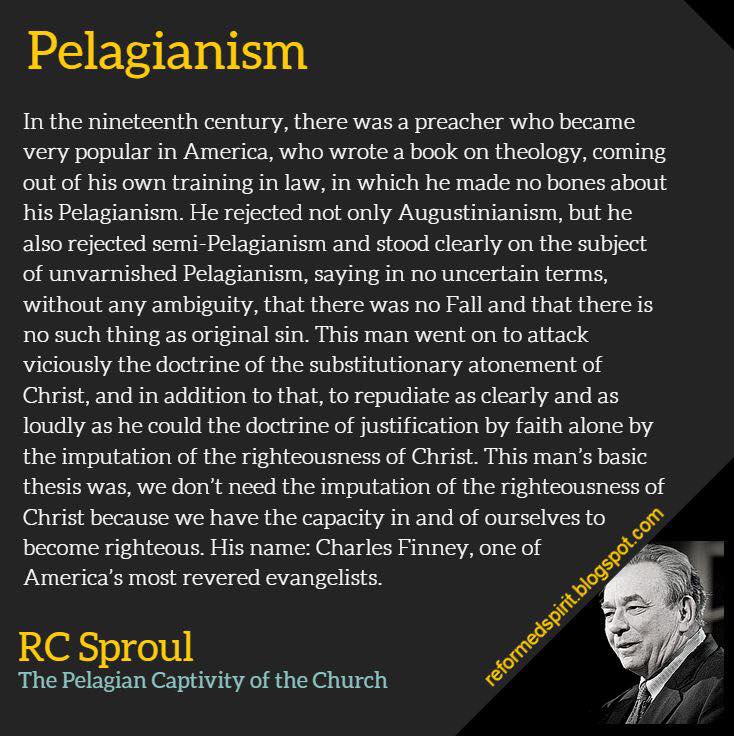
The most famous evangelist of the nineteenth century declared that The Westminster Divines had created ‘a paper pope’ and had ‘elevated their confession and catechism to the Papal throne and into the place of the Holy Ghost.’ ‘It is better,’ he declared, ‘to have a living than a dead Pope,’ dismissing the Standards as casually as the boldest Enlightenment rationalist: ‘That the instrument framed by that assembly should in the nineteenth century be recognized as the standard of the church, or of any intelligent branch of it, is not only amazing, but I must say that it is highly ridiculous. It is as absurd in theology as it would be in any other branch of science.’1

Given the unpopularity of Calvinism in particular and confessionalism in general, all of this might not have raised the slightest hint of impropriety except for the fact that the evangelist was Charles G. Finney, an ordained Presbyterian minister. In his introduction to Finney’s Lectures on Revivals of Religion, William McLoughlin wrote the following:

The first thing that strikes the reader of the Lectures on Revival is the virulence of Finney’s hostility toward traditional Calvinism and all it stood for. He denounced its doctrinal dogmas (which, as embodied in the Westminster Confession of Faith, he referred to elsewhere as ‘this wonderful theological fiction’); he rejected its concept of nature and the structure of the universe…; he scorned its pessimistic attitude toward human nature and progress…; and he thoroughly deplored its hierarchical and legalistic polity (as embodied in the ecclesiastical system of the Presbyterian Church). Or to put it more succinctly, John Calvin’s philosophy was theocentric and organic; Charles Finney’s was anthropocentric and individualistic….As one one prominent Calvinist editor wrote in 1838 of Finney’s revivals, ‘Who is not aware that the Church has been almost revolutionized within four or five years by means of such excitements?’

In this brief survey, our purpose will be two-fold: first, to understand the factors that shaped Finney’s theology and practice and, second, to appreciate the legacy of both for contemporary evangelicalism and especially Reformed faith and practice in the United States.

I. The Man: His Life & Times

We must remember that the period just prior to the Great Awakening was not congenial to an undiluted Calvinism: Jonathan Edwards lost his pulpit in 1750 in large part because he would not moderate his belief in total depravity; Solomon Stoddard, Edwards’ grandfather, had softened the Puritan emphasis on conversion in the interests of civil order with his ‘Half-Way Covenant,’ and the Enlightenment, having practically extinguished the remnants of orthodox Calvinism in English nonconformity, was threatening the citadels of American learning.

It was in reaction to the spiritual state of New England, ranging in general from nominal to skeptical, that a handfull of preachers–Anglican, Presbyterian, Congregationalist, and Dutch Reformed, but Calvinists all, began to recover the evangelical emphasis of the Protestant Reformers, summoning men and women to a confrontation with God through the Law and the Gospel. A cursory glance at the most popular sermon titles illustrates the dependence on classical biblical categories of sin and grace, judgment and justification, Law and Gospel, despair and hope, and these gifted evangelists were convinced that the success of their mission rested in the hands of God and faithfulness to the apostolic proclamation.

In spite of such biblical rigor, matched with evangelistic zeal, the Great Awakening (1739-43) itself was not without its excesses of enthusiastic religion, as Edwards himself was painfully aware. The Princeton divine labored to distinguish between true and false religious emotions. A man of towering presence and celebrated oratory, George Whitefield proved a valuable colleague in awakening sinners to God, and yet, as Harry S. Stout has argued in a controversial work, Whitefield himself may have contributed to some of the seminal features of mass evangelism that would manifest themselves in the revivalism to follow.2 The Tennent brothers, along with James Davenport, were also accused by some of their brethren as sowing seeds of unwholesome enthusiasm and a host of questions could be raised concerning the Awakening in terms of its ecclesiology and the prominence given to radical individual conversion over and against the more traditional covenantal motifs of Reformed theology. While the ‘New Light’ and ‘Old Light’ factions do not directly parallel the ‘New School’ and ‘Old School’ divisions to follow, they do reflect the controversial innovations introduced by those who sought to wed a pietistic impulse to Reformed orthodoxy, leading to a secession of Gilbert Tennent’s ‘New Light’ Presbyterians from the more traditional Philadelphia presbytery in 1741.

However essential it may be to raise those questions within the Reformed family, it is not within the scope of this brief survey to explore. It is sufficient for our purposes to at least recognize the fundamental Reformed consensus of the Great Awakening on anthropological and soteriological grounds. Revival was ‘a surprising work of God,’ as Edwards expressed it, and depended entirely on divine freedom.

The revivals associated with the Great Awakening created a rift in New England Congregationalism, encouraging many who were offended on grounds of taste and style (as well as the resurgent Calvinism) to embrace Unitarianism, while Edwards provided the intellectual resources for a courageous defense of Calvinism in conversation with, not merely in reaction to, the Enlightenment. Perhaps no other movement has had such a profound hand in shaping the religious character of Revolutionary America and the evangelicalism that is its heir–with the possible exception of the Second Great Awakening. Continue reading