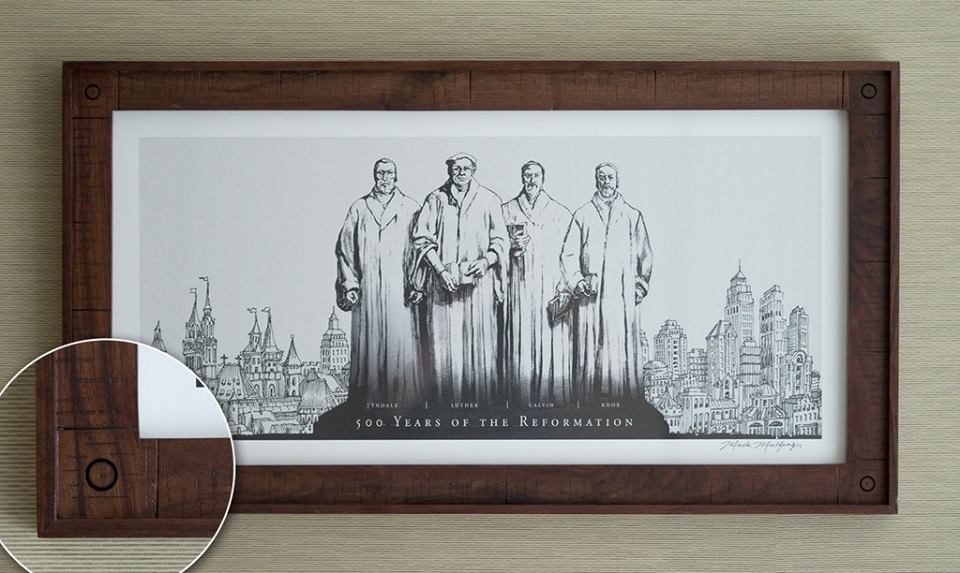
 Article: The Courage to Be Reformed by Buck Parsons (original source here)
When we come to grasp Reformed theology, it’s not only our understanding of salvation that changes, but our understanding of everything. It’s for this reason that when people wrestle through the rudimentary doctrines of Reformed theology and come to comprehend them, they often feel like they have been converted a second time. In fact, as many have admitted to me, the reality is that some have been converted for the very first time. It was through their examination of Reformed theology that they came face-to-face with the stark reality of their radical corruption and deadness in sin, God’s unconditional election of His own and condemnation of others, Christ’s actual accomplishment of redemption for His people, the Holy Spirit’s effectual grace, the reason they persevere by God’s preserving grace, and God’s covenantal way of working in all of history for His glory. When people realize that ultimately, they didn’t choose God, but He chose them, they naturally come to a point of humble admission of the amazing grace of God toward them. It’s only then, when we recognize what wretches we really are, that we can truly sing “Amazing Grace.” And that is precisely what Reformed theology does: it transforms us from the inside out and leads us to sing—it leads us to worship our sovereign and triune, gracious, and loving God in all of life, not just on Sundays but every day and in all of life. Reformed theology isn’t just a badge we wear when being Reformed is popular and cool, it’s a theology that we live and breathe, confess, and defend even when it’s under attack.
The Protestant Reformers of the sixteenth century, along with their fifteenth-century forerunners and their seventeenth-century descendants, did not teach and defend their doctrine because it was cool or popular, but because it was biblical, and they put their lives on the line for it. They were not only willing to die for the theology of Scripture, they were willing to live for it, to suffer for it, and to be considered fools for it. Make no mistake: the Reformers were bold and courageous not on account of their self-confidence and self-reliance but on account of the fact that they had been humbled by the gospel. They were courageous because they had been indwelled by the Holy Spirit and equipped to proclaim the light of truth in a dark age of lies. The truth they preached was not new; it was ancient. It was the doctrine of the martyrs, the fathers, the Apostles, and the patriarchs—it was the doctrine of God set forth in sacred Scripture.
The Reformers didn’t make up their theology; rather, their theology made them who they were. The theology of Scripture made them Reformers. For they did not set out to be Reformers, per se—they set out to be faithful to God and faithful to Scripture. Neither the solas of the Reformation nor the doctrines of grace (the five points of Calvinism) were invented by the Reformers, nor were they by any means the sum total of Reformation doctrine. Rather, they became underlying doctrinal premises that served to help the church of subsequent eras confess and defend what she believes. Even today there are many who think they embrace Reformed theology, but their Reformed theology only runs as deep as the solas of the Reformation and the doctrines of grace. What’s more, there are many who say they adhere to Reformed theology but do so without anyone knowing they are Reformed. Such “closet Calvinists” neither confess any of the historic Reformed confessions of the sixteenth or seventeenth centuries nor employ any distinctly Reformed theological language.
However, if we truly adhere to Reformed theology according to the historic Reformed confessions, we cannot help but be identified as Reformed. In truth, it’s impossible to remain a “closet Calvinist,” and it’s impossible to remain Reformed without anyone knowing it—it will inevitably come out. To be historically Reformed, one must adhere to a Reformed confession, and not only adhere to it but confess it, proclaim it, and defend it. Reformed theology is fundamentally a confessional theology.
Reformed theology is also an all-encompassing theology. It changes not only what we know, it changes how we know what we know. It not only changes our understanding of God, it changes our understanding of ourselves. Indeed, it not only changes our view of salvation, it changes how we worship, how we evangelize, how we raise our children, how we treat the church, how we pray, how we study Scripture—it changes how we live, move, and have our being. Reformed theology is not a theology that we can hide, and it is not a theology to which we can merely pay lip service. For that has been the habit of heretics and theological progressives throughout history. They claim to adhere to their Reformed confessions, but they never actually confess them. They claim to be Reformed only when they are on the defensive—when their progressive (albeit popular) theology is called into question, and, if they are pastors, only when their jobs are on the line.
While theological liberals might be in churches and denominations that identify as “Reformed,” they are ashamed of such an identity and have come to believe that being known as “Reformed” is a stumbling block to some and an offense to others. Moreover, according to the historic, ordinary marks of the church—the pure preaching of the Word of God, prayer according to the Word of God, the right use of the sacraments of baptism and the Lord’s Supper, and the consistent practice of church discipline—such “Reformed” churches are often not even true churches. Today, there are many laypeople and pastors who are in traditionally Reformed and Protestant churches and denominations who, along with their churches and denominations, left their Reformed moorings and rejected their confessions years ago.
Contrary to this trend, what we most need are men in the pulpit who have the courage to be Reformed—men who aren’t ashamed of the faith once delivered to the saints but who are ready to contend for it, not with lip service but with all their life and all their might. We need men in the pulpit who are bold and unwavering in their proclamation of the truth and who are at the same time gracious and compassionate. We need men who will preach the unvarnished truth of Reformed theology in season and out of season, not with a finger pointing in the face but with an arm around the shoulder. We need men who love the Reformed confessions precisely because they love the Lord our God and His unchanging, inspired, and authoritative Word. It’s only when we have men in the pulpit who have the courage to be Reformed that we will have people in the pew who grasp Reformed theology and its effects in all of life, so that we might love God more with all our heart, soul, mind, and strength and love our neighbor as ourselves. That is the theology that reformed the church in the sixteenth century, and that is the only theology that will bring reformation and revival in the twenty-first century. For in our day of radical progressive theological liberalism, the most radical thing we can be is orthodox according to our Reformed confessions, yet not with arrogance but with courage and compassion for the church and for the lost, all for the glory of God, and His glory alone.