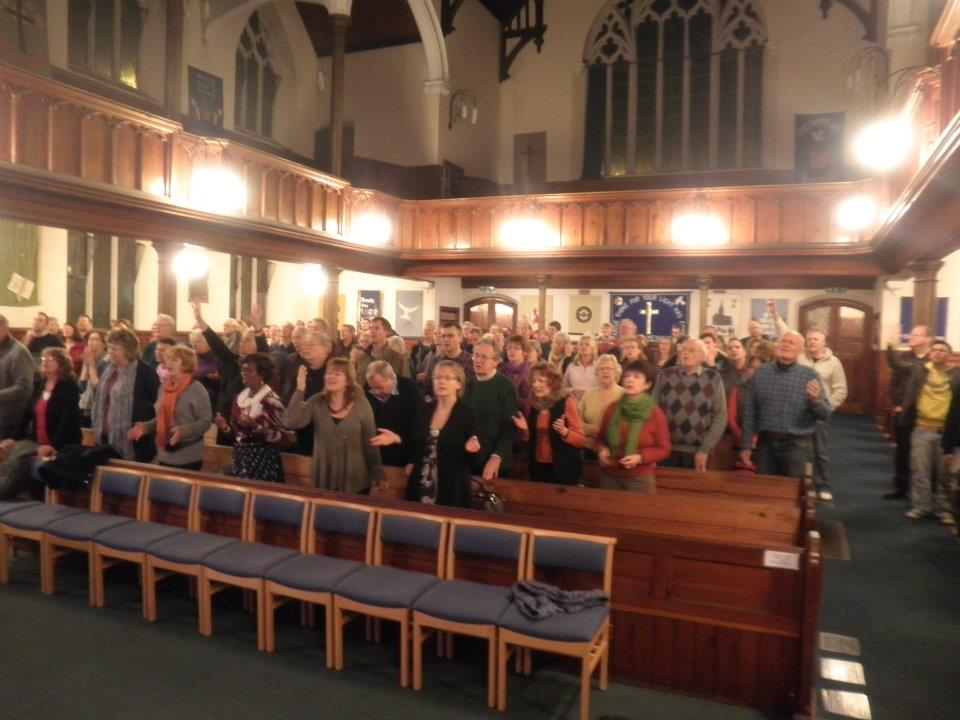
Agape International Baptist Church – Five Solas Reformation Conference
Session 5: Phil Johnson – Have The Apostolic Gifts Ceased? (1 Cor. 12:8-10)
Article by Josh Buice (original source here)
When it comes to worship, there are no shortage of opinions on how it should be done. However, when it comes to worship, we must likewise remember that we have a sufficient guide in holy Scripture. Everything about how God desires to be worshipped can be found in the pages of the Bible.
Jesus instituted the Lord’s Supper at the very moment of his Last Supper with his disciples. His time of celebration with them involved the observation of the Passover feast—a yearly meal designed to remember the deliverance of God’s people from Egypt. The Passover feast predates the tabernacle, the establishment of the law, and Israel’s priesthood (Ex. 12:15-17). As Jesus celebrated with his followers, he likewise pointed them to the culmination of the Passover in the Lord’s Supper since Jesus is the fulfillment of the promises and sacrificial system of Israel’s history. Jonathan Edwards wrote in his A History of the Work of Redemption, “Christ and his redemption are the subject of the whole Word of God.” [1]
Since Jesus instated the Lord’s Supper as a means of continual worship (see the language of 1 Corinthians 11:26), the way in which we engage in worship at the Lord’s Table matters. We should intentionally aim at theological precision and emotional balance. We should approach the Lord’s Table with tears of sorrow and smiles of joy. We must avoid superficial cliché worship and sacramentalism at the same time. With that in mind, there are two ways to engage in worship at the Lord’s Table that honor God.
A Heart of Sorrow
As Jesus ate and drank with his disciples, he said these words, “For as often as you eat this bread and drink the cup, you proclaim the Lord’s death until he comes” (1 Cor. 11:26). We are to remember the body and blood of Jesus that was nailed to a Roman cross and we’re called to proclaim his death until Christ returns.
As Jesus instituted the Lord’s Supper, he said, “Do this in remembrance of me” (1 Cor. 11:24). To remember the death of Jesus requires a sober mind and one that leads to a heart of sorrow. Consider the Son of God betrayed by a friend, accused of blasphemy, beaten beyond recognition, publicly humiliated, nailed to a cross, and raised up in open shame. Consider the pain and discomfort he was experiencing at that moment. Consider the crushing weight of the sins of all of his people being laid upon him. This scene brings us to a place of sorrow.
Furthermore, our sorrow is not merely sentimental—it’s personal sorrow. It’s personal sorrow based on personal sin. The crushing blow of the God’s wrath was unleashed on Jesus for the sins of his people. As we remember this scene, we have to recall the fact that Jesus was paying for our sin debt—our personal sins—each and every one of them. This should bring us to a proper place of humility and sorrow.
A Heart of Joy
How can the scene of the dying Savior bring us to a place of joy and celebration? The emotion of sorrow seems much more fitting, so how do we arrive at joy as we stand in the shadow of the cross of Jesus? The answer is found in how Jesus’ sacrifice became the fulfillment of the long awaited promise of Genesis 3:15. Did Jesus satisfy the Father’s wrath? Did Jesus pay in full our sin debt? With absolute certainty he accomplished those realities, and in doing so he accomplished the plan of redemption in victory.
Consider the words of the apostle Paul as he describes the work of Jesus, stating he forgave us “by canceling the record of debt that stood against us with its legal demands. This he set aside, nailing it to the cross. He disarmed the rulers and authorities and put them to open shame, by triumphing over them in him” (Colossians 2:14–15).
We can celebrate at the Lord’s Table as we consider the victory that has been secured by Jesus for each and every one of his people. Not one single sin will be held to our account. There is no condemnation for those who are in Christ Jesus (Rom. 8:1). Every single sin was nailed to the cross and Christ paid our debt in full. By doing so, Jesus disarmed the rulers and authorities and put them to open shame. His substitutionary death was the fulfillment of Genesis 3:15, therefore, we can celebrate as we gather around the Lord’s Table to remember the body and blood of King Jesus. We don’t approach the Lord’s Table with a heart fueled by superficial clichés. We approach the Lord’s Table with a heart filled with sorrow and overflowing with joy. J.C. Ryle, in his commentary on Matthew 26, writes the following:
Are we in the habit of coming to the Lord’s table? If so, in what frame of mind do we come? Do we draw near intelligently, humbly, and with faith? Do we understand what we are doing? Do we really feel our sinfulness and need of Christ? Do we really desire to live a Christian life, as well as profess the Christian faith? Happy is that soul who can give a satisfactory answer to these questions. Let him go forward, and persevere.
(1) Philip Graham Ryken and R. Kent Hughes, Exodus: Saved for God’s Glory (Wheaton, IL: Crossway Books, 2005), 330.
Chris Castaldo (PhD, London School of Theology) serves as lead pastor of New Covenant Church in Naperville, Illinois. He is the author of Talking with Catholics about the Gospel and co-author of the recently released The Unfinished Reformation: What Unites and Divides Catholics and Protestants After 500 Years. Chris blogs at www.chriscastaldo.com. (original source of this article found here)
“I will build my church,” Jesus declared (Matthew 16:18). And what a magnificent and agonizing process has unfolded for two millennia. Essential to this work is the formation of living stones — men and women drawn from the quarry of sin, whose lives now testify to gospel grace.
But how does Christ construct his church? One answer is suggested inside the dome of St. Peter’s Basilica in Rome, in letters six feet tall, where Christ’s promise is written in Latin: “Thou art Peter, and upon this rock I will build my church . . .” Illumined by encircling windows, these words sit as a crown atop the crypt of the apostle himself, who is hidden far beneath the high altar, a reminder of the authority given to Peter’s heir who sits upon the papal throne.
Martin Luther was not the first to question papal authority, but his argument was especially incisive. When Luther’s ideas began to congeal in 1520, he articulated his concerns in a seminal work: To the Christian Nobility. This treatise was occasioned by attacks from the pope’s theologian, Sylvester Prierias, who asserted papal absolutism with such bravado that Luther called it a “hellish manifesto.” Convinced of Scripture’s supreme authority, and believing German nobility to be sympathetic to his position, Luther, in light of historical precedent, urged nobles to embrace the responsibility of church reform.
Luther’s treatise laid an ax at the Roman institution — the social, political, legal, and religious conventions that undergirded Western Christendom. Of central concern was the papal claim (championed by Prierias) that only the pope can reliably interpret Scripture and speak without error. Luther viewed such traditions as religious accretions that threatened the church’s integrity if not eradicated.
Looking back, we sometimes wonder how the accumulation of Roman tradition developed from the Galilean’s fishing boat to Luther’s day; that is, from the day of Pentecost to the sixteenth century. While the story is protracted and complex, the following overview will attempt to offer some perspective, giving particular attention to the development of ecclesial authority in the papal office.
First Pope
Our story begins with a reminder from Lord Acton who suggested the best way to ensure the cogency of one’s position is to make the best possible argument for those we believe are wrong. While the following narrative is not an argument per se, it is intended to demonstrate that the misguided trajectory of papal authority developed rather naturally in the scope and sequence of Western history, a development that cautions followers of Christ in every age.
Catholic historians typically acknowledge that there is no straight line from the current pope to the apostle Peter. In the words of Eamon Duffy, “There is, therefore, nothing directly approaching a papal theory in the pages of the New Testament,” and from all indications, “there was no single bishop of Rome for almost a century after the deaths of the apostles.”
It was around 150 AD when the loose pattern of presbyterial authority began to give way to a single Roman bishop, an office that eventually developed into a monarchical position under Bishop Victor (189–198) and to a greater extent under Bishop Stephen I (254–257) who claimed some of the powers and honors attributed to the apostle Peter. Stephen’s invocation of Matthew 16 was the first instance of a bishop of Rome attempting to elevate himself over other bishops with an authority that was qualitatively superior.
The conversion of Constantine, and his subsequent investment in church institutions, placed Roman bishops at the center of imperial life. They soon became affluent and politically engaged potentates, acquiring the urbane trappings of aristocracy. The bishop’s political influence increased when Constantine transferred the capital of the empire to Constantinople in 330, a move that left Rome’s bishop as the single most important individual in the city. But which of these bishops should be considered the first pope? Continue reading