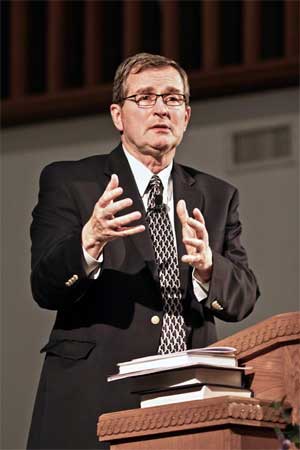
Dr. Michael Reeves (the message begins around the 16:40 mark):
Charles Spurgeon and the Christian Life
Reply

 This excerpt is adapted from Living for God’s Glory: An Introduction to Calvinism by Joel Beeke.
Although evangelism differs to some degree from generation to generation according to gifts, culture, style, and language, the primary methods of Puritan evangelism—plain preaching and catechetical teaching—can show us much about how to present the gospel to sinners.
Like the Reformers, the Puritans were catechists. They believed that pulpit messages should be reinforced by personalized ministry through catechesis—the instruction in the doctrines of Scripture using catechisms. Puritan catechizing was evangelistic in several ways.
Scores of Puritans reached out evangelistically to children and young people by writing catechism books that explained fundamental Christian doctrines via questions and answers supported by Scripture. For example, John Cotton titled his catechism Milk for Babes, drawn out of the Breasts of both Testaments. Other Puritans included in the titles of their catechisms such expressions as “the main and fundamental points,” “the sum of the Christian religion,” the “several heads” or “first principles” of religion, and “the ABC of Christianity.” At various levels in the church as well as in the homes of their parishioners, Puritan ministers taught rising generations from both the Bible and their catechisms. Their goals were to explain the fundamental teachings of the Bible, to help young people commit the Bible to memory, to make sermons and the sacraments more understandable, to prepare covenant children for confession of faith, to teach them how to defend their faith against error, and to help parents teach their own children.
Catechizing was a follow-up to sermons and a way to reach neighbors with the gospel. Alleine reportedly followed his work on Sunday by several days each week of catechizing church members as well as reaching out with the gospel to people he met on the streets. Baxter, whose vision for catechizing is expounded in The Reformed Pastor, said that he came to the painful conclusion that “some ignorant persons, who have been so long unprofitable hearers, have got more knowledge and remorse of conscience in half an hour’s close disclosure, than they did from ten years’ public preaching.” Baxter invited people to his home every Thursday evening to discuss and pray for blessing on the sermons of the previous Sabbath.
The hard work of the Puritan catechist was greatly rewarded. Richard Greenham claimed that catechism teaching built up the Reformed church and seriously damaged Roman Catholicism. When Baxter was installed at Kidderminster in Worcestershire, perhaps one family in each street honored God in family worship; at the end of his ministry there, there were streets where every family did so. He could say that of the six hundred converts brought to faith under his preaching, he could not name one who had backslidden to the ways of the world. How vastly different was that result compared with those of today’s evangelists, who press for mass conversions and turn over the hard work of follow-up to others.
https://verticallivingministries.com/2018/09/10/is-evolution-a-viable-option-scientifically/
Some Key Problems With Evolution
1. Darwinian evolution is based on a hopelessly illogical premise, the concept of spontaneous generation, or life arising from non-living matter.
2. If Darwinian evolution were true we should literally find millions of transitional forms in the fossil record, but the missing links are still missing.
3. Darwinists claim that natural selection is evidence of macroevolution. However, natural selection, which is basic science, simply demonstrates change within species or microevolution.
4. Critiquing Darwinism does not make a person anti-science. We all share the same scientific evidence. The question is, what theory or interpretive framework best explains the evidence? (Ron Carlson, Christian Ministries International)
Synopsis of 6 Big Problems with Evolution:
(1) Scientists today generally agree that the universe had a beginning. This implies the existence of a Beginner or Creator (Hebrews 3:4, “For every house is built by someone, but the builder of all things is God.”).
(2) The universe is so perfectly fine-tuned for life on earth, it must have come from the hands of an intelligent Designer ([God] Romans 1:20 & Psalm 19:1, “For his invisible attributes, namely, his eternal power and divine nature, have been clearly perceived, ever since the creation of the world, in the things that have been made. So they are without excuse….The heavens declare the glory of God, and the sky above proclaims his handiwork”).
(3) If evolution were true, the fossil records would reveal progressively complex evolutionary forms with transitions. However, no transitional links (with species forming into different species) have been discovered in the fossil records.
(4) Evolution assumes a long series of positive and upward mutations. In almost all known cases, however, mutations are not beneficial but are harmful to living beings. This is a huge problem for evolution.
(5) The Second Law of thermodynamics, which has never been contradicted in observable nature, says that in an isolated system (like our universe), the natural course of things is degenerate. The universe is running down, not evolving upward. In a closed, isolated system, the amount of useable energy decreases. That is, matter and energy deteriorate gradually over time. Also, things tend to move from order to disorder, not the reverse.
(6) Evolutionists often make false claims. Some have claimed that scientific evidence confirms that evolution is true. They generally appeal to the fact that mutations do occur within species (microevolution). But an incredible leap of logic is required to say that mutations within species prove that mutations can yield entirely new species (macroevolution). Two dogs cannot produce a cat! (Ron Rhodes, 5-Minute Apologetics for Today)
How Did the Universe Come to Be? The opening line of Genesis puts it succinctly: “In the beginning God created the heavens and earth” (1:1). The Bible teaches that through an act of God the temporal creation of the universe came from nothing (ex nihilo). Continue reading