Article: DOES JOHN MACARTHUR MAKE HIS CASE ON THE OLIVET DISCOURSE? by Gary DeMar
In his book The Second Coming: Signs of Christ’s Return and the End of the Age, John MacArthur seems to go out of his way to avoid having to deal with the inherent problems of his prophetic system. Here’s just one example:
[N]otice Christ’s only explicit remarks about the destruction of the temple are those recorded in verse 2 [of Matthew 24], as Jesus and the disciples were departing from the temple (v. 1). In the Olivet Discourse itself He makes no clear reference to the events of A.D. 70. His entire reply is an extended answer to the more important question about the signs of His coming and the end of the age. Virtually ignoring their initial question, He said nothing whatsoever about when the destruction of Jerusalem would occur. That is because those events were not really germane to the end of the end of the age. They were merely a foretaste of the greater judgment that would accompany His return, previews of what is to come ultimately.1
This is a remarkable statement given that there is nothing in the context of the Olivet Discourse that indicates that Jesus is “ignoring their initial question.” How does MacArthur know this? He doesn’t. This is not exegesis. He is reading his dispensational system into the text. He scrupulously avoids the heart of the debate over the time texts, especially regarding “this generation” (24:34).
“Virtually ignoring their initial question, He said nothing whatsoever about when the destruction of Jerusalem would occur.” Nothing whatsoever? He has to say this because to admit that Jesus was describing what was going to happen to the temple that was standing there – “not one stone here shall be left upon another” (24:3) – would mean Jesus had a great deal to say “about when the destruction of Jerusalem would occur.” It would occur before that existing generation passed away (24:34).
There’s a lot I could say about MacArthur’s comments on Matthew 24, but I’ve said them repeatedly elsewhere. I found this comment surprising:
Notice, moreover, that the great tribulation Christ described involves cataclysm and suffering on a global cosmic scale (vv. 29-30)—not a local holocaust in Jerusalem only.2
If Jesus isn’t describing “a local holocaust in Jerusalem only,” then how is it that it can be avoided by escaping to the mountains outside of Judea (24:16-20)?
The cosmic language of 24:29-30 is typical of cosmic language being used to describe a judgment on Babylon (Isa. 13:1-11) and “Judah and against all the inhabitants of Jerusalem” (Zeph. 1:1-4).
The Second Coming: Signs of Christ’s Return and the End of the Age reads as if it was written in a hurry. For example, in one place MacArthur writes that preterists “ultimately depart from and nullify the strict literal sense of Matthew 24:34,” while on the previous page he chides preterists for insisting that Matthew 24:34 should be interpreted with “wooden literalness.”3 MacArthur should have studied how “this generation” is used elsewhere in the New Testament. “This generation” always refers — without exception — to the generation to whom Jesus is speaking.4 Since the meaning of “this generation” is crucial for establishing the proper time setting for the Olivet Discourse, MacArthur should have spent considerable time justifying his interpretation.
He calls the preterist interpretation of “this generation” a “misunderstanding”5 without ever dealing with the extensive arguments preterists use to defend their position. Preterists are not the only ones who have this “misunderstanding.” Here are three examples from commentators who would not describe themselves as preterists:
- [T]he obvious meaning of the words “this generation” is the people contemporary with Jesus. Nothing can be gained by trying to take the word in any sense other than its normal one: in Mark (elsewhere in 8:12, 9:19) the word always has this meaning.6
- [This generation] can only with the greatest difficulty be made to mean anything other than the generation living when Jesus spoke.7
- The significance of the temporal reference has been debated, but in Mark “this generation” clearly designates the contemporaries of Jesus (see on Chs. 8:12, 38; 9:19) and there is no consideration from the context which lends support to any other proposal. Jesus solemnly affirms that the generation contemporary with his disciples will witness the fulfillment of his prophetic word, culminating in the destruction of Jerusalem and the dismantling of the Temple.8
Why doesn’t MacArthur attempt to refute these non-preterist scholars? Do they misunderstand the clear teaching of Scripture?
In addition to an incomplete study of how “this generation” is used in the gospels, MacArthur morphs “near” and “shortly” into “imminent” without ever making a case for how this can be done exegetically. If the Holy Spirit wanted to convey that Jesus could return at “any moment” over a period of nearly 2000 years (so far), He would have directed the biblical writers to choose Greek words that mean “any moment” instead of “near” and “shortly.” He didn’t.
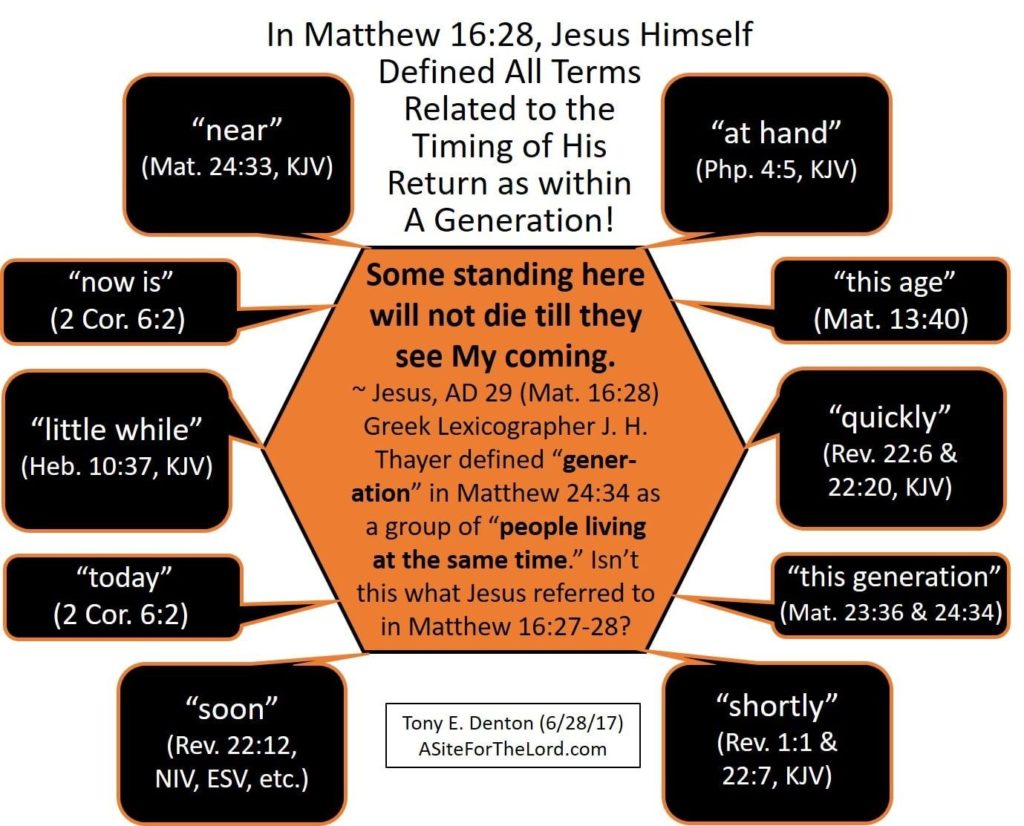
Consider James 5:8–9, a passage that MacArthur uses to support his contention that Jesus could come “at any moment” but near to those who first received and read his letter.9 “You too be patient; strengthen your hearts, for the coming of the Lord is at hand” (5:8). “At hand,” or “near,” cannot be made to mean “any moment.” “At hand” is defined for us by the Bible in the next verse: “Behold, the Judge is standing right at the door” (5:9). “At hand” = “right at the door.” How far from the door is Jesus in Revelation 3:20? Being “right at the door” means being close enough to knock.
MacArthur is either oblivious to the debate surrounding this issue or he tactically decided to steer his readers around the topic so as not to raise a very big red flag.
Will the Real Literalist Please Stand Up?
MacArthur states that interpreting “this generation” in a “wooden literalness” fashion would mean that “the rest of the Olivet Discourse must be spiritualized or otherwise interpreted figuratively in order to explain how Christ’s prophecies could all have been fulfilled by A.D. 70 without His returning bodily to earth.”10 Do preterists spiritualize (a word not often defined) the events described by Jesus in Matthew 24? Not at all! They compare Scripture with Scripture. We let the Bible interpret the Bible. There were literal earthquakes (Matt. 27:54; 28:2; Acts 16:26) and literal famines (Acts 11:28; cf. Rom. 8:35), just as Jesus predicted (Matt. 24:7). Paul tells us that the “gospel” literally had been preached “throughout the world [kosmos]” (Rom. 1:8), “to all the nations” (Rom. 16:25-26; 1 Tim. 3:16), “in all creation under heaven” (Col. 1:23; also 1:6), just as Jesus predicted (Matt. 24:14). Then there are Jesus specific words that the literal temple that the disciples asked about would be destroyed before the last apostle died (Matt. 16:27-28) and that first-century generation passed away (24:34).
Last Days Madness and Wars and Rumors of Wars answer every argument raised by MacArthur, arguments which he studiously avoids addressing in this poorly conceived book. Some might claim that MacArthur is unaware of the work done in this area. This debate has been around for centuries. Anyone writing on this topic should be aware of the current literature. He knows what’s going on. He quotes from an internet article by me and references other preterist sources. MacArthur, who was good friends with R. C. Sproul who wrote The Last Days According to Jesus (1998), was aware of Sproul’s preterist position.
- John MacArthur, The Second Coming: Signs of Christ’s Return and the End of the Age (Wheaton, IL: Crossway, 1999), 80. [↩]
- MacArthur, The Second Coming, 78. [↩]
- MacArthur, The Second Coming, 81, 80. [↩]
- Gary DeMar, Last Days Madness: Obsession of the Modern Church, 4th ed. (Atlanta, GA: American Vision, 1999), 55-60, 183-188. [↩]
- MacArthur, The Second Coming, 219. [↩]
- Robert G. Bratcher and Eugene A. Nida, A Translator’s Handbook of the Gospel of Mark (New York: United Bible Societies, 1961), 419. [↩]
- D.A. Carson, “Matthew” in The Expositor’s Bible Commentary, gen. ed. Frank E. Gaebelein, 12 vols. (Grand Rapids, MI: Zondervan, 1985), 8:507. [↩]
- William L. Lane, Commentary on the Gospel of Mark (Grand Rapids, MI: Eerdmans, 1974), 480. [↩]
- MacArthur, The Second Coming, 51. [↩]
- MacArthur, The Second Coming, 80. [↩]