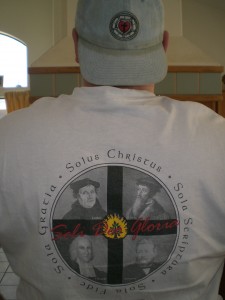
 For those who have asked, the answer is “yes, that is me in the photo.” Taken on Reformation Day (the last Sunday in October) I’m wearing my Five Solas T-shirt and my Martin Luther rose cap.
New to the Reformed faith, I remember taking a car journey with a fellow minister. I had a book in my hands outlining the five Solas of the Protestant Reformation. Seeing this, my preacher friend remarked, “I just don’t get it? The word “Sola” means alone, right?”
“Yes” I replied.
He then said, “Well how is it in any way possible for five things together to be alone? Its utter hogwash.”
Now I was not sure exactly what “hogwash” was. Perhaps it is the water left behind in a tub after a pig has taken a bath. I wasn’t sure… but whatever it was, I could tell that it was not good in any way at all. My preacher friend thought the concept of the five Solas was intellectually untenable.
You are probably now waiting for me to finish this story by saying that in intellectual prowess and intestinal fortitude, I rose up (if that is possible in the passenger seat of a car) and put ignorance and unbelief to the sword, with a single blast of God given wisdom as the oracles of God thundered forth out of my mouth. Well, I could end the story that way, but I would be lying. The fact is, I did not really know how to answer him. I stumbled around… I am sure I said something, and yet he and I both knew that I had no adequate answer that day.
Don’t get me wrong. I knew there was an answer. I just was not sure what it was or how to articulate it.
Many years on, if I was asked that same question today I think I would seek to provide an answer by using a simple illustration. As with most illustrations (or parables) there is usually a limit as to how far one can go – each image in the parable cannot usually be stretched too far, but the illustration can at least provide a window, an insight, that can help people understand concepts far better than before. The same is true in this case.
The American Space organization NASA has a desire to put a man on the moon and for him to walk on it. With their best personnel, they form a highly skilled team and take what they know of the laws of science and set about the task of designing and building a rocket capable of accomplishing their goal. They build a launch site for the rocket and fill the rocket with specially designed rocket fuel.. and to cut a long story short, the man goes inside the rocket, the countdown… counts all the way down… the rocket launches and many days later, the man lands and walks on the moon. Every goal was achieved; the mission was successful.
We could summarize the mission as follows: Based on the laws of science alone, the man walked on the moon by means of rocket-fuel alone, through enclosing himself in his space suit alone, because of the rocket alone, for the glory of NASA alone.
It was not the laws of science, plus something else added, it was not rocket fuel, plus hamburger meat thrown in, it was not the space suit plus a 30 minute moonwalk wearing only his favorite Football uniform, it was the rocket alone that got him there and not some sea hovercraft added in, and when NASA got him there, the fishermen of Iceland who had nothing to do with the enterprise could not take any of the praise when the goal was realized.
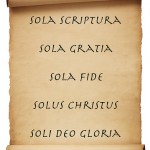 In a similar way, the Reformers, in articulating the five Solas used prepositions to state these central truths. They explain how five things all work together in the plan of God, and yet each is distinct in itself, without the mixture of anything else added to it. Note the words that are capitalized in the following sentence: BASED ON Scripture alone, we can affirm that justification is BY grace alone, THROUGH Faith alone, BECAUSE OF Christ alone, all TO THE GLORY OF God alone.
Now see the contrast between the Reformers and the Roman Catholic Church. Rome believed (then as it does now) that justification is by grace, through faith and because of Christ. What Rome does not believe is that justification is by faith alone, or by grace alone, or by Christ alone. For Rome, justification is by grace plus merit, through faith plus works; by Christ plus the sinner’s contribution of inherent righteousness. In contrast, the Reformers called the Church back to the one true Biblical Gospel: Christ saves by Himself alone, and does not need a co-Redemptrix in Mary, or the added righteousness of Mary and the saints in the treasury of merit, which merit is made available to the masses in the form of indulgences by the decree of the Pope, who alone possesses the keys to the treasury. As 1 Timothy 2:5 says, “There is one God and one Mediator between God and men, the man Christ Jesus.” Salvation is by God’s grace alone, received through faith alone, because of Jesus Christ alone, based on the Scriptures alone, to the Glory of God alone.
God has done for us something much more remarkable than anything science and NASA could do. Seeing our desperate need, God has come to us in the Person of His Son, born of a virgin – He lived a sinless life, dying an atoning death, and being raised up from the dead, has provided a great and wondrous salvation for all who will come to Christ as their perfect sin-bearing Savior and Lord.
Let us celebrate the Solas of the Reformation, not because of mere historical interest, but because this is the only way God does in fact save anyone. These five central truths of the Gospel stand together, and forever, and always… alone.

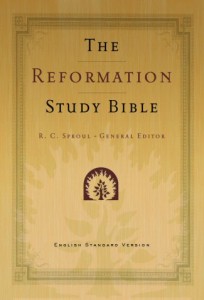 It is a high and holy calling to lead people in the things of God and great care is needed to help guide God’s people in the way of truth. This is certainly the case when it comes to providing study notes in a Bible. Because of this, for many years, I would never recommend a Bible with study notes. It is better to have no notes at all, than to be steered in the wrong direction. However, in recent years, the publishing of two study Bibles have excited me greatly and I would like to see at least one of these in the hands of every English speaking Christian. In terms of the two things that I believe to be most important features of a Study Bible – accurate translation and helpful and reliable (sure guide) study notes – in my opinion, the two which are outstanding are the ESV Study Bible and the Reformation Study Bible (ESV). Both are great resources. However in terms of sheer practicality, the ESV Study Bible is very bulky and a great weight to cart around (my mother said its too heavy to take to church with her, and who am I to argue?). Therefore if I could only recommend one, it would be the Reformation Study Bible in the ESV. Its also the one I use in my preaching. Right now, there is a 40% off sale on this Bible at Ligonier, so if you were interested in obtaining one (either in hardback or several different cover types) now would be a good time to do so.