
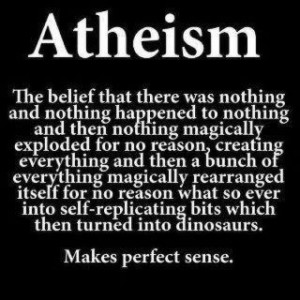
 Continued from as a Christian, want the claims I have embraced about Christ to be true, and I accept the fact that I want that desperately. I would be absolutely devastated if the claims of Christ were proven to be untrue. I would have no reason for living. But Tony, Russell is not being honest with us is he? Why? Because there is an equally obvious emotional factor behind atheism!
Why do I say this? Because as an atheist, speaking out publicly and in writing of the non-existence of God, isn’t the very last thing that Russell wants – the existence of a righteous and holy God – the existence of the God of the Bible? Isn’t this the least desired, the most terrible thing conceivable for Bertrand Russell? Yes, the worst news Russell could imagine would be the confirmation that God does exist, and by the way, he is summoned to give an account of his life before Him on the Day of Judgment. Here is the motivation behind atheism – the desire to live independent of a Holy and Righteous God.
Here, as I said, the double standard Russell uses is obvious. He appealed to feelings of pride, courage, freedom and self-worth as a basis for those listening to him to say no to Christianity, yet attacked the Christian for having feelings which drove them to accept the Lordship of Christ.
Tony, isn’t it obvious that all of us need to admit that as to the existence of God, none of us is without bias. A Christian desperately wants Christ’s claims to be valid and true, and an Atheist desperately wants them to be invalid and untrue. Scripture leaves no room for neutrality in this regard. No one is neutral. Either we are God lovers or God haters. So to attack the Christian for his feelings in this shows double standard par excellence!
If Russell was honest, he would have to admit that both the atheist and the Christian possess a great deal of bias when it comes to this issue of God’s existence, but that doesn’t mean that both propositions are wrong. The issue of course is not our feelings about God’s existence, but whether or not God actually exists in reality. If God does not exist, then all my feelings of love and empathy towards Him won’t conjure Him up! If He exists, then all of Russell’s feelings against His existence won’t kill Him!
Russell has to stoop to obvious prejudice, to use logical fallacies in his argumentation, and shows no basis for his philosophical arguments. I am left with the Apostle Paul to conclude that Russell simply suppressed the truth he knew about God because he was desperate to avoid the God who really is. Even Russell’s most ardent followers would have to admit that this essay is open to much criticism, and Tony, I have to conclude that his rejection of God in his thinking was not based upon any sound or intellectual basis at all but only on a prejudicial bias in the extreme.
I hope that these comments help you to see through the issues clearly. As I conclude, I would ask you to read a couple of passages of scripture to meditate upon. The first I have already mentioned in Romans 1:16-23; and the second is found in 1 Corinthians 1:18 – 2:16. As you read these through, I believe that you can be very thankful to God for the wondrous and amazing grace He has given you in revealing His truth to you. It wasn’t your wits or intelligence that caused you to see His truth, but the Sovereign gracious gift of God (Ephesians 2:8, 9). Though the message of the cross is foolishness to others, to the called, to those being saved, it is the power of God (1 Corinthians 1:18). In verse 19 Paul goes on to say that God will “destroy the wisdom of the wise, and bring to nothing the understanding of the prudent.” I can’t help but think of men like Bertrand Russell at this point.
As we read further in 1 Corinthians 1, we find a series of four questions posed to us.
1) Where is the wise?
2) Where is the scribe?
3) Where is the disputer of this age?
4) Has not God made foolish the wisdom of this world?
The obvious point of these questions is to provoke us to answer that the world’s wisdom is not real wisdom at all, for it starts in the wrong place, without God.
For since, in the wisdom of God, the world through wisdom did not know God, it pleased God through the foolishness of the message preached to save those who believe.” (v. 20, 21)
Because you are part of the company called “the called” you know that Christ is the power and wisdom of God. (v. 24)
God leaves the debaters to themselves, knowing that without acknowledging Him, they are sure to end up only in intellectual cul de sacs, never getting anywhere. However this same God is pleased to reveal the truth to those He calls. What grace!
As you reflect on these things Tony, I pray that your faith will be strengthened even after you have considered some of the main arguments of atheism and that you will be stronger in your faith because of it.
I will get this off in the mail to you and will wait a couple of days before calling you again. I am confident that after reading this, “your faith might not rest on the wisdom of men, but on the power of God.” (1 Cor. 2:5).
 If there is anything else I can help you with, or if I can clarify any of these things further, just let me know and I’ll be happy to try to answer any questions you have or else I can point you to resources that I think would be of help to you. I look forward to hearing good news about you when I call. Keep the faith Tony!
In the Perfect Savior,
Rev. John Samson
 “Can controversial teachings nurture our Christlikeness? Before you answer this question, ask another one: Are there any significant biblical teachings that have not been controversial? I cannot think of even one, let alone the number we all need for the daily nurture of faith. If this is true, then we have no choice but to seek our food in the markets of controversy. We need not stay there. We can go home and feast if the day has been well spent. But we must buy there. As much as we would like it, we do not have the luxury of living in a world where the most nourishing truths are unopposed. If we think we can suspend judgment on all that is controversial and feed our souls only on what is left, we are living in a dreamworld. There is nothing left. The reason any of us thinks that we can stand alone on truths that are non-controversial is because we do not know our history or the diversity of the professing church. Besides that, would we really want to give to the devil the right to determine our spiritual menu by refusing to eat any teaching over which he can cause controversy?