 There is a flip side to Divine election; that being the doctrine of reprobation. Here is an excerpt from Loraine Boettner’s book “The Reformed Doctrine of Predestination”:
This is admittedly an unpleasant doctrine. It is not taught to gain favor with men, but only because it is the plain teaching of the Scriptures and the logical counterpart of the doctrine of Election. We shall find that some Scripture passages do teach the doctrine with unmistakable clearness. These should be sufficient for any one who accepts the Bible as the word of God.
“Jehovah hath made everything for its own end; Yea,” Prov. 16:4.
Christ is said to be to the wicked, “A stone of stumbling, and a rock of offence; for they stumble at the word, being disobedient; whereunto also they were appointed,” I Peter 2:8.
“For there are certain men crept in privily, even they who were of old written of beforehand to this condemnation, ungodly men, turning the grace of our God into lasciviousness, and denying our only Master and Lord, Jesus Christ,” Jude 4.
“But these, as creatures without reason, born mere animals to be taken and destroyed, railing in matters whereof they are ignorant, shall in their destroying surely be destroyed,” II Peter 2:12.
“For God did put in their heart to do His mind, and to come to one mind, and to give their kingdom unto the beast, until the word of God should be accomplished,” Rev. 17:17.
Concerning the beast of St. John’s vision it is said, “All that dwell on the earth shall worship him, every one whose name hath not been written from the foundation of the world in the book of life of the lamb that hath been slain,” Rev. 13:8; and we may contrast these with the disciples whom Jesus told to rejoice because their names were written in heaven (Luke 10:20), and with Paul’s fellow-workers, “whose names are in the book of life,” Phil. 4:3.
Paul declares that the “vessels of wrath” which by the Lord were “fitted unto destruction,” were “endured with much long suffering” in order that He might “show His wrath, and make His power known”; and with these are contrasted the “vessels of mercy, which He afore prepared unto glory” in order “that He might make known the riches of His glory” upon them (Rom. 9:22, 23).
Concerning the heathen it is said that “God gave them up unto a reprobate mind, to do those things which are not fitting,” Rom. 1:28; and the wicked, “after his hardness and impenitent heart treasures up for himself wrath in the day of wrath and revelation of the righteous judgment of God,” Rom. 2:5.
In regard to those who perish Paul says, “God sendeth them a working of error, that they should believe a lie,” II Thess. 2:11. They are called upon to behold these things in an external way, to wonder at them, and to go on perishing in their sins.
Hear the words of Paul in the synagogue at Antioch in Pisidia: “Behold, ye despisers, and wonder, and perish; For I work a work in your days, A work which ye shall in no wise believe, if one declare it unto you,” Acts 13:41.
The apostle John, after narrating that the people still disbelieved although Jesus had done so many signs before them, adds, “For this cause they could not believe, for that Isaiah said again, He hath blinded their eyes, and He hardened their heart; Lest they should see with their eyes, and perceive with their heart, And should turn, And I should heal them,” John 12:39, 40.
Christ’s command to the wicked in the final judgment, “Depart from me, ye cursed, into the eternal fire which is prepared for the Devil and his angels,” Matt. 25:41, is the strongest possible decree of reprobation; and it is the same in principle whether issued in time or eternity. What is right for God to do in time it is not wrong for Him to include in His eternal plan.
On one occasion Jesus Himself declared: “For judgment came I into this world, that they that see not may see; and that they that see may become blind,” John 9:39. On another occasion He said, “I thank thee, O Father, Lord of heaven and earth, that thou didst hide these things from the wise and understanding, and didst reveal them unto babes,” Matt. 11:25.
It is hard for us to realize that the adorable Redeemer and only Savior of men is, to some, a stone of stumbling and a rock of offence; yet that is what the Scriptures declare Him to be. Even before His birth it was said that He was set (that is, appointed) for the falling, as well as for the rising, of many in Israel (Luke 2:84). And when, in His intercessory prayer in the garden of Gethsemane, He said, “I pray for them; I pray not for the world, but for those whom thou hast given me,” the non-elect were repudiated in so many words.
Jesus Himself declared that one of the reasons why He spoke in parables was that the truth might be concealed from those for whom it was not intended. We shall let the sacred history speak for itself: “And the disciples came, and said unto Him, Why speakest thou unto them in parables? And He answered and said unto them, Unto you it is given to know the mysteries of the kingdom of heaven, but unto them it is not given. For whosoever hath, to him shall be given, and he shall have abundance; but whosoever hath not, from him shall be taken away even that which he hath. Therefore speak I unto them in parables; because seeing they see not, and hearing they hear not, neither do they understand. And unto them is fulfilled the prophecy of Isaiah, which saith,
“By hearing ye shall hear, and shall in no wise understand;
And seeing ye shall see, and shall in no wise perceive;
For this people’s heart is waxed gross.
And their ears are dull of hearing.
And their eyes they have closed;
Lest haply they should perceive with their eyes,
And hear with their ears,
And understand with their heart,
And should turn again,
And I should heal them.” Matt. 13:10-15; Is. 6:9, 10.
 In these words we have an application of Jesus’ words, “Give not that which is holy unto the dogs, neither cast your pearls before swine,” Matt. 7:6. He who affirms that Christ designed to give His saving truth to every one flatly contradicts Christ Himself. To the non-elect, the Bible is a sealed book; and only to the true Christian is it “given” to see and understand these things. So important is this truth that the Holy Spirit has been pleased to repeat six times over in the New Testament this passage from Isaiah (Matt. 13:14, 15; Mark 4:12; Luke 8:10; John 12:40; Acts 28:27: Rom. 11:9, 10).
Paul tells us that through grace the “election” received salvation, and that the rest were hardened; then he adds, “God gave them a spirit of stupor, eyes that they should not see, and ears that they should not hear.” And further, he quotes the words of David to the same effect:
“Let their table be made a snare and a trap,
And a stumbling block, and a recompense unto them;
Let their eyes be darkened, that they may not see,
And bow down their backs always,” Rom. 11:8-10.
Hence as regards some, the evangelical proclamations were designed to harden, and not to heal.
This same doctrine finds expression in numerous other parts of Scripture. Moses said to the children of Israel, “But Sihon king of Heshbon would not let you pass by him; for Jehovah thy God hardened his spirit, and made his heart obstinate, that He might deliver him into thy hand, as at this day,” Deut. 2:30.
In regard to the Canaanitish tribes who came against Joshua it is written, “For it was of Jehovah to harden their hearts, to come against Israel in battle, that He might utterly destroy them, as Jehovah commanded Moses.” Joshua 11:20. Hophni and Phinehas, the sons of Eli, when reproved for their wickedness, “hearkened not unto the voice of their father, because Jehovah was minded to slay them,” I Sam. 2:25.
Though Pharaoh acted very arrogantly and wickedly toward the Israelites, Paul assigns no other reason than that he was one of the reprobate whose evil actions were to be overruled for good: “For the Scripture saith unto Pharaoh, For this very purpose did I raise thee up, that I might show in thee my power, and that my name might be published abroad in all the earth,” Rom. 9:17 (see also Ex. 9:16).
In all the reprobate there is a blindness and an obstinate hardness of heart; and when any, like Pharaoh, are said to have been hardened of God we may be sure that they were already in themselves worthy of being delivered over to Satan. The hearts of the wicked are, of course, never hardened by the direct influence of God, — He simply permits some men to follow out the evil impulses which are already in their hearts, so that, as a result of their own choices, they become more and more calloused and obstinate. And while it is said, for instance, that God hardened the heart of Pharaoh, it is also said that Pharaoh hardened his own heart (Ex. 8:15; 8:32; 9:34). One description is given from the divine viewpoint, the other is given from the human viewpoint. God is ultimately responsible for the hardening of the heart in that He permits it to occur, and the inspired writer in graphic language simply says that God does it; but never are we to understand that God is the immediate and efficient cause.
Although this doctrine is harsh, it is, nevertheless, Scriptural. And since it is so plainly taught in Scripture, we can assign no reason for the opposition which it has met other than the pure ignorance and unreasoned prejudice with which men’s minds have been filled when they come to study it. How applicable here are the words of Rice: —
Happily would it be for the Church of Christ and for the world, if Christian ministers and Christian people could be contented to be disciples, — LEARNERS; if, conscious of their limited faculties, their ignorance of divine things, and their proneness to err through depravity and prejudice, they could be induced to sit at the feet of Jesus and learn of Him. The Church has been corrupted and cursed in almost every age by the undue confidence of men in their reasoning powers. They have undertaken to pronounce upon the reasonableness or unreasonableness of doctrines infinitely above their reason, which are necessarily matters of pure revelation. In their presumption they have sought to comprehend ‘the deep things of God,’ and have interpreted the Scriptures, not according to their obvious meaning, but according to the decisions of the finite reason.
And again he says,
No one ever studied the works of Nature or the Book of Revelation without finding himself encompassed on every side by difficulties he could not solve. The philosopher is obliged to be satisfied with facts; and the theologian must content himself with God’s declarations.
Strange to say many of those who insist that when people come to study the doctrine of the Trinity they should put aside all preconceived notions and should not rely simply upon the unaided human reason to decide what can or cannot be true of God, and who insist that the Scriptures should be accepted here as the unquestioned and authoritative guide, are not willing to follow those rules in the study of the doctrine of Predestination.

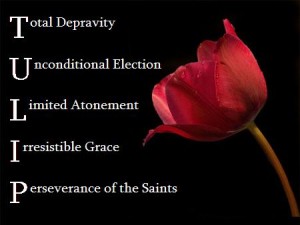 This short article by Justin Taylor made me laugh. It contains some helpful and useful material, but I just saw the funny side of the historic TULIP acrostic suffering a massive regressive evolution of sorts and becoming WUPSI:
 “The world’s theology is easy to define. It is the view that human beings are basically good, that no one is really lost, that belief in Jesus Christ is not necessary for salvation.” – James Montgomery Boice, Foundations of the Christian Faith